
Trending
More than a century after a newlywed couple died here under mysterious circumstances, a member of the Lycoming County Historical Society has solved the case.
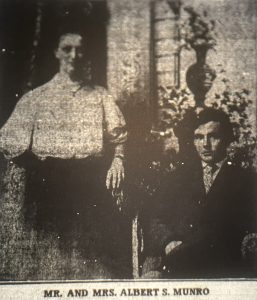
At the society's annual meeting earlier this week, Elaine Decker spoke about her investigation into the unexplained deaths of Mr. and Mrs. Albert S. Munro -- and she pointed to the cause, revealed through a modern-day lens.
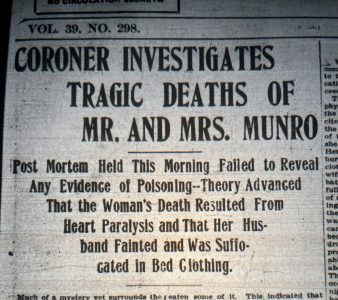
News reports of the day detailed attempts by the coroner and police to determine a cause of death, saying "much of a mystery yet surrounds the tragic deaths" of the couple after ruling out poison, weapons or suicide.
The couple had been married only eight days in June 1909 when they were found dead at 829 Maple Place, according to Decker. That home no longer stands, and the street has been renamed Nichols Place. Today the site of the home serves as the historical society's parking lot.
Trying to explain this mystery in 1909, the coroner and police advanced an odd theory -- that the woman had a sudden heart attack while in the bathroom and her husband attempted to carry her to the bed, but he fainted, fell onto the bed and suffocated in the bed sheets.
"I absolutely could not believe that," Decker said.
So she dug in, starting with the house.
It was owned by Inspector George W. Vernes, who died in 1911 in Erie, and his wife, who continued to take in occasional boarders.
A number of those boarders had the experience of feeling odd while in the bathroom, a small room. One fainted while in the tub and Mrs. Vernes used an axe to break down the door, Decker said.
Another who was found unresponsive took 45 minutes to recover.
Finally, the decision was made to remodel the bathroom.
"It's clear that the killer is the house," Decker said, circling back to 1909.
She turned to two State Police detectives she knew and together they ran through the possibilities of what could have killed the couple.
"They were very helpful," Decker said.
There were no symptoms of drug overdose, and natural gas was ruled out as the lantern was still burning in the bathroom when the couple was found. Electricity was new at the time, but the bodies lacked burn marks that would have been a sign of electrocution, Decker said.
One other possible culprit that was not as known back in 1909 was carbon monoxide, she said, pointing to the common use of coal-burning stoves and ovens for cooking.
Also, the house had an interior chimney, meaning three sides were inside the house, increasing the chance for leaks to occur inside the house.
Finally, the bathroom's small size would have allowed carbon monoxide to build up and affect a person, explaining why so many people had negative experiences while in it.
Decker also consulted with Charles E. Kiessling Jr., county coroner, as she wanted to know more about the red eyes that Mr. Munro was described as having when his body was found.
Asphyxiation would have caused "little red dots," she said, but Mr. Munro's eyes were described as having a "peculiar" redness to them, a condition Kiessling identified as "tache noire."
In other words, the 1909 theory of asphyxiation could not have been the cause.