
New American citizens join ‘Shining City on a Hill’
Trending
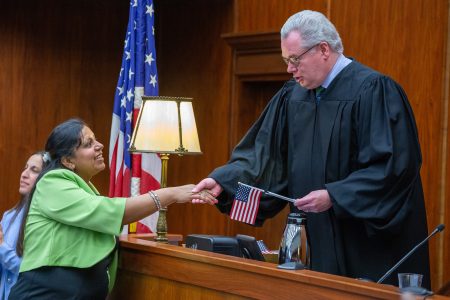
Kamna Kanesh Lohano, left, is congratulated and handed an American flag from Judge Matthew Brann, right, during a naturalization ceremony at the Federal Courthouse in Williamsport. Kamna immigrated from Pakistan. KAREN VIBERT-KENNEDY/Sun-Gazette
Federal court was bustling with accomplishment and happiness Friday, as 30 individuals from 22 countries became American citizens, in a formal naturalization ceremony.
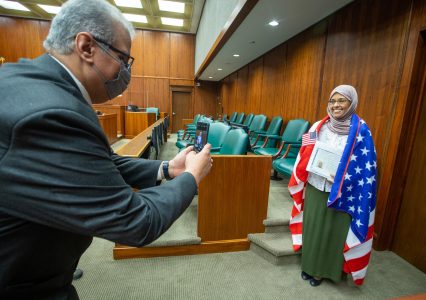
"I'm free," exclaimed new American citizen Aisha Alhifi as she posed for a photo taken by her husband Nagib Alhavi. Alhifi immigrated to the U.S. from Yemen.
The journey speaker at the ceremony, Asm Tuhin of Bloomsburg, was born in Bangladesh.
He told the packed largest courtroom in the U.S. Middle District Court, filled with the soon-to-be citizens and their families, that he was 16 years old when he decided to apply for a scholarship with the U.S. Department of State to become a foreign exchange student.
He said he was fortunate enough to be selected in the foreign exchange student program and spent a year with a family from the state of Washington.
Tuhin said the experience taught him about community, about the American family and the values of the American people.
When Tuhin was at school, he said he asked a teacher about the importance of the Bill of Rights. He questioned the teacher in order to learn about the "great American experiment."
"As we are becoming citizens, I am fortunate to be given this opportunity," he said with U.S. Chief District Judge Matthew W. Brann, presiding over the ceremony.
He noted how his plan was to give back to this great nation and its values that all Americans hold dear.
American exceptionalism
Those in the courtroom learned from Brann, using excerpts and quotes from historians, a dean of Yale Law School, political scientist and President Abraham Lincoln to describe the theory that focuses on the United States as being "qualitatively different from other nations."
In this view, American exceptionalism stems from its emergence from a revolution, becoming what political scientist Seymour Martin Lipset called "The First New Nation."
The U.S. developed a uniquely American ideology, Brann continued – "Americanism – which is based on liberty, egalitarianism, individualism, republicanism, populism and laissez faire.
"We were first an example to the world of freedom's possibilities," Brann said quoting Lipset.
Historian Gordon Wood has argued that, "Our beliefs in liberty, equality, constitutionalism and the well being of ordinary people came out of the revolutionary era.
"So, too, did our idea that we Americans are a special people, with a special destiny to lead the world toward liberty and democracy. No other nation can do what we do," Wood said.
The U.S. is exceptional, also, because it was founded on a set of common ideals, rather than a common heritage, ethnicity or ruling elite.
President Abraham Lincoln once observed: "The United States is a nation conceived in liberty, dedicated to the proposition that all men are created equal."
America has guaranteed freedom, security and peace for more of humanity than any other nation in history.
Yale Law School Dean Harold Koh, himself the son of immigrant Chinese parents, identified what he said is the most important respect in which the U.S. is exceptional: The nation is exceptional with regard to international affairs, international law and the promotion of human rights.
Namely, it is exceptional for its global leadership and activism, according to Koh.
Lawmaker who visited the U.S.-Mexico
border responds
U.S. Rep. Fred Keller, R-Kreamer, who has advocated for more border security and has visited the U.S.-Mexican border with others in Congress, attended the ceremony and offered his congratulations to the new citizens.
Like Tuhin, Keller also considered it a privilege to be at the ceremony. He noted how they would see what "America has to offer."
"The greatest gift I ever received was American citizenship that my parents gave me," Keller said.
"You have earned it and America will be a better country because you are citizens, immigrants who built this nation," Keller said.
Immigrants, he said, those who go through the legal process to be naturalized citizens represent the best of America and will keep it that "shining city on a hill."
To become naturalized, persons must be of the minimum required age (typically, at least 18). They must continuously and physically live in the United States as a green card holder for a certain number of years. They establish residency in the state or U.S. Citizenship and Immigration Services (USCIS) district where they intend to apply.
Chris Baran, Immigration Services officer, welcomed the citizens who came from countries around the globe and Kenneth Williams, of the courthouse, guided the group through the process, asking if anyone had a question before the ceremony began.
The group pledged an oath of allegiance to the U.S. and recited the pledge of allegiance.
Each -- including people from Afghanistan and Yemen -- was called by their chosen American name. The men and women walked forward and were handed their certificates, a small book with literature showing them steps that can further guide them and a miniature American flag.
Brann shook each of their hands and offered his congratulations. He also made a light-hearted but true enough statement, one reflective of the freedom he had spoken about minutes before.
He said they were not required to have their photographs taken with him, saying instead that it would be the case if they lived in Russia, where they would be required. But because they were Americans they could choose to have a photograph taken with the judge or not.
Most decided to have the pictures taken with Brann, who noted how he has been enjoying these special ceremonies and presiding over naturalization for more than 10 years.
"Each of you, today, have a remarkable story of how you came to be here this morning," Brann said.