
Trending
Recycle what can be recycled and do it responsibly but if you're thinking about dumping materials that are not listed as recyclable, understand at least at Old Lycoming Township's recycling site, there have been measures put in place to monitor the site and you will be held accountable for not following the guidelines for recycling.
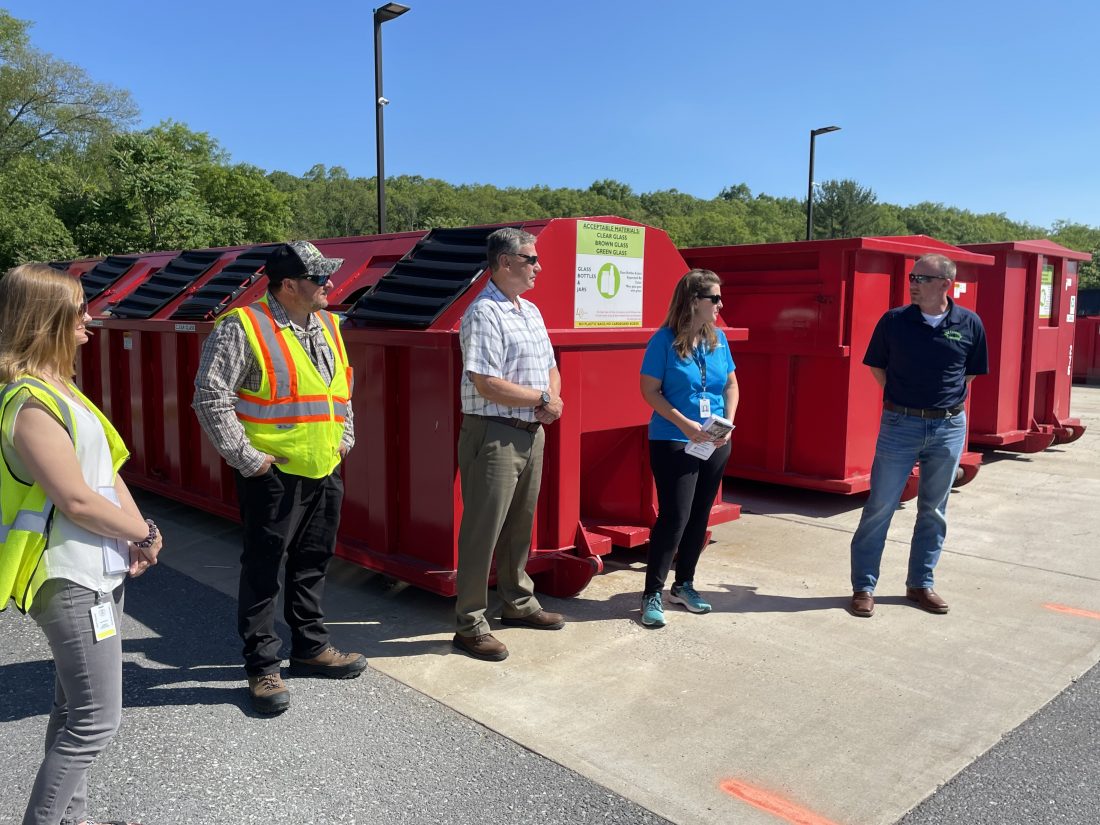
During a media event at Old Lycoming Township's recycling center, officials from the township, county and state highlighted measures that have been taken to alleviate a serious and expensive problem increasing at recycling sites around the state, including the township's on Princeton Ave.
"We chose to do the event here because Old Lycoming had a pretty difficult issue with illegal dumping at the site, but it's not unique to Old Lycoming," said Megan Lehman, community relations coordinator for the state's Department of Environmental Protection Northcentral Regional Office.
"We want to talk about DEP's recycling grants
programs and how they can assist municipalities and counties that need to do improvement or have issues with their recycling," Lehaman said.
Speaking to the benefits the township has garnered from the recycling grant, DEP and the county, Old Lycoming's township manager and recycling coordinator Matt Aikey said, "Everything you see here, pretty much from the pavement to the guardrails, the lights, the cameras, the gates, the concrete we're standing on has all been a result of that."
"It all came about because of the litter and the garbage that we were taking in at this site that couldn't be recycled either it didn't fit in the containers or people just didn't have the time to put it in there or it wasn't a recyclable item," he said.
The illegal dumping at the site became so bad that people would just throw things on the ground or leave piles of non-recyclable materials by the fence.
"It became an everyday job to come down and remove garbage," Aikey said.
Originally the site had been in a more populated area in the township where the space was limited, so it was moved to its present larger location, adjacent to the township's drop-off site for yard debris. The former location was also next to the township's police station, which was a deterrent for those who were dumping things illegally.
"Bigger site -- out of sight out of mind -- so that doubled the garbage," Aikey said of the problems that came with the move.
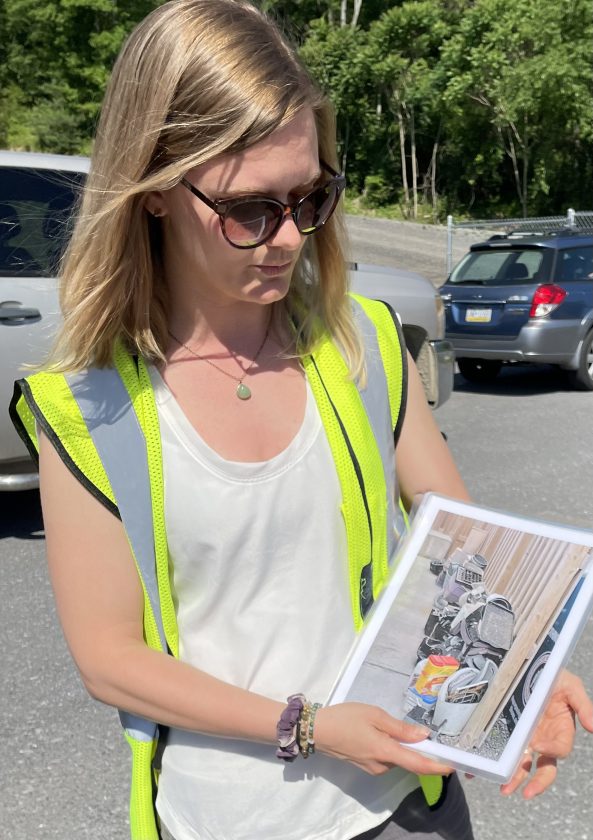
Lauren Strausser, recycling coordinator for Lycoming County, who was also at the media event offered photos of examples of materials that were dumped at various sites in the county.
"This is throughout Pennsylvania, throughout the United States that we have illegal dumping at these sites," Strausser said.
Displaying a photo of materials left at a recycling site at South Williamsport, Strausser said, Some people may think they're recyclable...they want everything to be recycled. It's plastic, why can't it be recycled? Well, it's not accepted if it can't fit into the container," Strausser said.
"People are throwing in these materials thinking maybe it'll be recycled if I can fit it in there. Not knowing that they're not helping the situation," Strausser said.
Boxes that are recycled need to be broken down, which has caused issues with people just throwing the boxes intact into the recycling bins, which means that the trucks hauling the materials to the recycling center are transporting air.
Lehman referred to a booklet compiled by DEP on what can and cannot be recycled.
"That's one of the main messages in this booklet is that if you're not sure, don't recycle it because people want to recycle everything they possibly can and they think it's a lost opportunity to throw it in the trash to go to the landfill. But it's kind of the opposite," Lehman said.
"Because if there's too much contamination in the recycling streams they cannot find a buyer for it and they actually have to throw the whole load in the landfill," she said.
She noted that people do not realize that even a container that is not thoroughly cleaned or tin cans mixed in with aluminum can contaminate the whole recycling container.
"If you think of a bin full of 100 cans and they're supposed to be aluminum, and three are soup cans, then that's all it takes, theoretically," she said.
The same applies to containers that are not properly cleaned, such as peanut butter jars.
"If in doubt, throw it out," Lehman said.
To deal with these problems, recycling in the county has changed. The containers have smaller openings, and materials have been combined so that the trucks are hauling a full load to the county's recycling facility, especially as fuel costs rise.
Old Lycoming was a pilot program for the smaller opening in the recycling bins and overnight they saw a pile of garbage at the site.
"Regardless of what anybody thinks, they come down and a lot of people have the intention. They come down, bring the recyclables and just get rid of that thing they don't want to take to the transfer station or to the landfill," Aikey said.
When people just dump those materials at the recycling sites, the municipalities are tasked with cleaning up the unwanted debris and disposing of it.
"The township was actually at the point--with the cost and the manpower and the hassle of illegal dumping-they were at the point of closing the drop off," Lehman said.
"So it really is kind of a story of the power of partnerships with the township, the county and DEP working together. Let's get the funding. Let's find a solution," Lehman continued.
"Let's do a pilot. Let's try to solve that problem because it's really easy to say recycling it too much effort," she added.
Since instituting the new measures to ensure proper recycling, the cost of disposing of unusable materials has gone down considerably, according to Aikey. Where they had needed a four-year dumpster at $100 a week, they're now down to needing one only once a month.
The security cameras atop poles encircling the center and at the main entrance gate have served as a deterrent for those who still think they can dump things indiscrimanately.
The township has also prosecuted those who break the rules, although not to the extent that they are now exploring. But, the word is out that they do prosecute.
"It's not that we're looking to make money off it, but we're also not looking to spend money," Aikey said.
"The township currently carries the liability on the property, winter maintenance and on point, the garbage, so we really don't want to get the other stuff. We don't want to have to clean up garbage because people just didn't feel like it or they bring stuff here that is not recyclable," he said.
Jason Yorks, director of the county's Resource Management Services, wanted people to know that taxpayer funds do not go to improve the recycling sites or for the transportation of the materials, but that costs are funded through the county's Resource Management Services.
"None of this is taxpayer funded. That's one of the misconceptions and that's one of the things that's kind of disgruntling with the staff is they get treated poorly by residents because they think it's their taxpayer dollars that are putting trucks on the road and the diesel in the tank and their wages. It's not," Yorks said.
"It's the landfill. The sale of the product from the containers, none of that is taxpayer funded," he added.
Lehman pointed out that recycling is a business in a sense that there had to be a market for the recycled items even though the outcome is not to make a profit.
"It has to make dollars and sense too. When items can be recycled into new products that kind of drives the market. If there's not a market for something, we can collect it all we want, but there's really nowhere for it to go," she said.
"So one thing that the public can do if they want to help support recycling is to buy recycled products and look for recycled products," she added.
"I think overall this county and the partnering townships do an outstanding job with the recycling programs," said Patrick Brennan, Waste Management, Program Manager with DEP, who was also at the media event.
The booklet from DEP outlining recycling in the state is available for download at: dep.pa.gov/recyclingbooklet. Locally they can be picked up at the DEP regional office at 208 West Third St., suite 101.