
Trending
In a reversal of their decision last week, the county's Election Board voted to remove the referendum from November's election ballot which would have allowed voters to decide if they wanted the county to continue the use of electronic voting systems.
The action was taken after the Department of State sent a letter, after the board's last meeting, telling the county that they lacked the authority to place the referendum on the ballot.
"Despite the strong emotions involved, the law clearly prohibits referendums regarding whether to use electronic voting systems," the letter from the state said.
Citing a case from Westmoreland County, the state said that the use of electronic voting systems "on the results of a referendum was barred by the federal Help America Vote Act (HAVA) which requires adoption of electronic voting systems."
The court determined that holding a referendum "would directly impede the goals of HAVA legislation including accessibility for disabled voters."
The request to place the referendum on the ballot was made by a group of concerned citizens who stressed that the people should decide how their votes should be counted -- by machine or by hand. The group had presented petitions with around 3,400 signatures from county voters.
A spokesperson for the group, Attorney Karen DiSalvo, said the referendum would allow the "people to decide whether to keep using machines or whether to go back to hand-counting the paper ballots we already use."
DiSalvo also accused the Department of State of mischaracterizing the law when it comes to HAVA," and also the law in the case cited in the court's decision.
"If you do want to say that Kuznik stands for the proposition that we no longer need to use a referendum to get the voting machines out of our county, we don't have to have people vote on it in Lycoming County...well, you have a couple of alternatives," DiSalvo said.
The county could withdraw the referendum and just vote to get rid of the electronic voting system or the county could continue with the electronic voting system which utilizes paper ballots which are then scanned for tabulation but follow that up with a hand count to find out if the two figures correspond. The vote count would not be certified until the two match.
"If the hand count matches the machine count, wonderful, beautiful. That's our official tally. That's all we want. We want transparency in our elections," DiSalvo said.
DiSalvo urged the Election Board to "not allow the Department of State to push you around."
"This is yet again an example of bureaucrats at the Department of State trying to take the power away from the people. Don't let them do it. You were not elected to rule over us; you were elected to be our voices," DiSalvo told the Election Board, which is comprised of the commissioners.
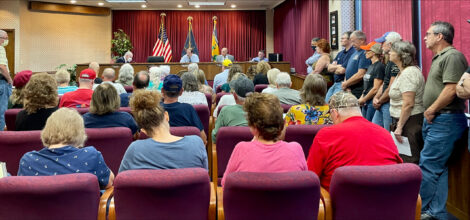
Throughout the three-hour meeting Monday, representatives of both viewpoints -- those calling for getting rid of the electronic voting system and those in favor of keeping it -- expressed their opinions and argued that the integrity of the election was a non-partisan issue.
Another spokesperson calling for going back to paper ballots, Jeff Stroehmann, said that he felt it had been a community effort.
"I believe that it's pulled our community together as opposed to pushing us apart. I think that should be the message today," Stroehmann said.
"We feel the confidence of the voters has been undermined and our efforts are to help the commissioners, help the community, walk into a solution that restores the confidence of our voters in Lycoming County," he said.
Another suggested resolution to the issue was offered by local resident Bill Miele.
"What I'm suggesting to the commissioners is kind of a middle ground to what you're seeing between the two sides," Miele said.
"I would hope we would all agree if something is on the ballot we want to have an educated electorate, we want to understand what's involved. All the angles, how much it's going to cost, and the question becomes are we going to be able to do that in 58 days," Miele said, referring to the time before Election Day.
"I would submit that's not really reasonable," Miele added.
His suggestion was that the current electronic voting system be used in the upcoming election, and then hand count every single vote to see if that corresponds to what the machines have.
Acknowledging that there might be a margin of error and it would be up to the county to decide if they wanted to continue using the current system if the two totals were within that margin.
"Maybe you'll say that the margin of error isn't enough to warrant getting rid of the machines and go to the extra cost and everything that's involved," he said.
Some of the people on hand for the meeting were poll workers who praised the current voting system, saying that the dual system of having a paper ballot which is then electronically tabulated offers back-up records that are saved. While others were skeptical and mistrusting of the system which they claimed could be hacked.
In the end the commissioners, Tony Mussare, Scott Metzger and Rick Mirabito, voted to remove the referendum from the ballot.
"We have to have faith in our system, and I have to abide by the law," Mussare said.
He explained that the commissioners had sought legal counsel after receiving the letter from the Department of State to see what options there were. They were told that, if they continued in court, they would not win.
"We would be wasting our money -- taxpayer money," he added.
Metzger concurred.
"It would cost this county a substantial amount of money to lose. Our No. 1 responsibility is to watch the finances in this county. And I fully understand that election integrity comes above it all. The confidence has been seriously violated," he said.
"To have it on the ballot, the statute doesn't permit it. We'll definitely lose the case -- that's coming from multiple counsels. You're wasting money that we know we're going to lose in the long run. That's just not good government. It's not smart on our behalf. That's not why you put us here," he said.
"The state statute does not give county commissioners the right to put this on the ballot as a referendum," Mirabito said.
"It would be irresponsible of us to move forward with a court case just to say we're going to fight back and spend taxpayer dollars fighting a court case that we know, based on legal counsel from multiple sources telling us we're not going to win," Mirabito added.