
Historical record collector: ‘It’s in a newspaper somewhere’
Trending
Did you ever want to read an account of a major historical event that was recorded at the time that it happened?
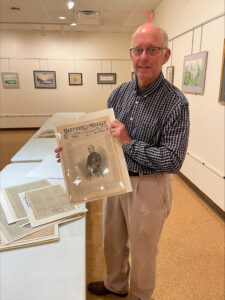
"It's in a newspaper somewhere," Timothy Hughes, a 46-year collector of rare and old newspapers, recently told a full house at the Thomas Taber Museum of the Lycoming County Historical Society.
Hughes held up one of his earliest newspapers, a copy of the London Gazette from 1666, consisting of one sheet of paper printed on the front and back, the size of which was about that of a standard sheet of modern printer paper, and commented on its content.
"It's kind of unique to find a period account of the plague," he observed.
Some historical events are harder to find than others. Hughes said he was only ever able to find two newspapers with any kind of actual reporting about the Salem witch trials in 1692. As he continued to show examples from his collection -- a warehouse in South Williamsport is brimming with 3.5 million newspapers from the mid-1600s through the 21st century -- he shared much about newspaper history.
Early newspapers have held up better over time than those of the past century because of the quality of the paper on which they were printed, he said.
During the Civil War era, for instance, the paper had cotton and linen elements.
"You can bend it and fold it and it will not crack," he said, showing one of his copies from that era.
It has not yellowed, he noted, as do newspapers produced after the industrial revolution allowed newsprint to be made from wood pulp and chemicals. While it's more fragile, it became "dramatically cheaper" and was followed by a boom in newspaper publishing, Hughes said.
Newspaper items began to include graphics in the mid-1800s. Popular were Civil War battleground maps, which allowed people to connect these sites in relation to where they lived, and portraits of prominent figures. Now people could not only read about important people, they could see what they looked like, Hughes said.
Early newspapers in this country did not have headlines. That is a device of more modern times, when the size of the headline coincided with the magnitude of the event. Newspapers with large headlines are often requested because of their graphic appeal, Hughes said. Such was the case with a half-page headline in the Sun-Gazette, "Japan surrenders," heralding the end of World War II. That issue is one of the top three ever requested because of graphic appeal, he said.
Other big collectible headlines included the erroneous "Dewey Defeats Truman" in a Nov. 3, 1948, edition of the Chicago Daily Tribune and another after a ticker tape parade in New York City to welcome home American aviator Douglas Corrigan.
After flying to New York City from Long Beach, Calif., Corrigan was denied permission to continue on a transcontinental flight to Ireland. But instead of returning to Long Beach, he flew to Ireland, later claiming that was due to a navigational error and earning him the nickname "Wrong Way Corrigan."
The one that earned its spot in collectible headlines? It ran in huge letters across the top of the New York Post -- in reverse type -- "Hail to Wrong Way Corrigan."
Other interesting newspapers to collect have contained stories about significant figures in history prior to the event for which they are remembered. As an example, Hughes shared a November 1863 edition of a Washington D.C. paper with an article about the opening of Ford's Theatre. It listed the appearance of a "distinguished young actor" -- John Wilkes Booth -- who more than a year later would return there to assassinate President Abraham Lincoln.
Even some very small newspapers become collectibles.
Hughes shared a 1969 Wapakonta Daily News headline about the moon landing. Wapakonta, Ohio, is the hometown of Neil Armstrong. What was unique about this headline was that it became very personal when it used only Armstrong's first name to announce the news of its hometown hero: "Neil walks on the moon."
Other newspapers that Hughes highlighted featured news about Williamsport. Those included papers with photos from the 1889 flood, a 19th century edition of Scientific American featuring a front-page article on lumber operations on the Susquehanna River and Williamsport, and an 1858 review of the troops of Pennsylvania at Camp Susquehanna.
While these are among the types of newspapers individuals seek through Hughes, among the most frequent requests are editions printed on the day of an individual's birth.
Those seeking more information may visit the website rarenewspapers.com.