Special Response Team prepares for variety of crises
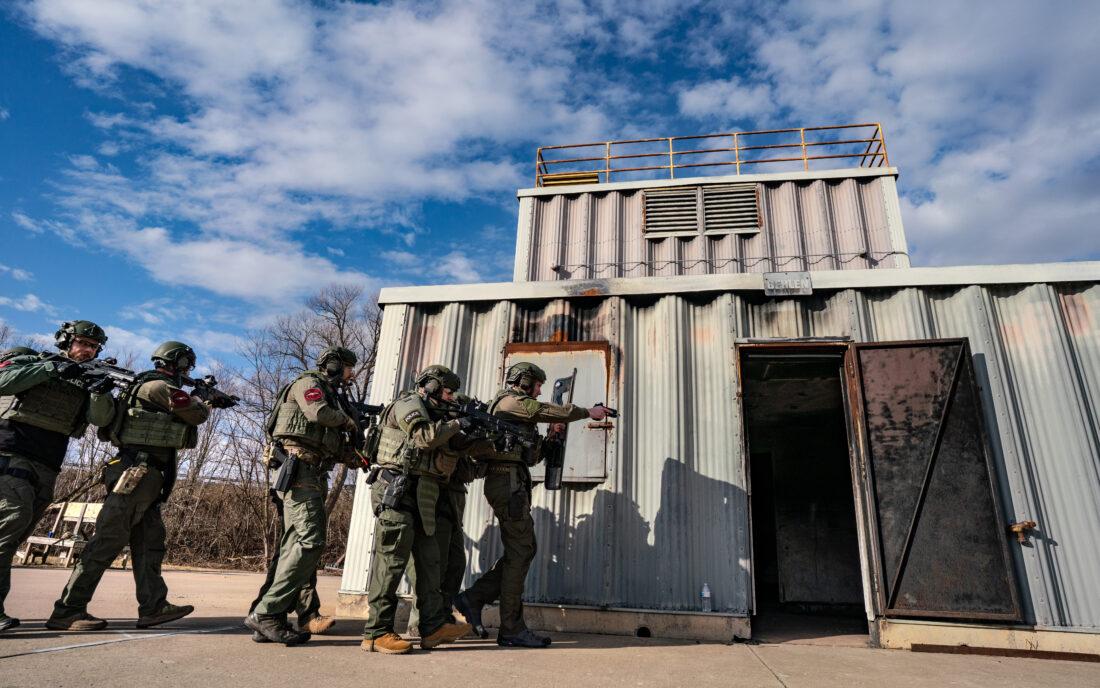
Williamsport Special Response Team members train recently in Williamsport Feb. 15, 2023. The team trains together weekly as well as doing individual training for their specialies as needed. The team is made up of volunteers from different local law enforcement agencies. DAVE KENNEDY/Sun-Gazette
An active school shooter, a violent criminal who has taken hostages or a pipe bomb found in the backyard of a residence.
These are the kind of scenarios triggering a response from the Williamsport Special Response Team, a multi-jurisdictional, multi-agency collection of specialists with specific skills.
The team consists of police, Emergency Medical Service personnel, firefighters, who are also trained in emergency medical service provision, and detective office personnel who have a common goal and mission.
“They all sort of bring a different skill set with them,” said Joshua K. Bell, Williamsport Bureau of Police, Criminal Investigation Division commander and commander of the Special Response Team.
His secured office is at 100 W. Third St. on the third floor with police administration.
But on any given day, Bell will be among the team training at a facility in Williamsport, or other locations.
SRT consists of officers from Williamsport Bureau of Police, detectives from the office of Lycoming County District Attorney Ryan Gardner, officers from South Williamsport Borough Police Department, Lycoming Regional Police Department (formerly Tiadaghton Valley and Old Lycoming police departments), Williamsport Bureau of Fire firefighters, Susquehanna Emergency Management Services and other agencies. The team is what people commonly refer to as SWAT.
As a group of officers and personnel who train beyond the initial response in what one would see with patrol units, these professionals augment as a tool for law enforcement and first responders.
“They bring with them additional skill sets, additional training and additional equipment that is seen on a patrol response,” Bell said.
The team wears a full array of protective gear. Team members wear ballistic helmets, specialized gear and different team members bring different pieces of equipment for specific reasons. For example, some of them might be carrying a shield. The SRT, as it is called for short, responds to critical incidents and contingencies that go beyond what is seen by patrol.
What types of
incidents are these?
Arriving in a large black vehicle, the team will respond to serve high-risk search warrants at a residence or building where the personnel involved are considered to be an added danger. The suspects they encounter may have firearms’ charges or a violent criminal history, such as a homicide suspect.
SRT works cooperatively with crisis negotiators in the county.
There are several of them, and the team has members who are negotiators as well, Bell noted.
The team will respond to hostage incidents, the goal of which is to bring a peaceful resolution and to preserve life, he said.
“We want to bring it to a conclusion with everybody’s safety in mind and the least amount of force to be deployed to bring it to a peaceful resolution,” Bell said.
“You will see them respond to terrorism incidents,” he said.
“We are part of the Northcentral Terrorism Task Force,” he said.
The SRT has responded to barricaded gunman or gunmen, he said. For example, if an active shooter(s) barricades himself, herself or themselves, or even a domestic incident, where there have been shots fired, and the shooter(s) end up barricading.
The SRT has additional tools and tactics it uses. Their purpose is to slow down the process a bit, bring it to a peaceful resolution, keeping everyone — including the community and the suspect(s) from injury, Bell said.
Vital need for
various skill sets
“You are tapping the resources of various agencies and professionals who are masters of their craft,” Bell said, adding they are brought together to train as a unified group.
For example, if there is an injured civilian during one of the incidents, the team has emergency medical service provision and skills with it at the scene.
Their job is two-fold: to provide care for people who the team may come into contact with at a scene and for the protection and treatment of officers on the team and responders.
Should an officer be shot and suffer a bullet wound or other trauma, others are able to support their care on the spot.
“We have firefighters on the team that bring with them the craft of being able to breach certain doors, helping us to get into areas,” he said.
The team consists of officers who train extra hours on tactics and deploy the safest ways to get the job done.
The culmination of these things is what makes the team effective.
Strictly volunteer
“It is,” Bell said.
“Nobody here is appointed,” he said.
“They make an application to the team, take a physical fitness test — and must meet certain standards — and there is a team interview and a command interview,” Bell said.
The SRT members interview every candidate.
“They ask some tough questions.”
When members of this team come on, it’s not just an added part of their job, but, more, a way of life for them.
One of the questions that is often asked is: “Have you talked to your spouse about this?”
These people are on call 24/7, every day of the year, Bell said.
They don’t cycle on and off of rotation where they are on call, he said.
“They could be called any day, any time, any hour to respond and go perform,” he said.
With that responsibility, they have to have that conversation with their spouse, or children, or whoever they live with so that they understand the added responsibility.
“If a call is 2 in the morning, I have to get up and leave right away,” he said.
There is a deliberate selection process.
Extra training
While everyone on SRT is there on his or her own time, each member spends countless extra hours going to training.
Some of the training requires going out of the area, flying to other cities and other regions to get specific training that isn’t offered locally.
It is a huge responsibility, and very demanding to be on and remain on the team.
Equipment used, financial donations appreciated
Bell said there is a lot of gear and equipment used as part of the SRT.
Should anyone in the community want to donate, the SRT welcomes such offers.
“It absolutely is possible and it is greatly appreciated,” he said.
In today’s world, and with the equipment needed to safely respond to these incidents, the equipment needed to perform the job is expensive.
Ballistic armor and certain tools specific to tactical work are expensive.
Ballistic helmets, ballistic plate carriers, eye and ear protection, armor and the kit itself requires several thousand dollars per officer.
The cost to properly outfit an SRT member is close to $8,000.
“That can be extremely taxing for any one agency, let alone a regional agency,” he said.
When there are 15 to 20 people on a team, not including the weapons, the less lethal equipment they are required to use and to implement — any donations we receive we are truly grateful for them and helps us to serve the community better by doing the job more effectively.
The gear must be replaced every five years or the maker can’t guarantee it will serve its intended purpose.
The outdated van used to transport the team would cost about $350,000 for a new vehicle. Any amount toward outfitting the SRT, or applying it toward a more sophisticated and modern van would be appreciated, Bell said.
If people want to donate they can reach out to Bell at the police administration headquarters in Trade and Transit Centre I, 100 W. Third St.
In the past, donations were made out to the Williamsport Special Response Team.
Any checks, which is the best way of donating, will go into an account that is money used solely for the SRT.
“It does not go anywhere else,” Bell said.
The money will be used to purchase equipment, protective gear, and uniforms for officers on the team. It will be used to outfit the officer from head to toe.
“We are the quiet professionals, the kind that are not seen all of the time,” he said.
While residents may catch a glimpse while they are working at a scene, protecting the public, or in training exercises, please know they are working extra hours to bring the best possible training to incidents they encounter, Bell said.
Top News
Soap Box Derby looking for more racers
“A family event,” is how veteran racer Jane Mertes describes the annual Williamsport Soap Box Derby. Fellow ...
Williamsport City Council OKs work on fire station ceiling
Williamsport City Council recently approved a resolution authorizing an agreement between the Williamsport Bureau ...
Former owners sue to prevent Bush House demolition
The battle to preserve the historic Bush House Estate has landed in Lycoming County court. The former owners of ...
FAMVEST pushes Muncy Township supervisors to sign plan for Bass Pro Shops
Historic Reach Road cabin up for auction