
Mission to mend: Lycoming County Register and Recorder pursues deed book restoration project for a collection of land deals that goes back to 1795
Trending
Many of the worn, dingy and yellowish pages on the deed books in the archival room of the Lycoming County Register and Recorder will soon be preserved – and not a minute too soon.
The vault is in the basement of Lycoming County Register and Recorder Office, where David A. Huffman, register and recorder, was appalled at the condition when he first took office.
A few of the books date back nearly 230 years and the oldest is from 1795, the year the county was established from the larger Northumberland County.
"This is the DNA of Lycoming County," Huffman said of the deteriorating binders, volumes tucked away and damaged due to the kind of paper, ink and years of various interests thumbing through the pages.
"I just couldn't believe it," he said of their condition. Many bindings were non-existent and pages were so brittle the paper disintegrated upon human contact, he said.
Enter Kofile, a book restoration company based in Dallas, Texas, with six laboratories, including those being used for the county deed book project near Burlington, Vermont.
"The paper is in the process of becoming potato chips," said Ryan Chapman, an account executive with Kofile, a bibliophile who is in the process of preserving Lycoming County land ownership history.
Historians, museum curators and the public that need to or like to thumb through county land ownership history also should be overjoyed.
County history "must be preserved," Huffman said of the books that are a time travel back nearly 230 years in some cases.
These records of the history of the land bought and sold and insight into some of the earlier settlements within the county.
"Every book is so very precious," Huffman said.
Not only for history's sake, but they are a lesson in writing styles and attitudes that prevailed during that period.
"It gives insight into the different thought patterns within a very different American culture," Huffman said. "The general population seemed so much more expressive in their depth and scope of life," he said.
Kofile was picked because it specializes in mending old books and preserving documents, selected for its expertise, knowledge and credentials.
The county put out a Request for Proposals and the bid came back at $54,722 and must be completed no later than Dec. 31.
The funding was allocated and approved by commissioners to be taken from the general operating fund.
The work will involve a series of the deed books.
"We are hopeful for an annual budget to see this important project continue for many years to come -- all for the benefit of the people of Lycoming County," Huffman said.
Kofile, meanwhile, is a partner to thousands of local governments.
"It was a big job to navigate through the obstacles that ultimately led to finding a company to partner with but I never gave up on it so we could achieve that goal," Huffman said.
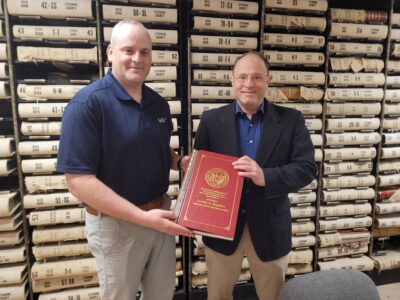
Chapman was at Huffman's office recently to demonstrate and show an example of the final product, a faux leather volume of impeccable quality.
"We will stop the aging process," Chapman said.
First, he will remove the worn volumes by hand -- about 30 to 40 at a time -- and take them to the Kofile laboratory near Burlington, Vermont, he said.
The damage to the pages in deed books was accelerated by the fervent searches for who owned land during the height of the natural gas exploration, he said.
That gas drilling began in earnest in this region about 2008 to 2011 and beyond.
During that time, private landowners, attorneys and various gas interests would get out the deed books, turning pages searching for information.
Sometimes, their fingers would add natural skin oil to the paper that would eventually ruin portions of the documentation or they would pull out information they needed in order to make copies.
That damage will end with Kofile's work.
Once at the lab, the books are disassembled by the employees. They remove the binding and scan the records.
The ink used in the older versions is so acidic it has eaten holes in the pages, Chapman said. Glue on the tape also is acidic, he added.
It wasn't until the 1990s when the U.S. stopped using the highly acidic paper, he said.
At the lab, the historic records will each be sprayed with a de-acidification solution that halts the decay of paper. Kofile uses non-acidic Japanese tissue paper, he said.
Each page is cleaned, and patched together, if necessary. The paper is then covered with a mylar plastic sleeve, which protects it from further deterioration. "We push out the air to preserve it forever," Chapman said.
Those sleeves ultimately make up a book that Kofile will bind.
Huffman is the first Register and Recorder in the county to take on such a project, Chapman said.
Kofile will produce books that have the colors that are selected by the county.
The finished product is one the government can be brought to own, and the people can use with ease and far less worry.
Chapman showed an example of the redone book. It was the color of a deep red and covered in faux leather. The red may or may not be the color that the county selects, he said.
Huffman, who serves on committees on the Tabor Museum and is a past member of an historic preservation board, said this project will prove its worth.
Once the restored deed books arrive, Huffman said he would like to show the commissioners during a meeting samples of Kofile's workmanship.
"It gives me a great sense of accomplishment to take on this important project," he said.