
Lycoming County’s Democratic candidates discuss public safety, other issues
Trending
For local businesswoman Tai Greene, the forum with the Democratic candidates seeking the commissioners' seats addressed issues that are of concern to her.
Greene, with her mother, began 4 D's Home Care LLC, a home health care business in Williamsport, the first run by a woman of color. She came to the forum earlier this week to hear the candidates views on funding for businesses offering people a second chance. She was also interested in hearing from Denitra Moffett, the first woman of color to run for commissioner.
"They all kind of touched on things that were deep to me from someone being incarcerated because of mental illness as opposed to somebody that's a repeat offender -- there's a difference, I know somebody personally like that -- down to benefits of helping children. I'm one of those single moms," Greene said, following the forum.
"Being one of those single moms, like they said, I still have to work until a certain time and depending on your income you may not qualify for after-school programs," she said.
"I feel like everybody touched on something, even down to our Christianity," Greene added.
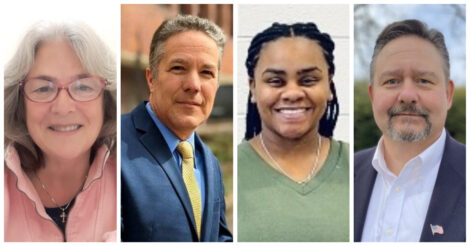
The four Democratic candidates running for their party's nominations in the May 16 primary are Victoria Marks, Denitra Moffett, Mark Mussina and Sean Simcox.
The election will determine who runs in November against the Republican slate of candidates to fill the three county commissioner seats. Only Commissioner Scott Metzger, a Republican, is up for re-election. Commissioners Tony Mussare and Rick Mirabito have both decided not to run for another term.
Each of the political parties is afforded two nominations for the three commissioner positions at stake in the November election. While the state law limiting nominations increases the likelihood that both parties will be represented on the board of commissioners, voters could elect -- and in some counties in past elections have elected -- a third Republican, a third Democrat or an independent candidate with write-in votes.
With the possibility of carrying their party's nomination in the fall, the candidates at the forum weighed in on questions from a moderator.
One question dealt with drug addiction and the opioid epidemic -- an issue of concern in the county.
"We just have to work with the right entities to use the funds that are allocated for us for those things," Marks said, citing the need for more help from the police and the state.
Mussina characterized the problem as "different than most other drug and alcohol addictions," suggesting that it is more of a middle-class problem rather than in lower income people.
"They ended up with it coming out of surgery, or coming out of some sort of medical need where the drug company was very willing to write prescriptions and they got hooked," he said.
Moffett on the other hand said, "Addiction has no color, no age or gender. It's not just older people, it's young kids."
She advocated for more intensive treatment for all types of addictions -- drug and alcohol -- and for "everyone from the lowest level all the way to the top 1%."
"A plague on our society," is how Simcox described the opioid epidemic.
"We have to fight this battle on all fronts from health care to the police," he said.
"I wish there was an easy answer, but beyond that there's not," he added.
Commenting on public safety, the candidates differed in their ideas of identifying the source of problems and also how to address them.
"We have a rising gang problem in the city," Mussina said, noting that he had spoken with people in juvenile probation about this issue.
"We need early education programs. We need preschool programs and after school programs to keep these kids engaged intellectually so as they get older, they have options that don't involve the gang," Mussina said.
"As we sit here as middle-class people, we don't understand why kids get into a gang. If you're 18 years old and there is no food in the house and the gang can get you food, the choice is obvious. There are lots of aspects of our society where kids are going into gangs, not because they want to, not because they think it's cool, but it's really an economic decision, because they don't have the economic capabilities that the rest of us have," he said.
Marks said she has lived in other areas and she feels Lycoming County is a relatively safe place.
She would like to see a better trained police force.
"I think some of the areas that they could improve in is the training on how they differentiate between a criminal and somebody with a mental illness because we often just exacerbate that problem by treating them like a criminal," Marks said.
Marks also advocated for gun safety and changes in how people obtain firearms.
Moffett said that after speaking with police officers and asking them what county commissioners can do to help them, they "surprisingly" didn't tell her that more money was the answer. Instead "They wanted proper training to understand how to deal with things like a mental health crisis, she noted.
"We also need to give them more training on diversity and inclusion," Moffett said.
"We as a community need to get together, hold hands and not try to push anyone out. Everyone needs to be included," she said.
"It takes a village to raise children. Children need to know they're loved -- that they are cared for," she added, referring to the idea that gangs are an issue.
"We just need to make sure we're putting the right people with the right resources and the right skills in the right position so we can get ahead of it," she added.
Simcox, who has worked with regionalization of emergency services in Jersey Shore, said that he sees public safety as more than police and crime.
Because of the regionalization of services, Simcox said, "We used to just respond to crime, now we're solving crime."
"It's these things that are powerful that we've got to work together and continue to do," he added.