
Trending
A leading natural gas official reminded local business and community leaders this week of the importance of the resource to the economy and sustainability of communities.
Dave Callahan, president of the Marcellus Shale Coalition, noted that Pennsylvania is the second largest producer of all U.S. states for natural gas.
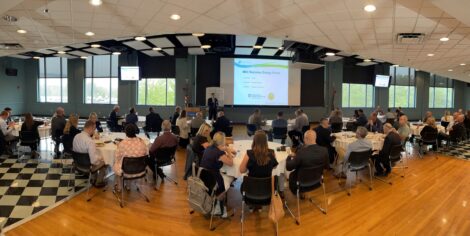
But despite vast production numbers, the industry continues to face challenges, he told those gathered for a luncheon at Pennsylvania College of Technology for the Marcellus Shale Coalition Energy Forum.
Callahan noted that Lycoming County, the fifth largest producer of natural gas among the state's counties, is a major player in the industry with Cummings Township leading the way at 245 wells.
Callahan lauded the state's lawmakers for having the foresight in 2013 to vote for an impact fee that annually generates tax revenues for gas-producing counties and municipalities.
With higher natural gas prices, 2022 resulted in what he called "a bellwether year" for those gas-producing communities, he said.
Lycoming County alone, he noted, has received $121.9 million in impact fee revenues in the past 10 years with the money being funded for various projects that have included the Indian Park nature trail in Montoursville and the brownfields to ballparks project in Williamsport.
Overall, he said the state is the largest exporter of power in the U.S.
Callahan lamented the pushbacks the industry has faced such as the failed attempt by Bechtel Corp. to develop a multi-million dollar natural-gas-fired electric generating plant in Renovo.
Environmental groups successfully fought attempts to establish the plant, citing air quality and other concerns.
Callahan said the industry has a good record of environmental compliance.
He noted that 95% of wastewater used in gas drilling is recycled and that air quality overall has improved since 2005.
Going forward, more pipelines are needed to transport natural gas to New England.
"We need permit reform," he said. "We see efforts to totally ban natural gas use."
Other challenges include finding employees to work in the natural gas industry.
State Sen. Gene Yaw, R-Loyalsock Township, said the state cannot turn back its energy reliance on fossil fuels and lamented the closure of coal-fired power plants such as the most recent shutdown of the Homer City facility in Indiana County.
"What happens when all the power plants close?" he asked.
Under the Regional Greenhouse Initiative (RGGI), a 12-state compact that sets a cap on greenhouse gases, more companies will be discouraged from coming to Pennsylvania, Yaw said.
"We are going down a path in the United States that no one likes," he said.
Other speakers were Lycoming Chamber of Commerce President Jason Fink who noted the support of the natural gas industry by his organization, and Pennsylvania College of Technology President Michael Reed.
"The manufacturing sector is still strong in this area," Fink said, adding the presence of natural gas is helping to attract more industries to the area.
Reed said a mission of the college is to help students reach their career goals. "That means working hand-in-hand with industry," he said.