
Senator brings warning about Medicaid renewal
Trending
With about 20 percent of the population receiving their health care coverage through the state's Medical Assistance Program, it is important to know that their coverage will not be automatically renewed now that the pandemic has ended.
With the passage of the Consolidated Appropriations Act of 2023, state residents who qualify for the program need to register to make sure that they are not caught without health care coverage. It is also important that they have their information up-to-date so that they can receive notifications from the Department of Human Services (DHS).
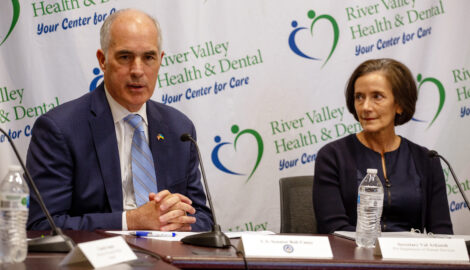
To get the word out about these changes, Sen. Bob Casey recently visited the River Valley Health and Dental Center, to participate in an informational panel, along with DHS Secretary Dr. Val Arkoosh, Pennie Director of External Affairs Chachi Angelo, River Valley's President and CEO Jim Yoxtheimer, and Patient Financial Services Representative Cherokee Phillips.
"It's critical that we get this word out...we've got to keep repeating the message about getting accurate, timely contact information and into the state so that Secretary Arkoosh and her team can continue to do that outreach," Casey said.
"During the COVID-19 pandemic, we were given a lot of flexibility in terms of making sure that people stayed insured," Arkoosh said.
Packets were sent out every year, but if people didn't send them back or if they didn't qualify because of the income guidelines, the coverage still remained.
That has ended. Starting in April, the packets have been going to each person according to when their renewal date is, Arkoosh said.
"The important thing is that if we don't hear back from them, we will need to remove them from the Medicaid program, even if they're technically still eligible. If we don't know they're eligible then we will have to remove them from the program." Arkoosh stressed.
"We are doing events like this all around the Commonwealth to help get the word out. Because the thing that is the hardest is making sure that people don't just take that envelope that comes in the mail and put it straight into the recycle bins. We want people to understand how important this particular moment is, and to make sure that they fill out that paperwork, because healthcare is so critically important," she said.
In some cases, individuals and families, even though they respond to the renewal package, may find that they are ineligible due to income guidelines, but Angelo explained the importance of still filling out the paperwork even though you might think you're not eligible for Medicaid.
"When an individual or a family responds to their renewal packet, if they're found ineligible, we are able to basically put folks a couple steps ahead of the game. You don't have to fill out all of that paperwork, figure out all that income, get your income, pay stubs again, we can immediately take that information and create what's called eligibility," he said.
An account is created on your behalf and then Pennie reaches out with a postal notice and it'll have your access code to log into the Pennie account, double check to make sure all the information is correct and then, because Pennie is the only link to financial assistance to enroll in a qualified health plan through Pennie, we'll give you an estimate of what the that financial savings looks like," Angelo said.
"All you have to do then is go into our shopping portal, filter plans, pick the one that works best for you, and stay covered. Make sure that you enroll within the first 60 days, because we're able to give a start date with a plan through Pennie right up to the date that one loses Medicaid so that there's no gap in coverage. And if you wait past 60 days you will be able to enroll, but we're not going to have a seamless enrollment time," he added.
For some people that are making just a little too much money for Medicaid, Arkoosh noted, are finding that if they enroll in Pennie, premiums are very affordable.
"We're trying to help educate people that these very substantial, really good commercial policies are available to them at very low cost if they're no longer eligible for Medicaid," Arkoosh said.
Casey echoed Arkoosh's statement.
"We have to continue to emphasize the opportunity provided by Pennie because of all the benefits coming from that program, especially if someone is found to be ineligible for Medicaid," Casey said.
"Lastly, I think we have to, for the broader conversation, keep reminding people about how important Medicaid is. I know in Washington, it's sometimes not only gets lost in the discussion, some other programs get more attention. But it's also because it gets lost is often the subject of targeting, targeting for big cuts, all of which are bad for the country. But I like to think about it this way. Medicaid is the program that tells us who we are, and whom we value. We say as a country-this may not be a program that someone paid into, because they're a senior, because they're a child, or because they're a person with a disability-we value them. We're Americans. We value these Americans, and anyone who gets in our way of valuing those people is going to lose that fight. We're gonna value those Americans and support this program no matter what," Casey said.
"That's usually the fight I'm engaged in in Washington, but this is different. We've got folks that have coverage, some of whom may not because of changes in their circumstances by way of income or otherwise. But for those who remain eligible, we cannot fail to make sure that they remain enrolled, especially in the context of children, children throughout the states who have the benefit of Medicaid, will get that early periodic screening, diagnosis and testing so they can get to a health up to a healthy start in life," he added.
Pennsylvania is the third lowest in the number of cases that have been closed due to people not responding to the initial contact from DHS.
"We want to be the lowest, but we're the third lowest," Arkoosh said.
"However that is when 43 percent of the cases that we've had to close are because we didn't hear back from somebody," she said.
The national average is 76 percent, which Arkoosh called "crazy."
"For us it's only 43 percent, which is nice that we're among the lowest, but I would like that 43 percent more like five or 10 percent," she said, adding that the word needs to get out into the community so that people will continue to be covered.
Phillips said that she has been able to help people walk through the process of renewing their. Medicaid through her work at River Valley Health.
One problem River Valley is seeing is that some people are not getting their renewal packets.
"It's important to just keep your contact information up-to-date," said Angelo.
"If it's an email address, if it's a phone number, if it's a mailing address, that is the call to action for right now-to update that contact information so we can find where you are so we can make sure that those packets are received," Angelo said.