
Daughter looks back on popular family business, the Market House
Trending
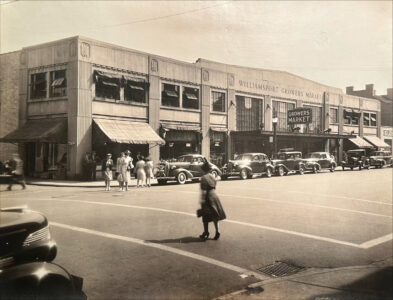
The historic Market House on Market Street was a hot spot for locally sourced fruits, vegetables and other foods, and the Eck family were mainstays from the beginning.
The family, originally from Switzerland, emigrated to Pennsylvania from Germany due to religious persecution.
In 1900, John J. Eck purchased a 60-acre farm in South Williamsport, where some of the original land is now comprised of the Little League World Series complex. After John's death in 1935, Horace W. Eck, along with brothers, John "Wally" and Clyde A., carried on the family business under the name John J. Eck and Sons.
As a young boy, Horace, who lost an eye in a pitchfork accident at 3 years old, drove horse and wagon selling and delivering goods throughout Williamsport. Horace's daughter, Barbara Eck recalled that the incident did not impact his spirit or attitude, stating, "I remember on rainy days when I was a child, he would say 'the sun will be shining in 15 minutes,' and it usually was."
After initially selling their goods on the Curbstone Market, Eck moved to a large stand after the opening of the Market House in 1932. In 1931, the two-floor property, built of steel and concrete, was used for a large car show.
The Market House was a bustling business, explained Barbara, "it was so crowded that one had to fight your way through, but everyone was happy, busy and enjoying themselves." The market was a hub for everything from fresh meat and fish to baked goods and groceries. It was truly a community, where "all the customers became friends and returned weekly," Barbara explained, "customers had a strong sense of trust and knew that a person's word was genuine, and the prices were fair."
The Eck farm's specialty was horseradish, which they originally ground by hand, before building a machine to help keep up with the increased demand. Horace would work 12-hour shifts on Tuesdays and Fridays, grinding horseradish, with the only added ingredient being white vinegar. The horseradish was a popular item at Weis Markets, and Barbara Eck remembers 18-wheelers being loaded up for delivery in New York.
Although it was hard work, there was plenty of fun to be had, as Barbara recalled, "one morning, an elderly lady picked up a red hot chili pepper, bit it in half, and left the other half on the counter, saying 'too hot,' as she walked away. This piqued my father's interest, so he picked up the other half and ate it. He disappeared, and at the end of the day, he was still feeling the after effects."
"Another time," Barbara continued, "an elderly gentleman, Mr. Savage, who lived in Muncy Hills, and made beautiful green roping and reeds to sell at our stand during the Christmas season, told my father he was hungry for ice cream. Dad got him a pint of ice cream, and we noticed him spitting into a can constantly. Dad got him butter pecan ice cream, and he had no teeth."
Operations at the Market House were truly a family affair, with Clyde as manager, and a member of the board of directors. He, along with his wife, Margaret also peeled horseradish, along with farm chores such as planting and milking cows. The couple also maintained finances for the farm. "Uncle Wally also did a lot of planting, digging, watering and waiting on customers," Barbara remembers.
Horace's wife, Odelia "Dee" worked by his side, often 14-hour days, selling the farm's wears. Dee also canned onions in the family's basement, helped pick flowers and made 200 corsages every Easter. Barbara would often help after school on Fridays and all day Saturday. "I remember jotting down prices, usually of 10 to 14 items, on a brown paper bag, and adding them quickly in my head," adding that in those days, "we actually had to make change ourselves."
"It was such fun to help all those great, appreciative customers," she said.
Barbara's devotion to the family business continued into her adult years, recalling her and her husband, Carl, skinning spring onions in the evening, for two cents a bunch with many of the neighborhood boys. "I guess I was talking and laughing too much, because I discovered at the end of the season that the boys were taking handfuls of my onions and putting them in their bushels," Barbara recounted.
Through it all, Horace was at the helm of the farm's stand, transporting the product from the farm to the Market House.
During the winter of 1969, two years prior to Horace's retirement, despite Mayor Richard Carey's pleas for residents to stay home, Horace made the trek through 15 inches of snow to the Market House he loved so much, explaining that "someone might need something." Despite getting snowed in at one point, and needing to dig himself out, he made it to the market only to find no one was there. "Thank goodness he made it back home," Barbara said.
Though the Market House closed in the early 1970s, its legacy and indeed its charm lives on in those who were there to be so affected by it.