
Trending
Locally sourced farm products are an important tool in the Central Pennsylvania Food Bank's fight against food insecurity.
Food insecurity -- the lack of access to nutritious food -- is not just limited to people living in urban areas, where there are often food deserts, or where it is difficult to buy affordable or good-quality fresh food.
It's hard to imagine that rural areas, where it would seem there should be more access to healthy food products, would have residents that are shut out of the bounty.
"It's a statewide story and it's a story in central Pennsylvania," said Joe Arthur, the food bank's executive director.
"It's kind of a split. We are seeing that in our highly rural areas, which is most of central Pennsylvania and we're also seeing that in our more highly populated communities, particularly communities of color. It has to do with economics and families," he said.
Caryn Long Earl, director of the Bureau of Food Assistance with the state's Department of Agriculture, agreed with that assessment.
"I think a lot of people think of it as an issue that happens only in urban areas. It's people who aren't working, people who may not be trying hard enough. I think that the reality is that food insecurity happens in every single county in every single community. It could be happening with your neighbors, with the kids that your kids go to school with, with the parishioners you worship with at church. It's a widespread thing," Earl said.
"So many people live paycheck to paycheck these days. It could be any one of us in a given couple of weeks, so it's really a more common issue than people think," she said.
The pandemic impacted families and some still have not recovered. Then their income took another hit when inflation increased and their buying power decreased.
"In central Pennsylvania a typical family's expenses for the same goods and services has gone up over $500 a month -- rents and all that sort of thing -- and that $500 a month was just too much a month for rural people," Arthur said.
To assume that the people affected are not working would be wrong. Many are what the United Way has determined are Asset Limited Income Constrained Employed or ALICE. They are working, making too much to qualify for many of the federal programs, but they don't make enough for what has been set as a life sustaining wage.
Arthur acknowledged that people who fall into that category are a large part of the people the food bank serves.
"Their income is too high for any programs, too low to sustain their household," he said.
"That's where we come in. We're a resource for at least the food assistance, Arthur said.
One of the food bank's goals is that by 2025, their collaborative network will provide access to enough nutritious food for everyone struggling with hunger" in each of the 27 counties that they serve, and that they will "convene and nurture partnerships to make progress toward ending hunger."
That network includes local farmers and food producers who have committed to helping the food bank reach its goal of eradicating hunger for their neighbors.
The state's Department of Agriculture operates a program called PASS, which stands for Pennsylvania Agriculture Surplus.
"We look at the PASS program as a real win-win. It's taking surplus products that might have otherwise gone to waste, and it's helping to reimburse our farmers 97% of whom in Pennsylvania are family farmers. It's helping to reimburse them for the costs that they may have put in to produce these products, and it's funneling those foods into the charitable food system, so that low income Pennsylvanians can benefit from that product," Earl said.
"So it's really a win-win in that we're supporting the production agriculture industry in Pennsylvania, and we're supporting the people who desperately need the food," she added.
Another plus with the PASS program is the wide variety of foods that can be accessed. Pennsylvania is still considered a major agriculture-producing state and ranked 14th nationally. Through PASS, food banks have a source for fresh produce, dairy and protein products such as milk, cheese, beef, chicken and eggs.
"We do get a lot of fresh produce, but we also substantially over the last few years have gotten more dairy products. So milk that may have been dumped, was diverted to cheese production or yogurt production. We've also gotten a lot of protein products -- beef, chicken. We have eggs through the program, so it's really diversified. Even with the fruits and vegetables, which is what it started out as being primarily, some of that's been diversified into some processed products as well," Earl said.
Funding for the program in this year's budget is up to $5.5 million. When it was mostly fruits and vegetables, funding was at $1 million. Because of the increase, Earl said, "we've been able to scale up and diversify."
"In central Pennsylvania, that means that we are going to work with Pennsylvania farmers only -- Pennsylvania grown, Pennsylvania produced, Pennsylvania processed -- that's a stipulation. And so for us, it's actually helped us to create more relationships and also to build that understanding of what the charitable food system is -- that we want to provide more fresh, nutritious foods. We don't want to stick to dry and boxed and canned as much as possible," said Erica Mowrer, Central Pennsylvania Food Bank's agriculture acquisition manager.
"That's how we're going to do it, by working with local farms," Mowrer added.
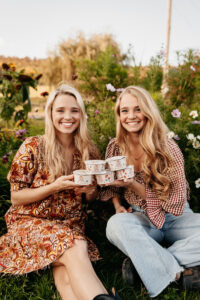
Painterland Sisters is an example of one that is contributing local products through the Feeding Pennsylvania program which is then distributed through the Central Pennsylvania Food Bank. Painterland Sisters is a national yogurt company that provides an Icelandic style skyr yogurt sourced from their family farm and other farms in the northern Pennsylvania area. The yogurt is a certified PA Preferred product.
Painterland Sisters is founded by Stephanie and Hayley Painter, fourth generation organic dairy and crop farmers. Their farm is located in Tioga County and is family owned and operated.
Currently the farm is owned by the third generation of Painter, Stephanie and Hayley's father, Clinton, as well as his two brothers John P. II and Bradley Painter.
According to Hayley, a family farm is truly an exceptional place to work. The sisters have two brothers and a cousin who work on the farm full time.
"It is safe to say this is one great family affair," Hayley said.
Hayley sees Painterland Sisters yogurt as well as her family's farm as an integral part of the food banks' mission to fight food insecurity.
"I really believe value-added products directly from family farms play a huge part in fighting food insecurity because it offers local jobs and the local economy to go directly back into our communities. Think about how many jobs dairy farmers support. They support the feed industry, the feed mills, the truckers, the supply stores, the stainless steel workers, the welders and many, many more. They support so many jobs in our rural communities that fuel the local economy. I feel like there's not another industry that can support so many people in such a vast area, all the way from accountants to lawyers," she said.
Hayley said she feels that a way to directly make an impact on food insecurity is to provide food that is packed with nutrients. Their yogurt is extremely nutrient dense -- per single serving cup, it contains up to 18g of protein, billions of probiotics, a good source of calcium, 13 essential nutrients, 6% milk fat and it is low in sugar. Their product is also inclusive because it is real dairy that is lactose-free, she said, noting that over 68% of the entire population has some sort of lactose sensitivity.
"We wanted to create a product that everyone could enjoy," she said.
Additionally, the brand is a certified women-owned brand while also being farmer-owned. Coming from one of the most rural parts of the state, Hayley said she is "proud to be able to offer products that can connect consumers to the direct source of their food, the American Farmer."
Creating any value added product is a challenge, but some of the trickiest products, according to Hayley, are dairy value-added products. This is due to the perishability of the products leaving only a short shelf life to distribute to the consumer. Additionally, Hayley said, the minimums to produce dairy products can be high. One other unknown is that dairy cattle produce different volumes depending on their environment.
To help balance out the quantity of yogurts in the weeks that they have more yogurts than they can move with such a short time, they have been able to work with Feeding Pennsylvania as an outlet for their extra yogurts to be sold or donated to the Food Banks.
"This allows us as entrepreneurs to grow and scale our business with little food waste while also being able to provide our nutrient dense yogurts to places in our state that really need it! It is a win-win for everybody," Hayley said.
She credits partners at Feeding PA like Tom Mainzer, Mowrer at the Central PA food bank and Beth Hamilton who preceded her with helping her and her sister, as millennial entrepreneurs, expand their business.
"There's not a lot of programs like this that can help entrepreneurs balance and then directly give back to the area by providing food. Through these programs they help entrepreneurs get started and maintain," she said.
"I know they're looking to continue their programs and to expand them and it's an amazing thing they have going on," she added.
Hayley feels that as young women growing up on a farm and now being able to supply a nutrient rich product that she and her sister have a unique perspective on what is needed to help alleviate food insecurity.
"It's from growing up on the farm and knowing what real food is building nutrients into your body. In our personal diets, we pretty much ate everything that we produced here on the farm," she said.
"We knew the value of real nutrients, real food. Then we knew the value of supporting local. We also valued the opportunity of community and really seeing the impact of people coming together and working together. When someone's struggling, you help them along and then when you're struggling, they'll help you along. We can build each other up. and we're going to be better off as a community and as a state and as a country by doing this! So we have to look at what each area does well and support each other," she said.
She shared how her family struggled a bit when she was growing up on the farm, and she became passionate when she spoke about the struggles that dairy farmers face.
"We were dairy farmers in the state of Pennsylvania, which means it's a rough life sometimes financially, but a very worthwhile life because we got to work with our family and with nature. Dairy farmers in our state are in a huge crisis due to the instability of the milk markets and opportunities. With the opportunity for value-added products it can provide stability for dairy farmers. Programs like Feeding Pennsylvania that support the growth and maintenance of our dairy food brands are much needed," she said.