
Project underway to rebuild trout habitat, boost economy and help environment in Clinton County
Trending
MILL HALL -- Phase one of Fishing Creek Project is finishing up.
Originally announced in April, the Fishing Creek Stream Rehabilitation Project will help rebuild habitat for the local trout population and improve the local economy.
Through funding by the Pennsylvania Department of Environmental Protection (DEP), the Clinton County Conservation District was able to partner with the PA Fish and Boat Commission and Mill Hall Borough in bringing the project to fruition.
The funds stemmed from the Countywide Action Plan (CAP) grant program. The conservation district was able to secure $506,000 in total from 2021 to 2023 for the project.
A Coldwater Heritage Grant was recently secured for $15,000 by conservation district watershed specialist Toby Boyer. The grant helped push phase one further.
"This is the way partnerships are supposed to go. It starts with money from DEP, the added benefit of the design coming from the PA Fish and Boat and construction oversight coming from PA Fish and Boat. We just make sure we get all the parties together and get the money for it with complete support of the borough. That is what a good government looks like," Wade Jodun, Clinton County Conservation District manager, said.
Fishing Creek is a Class A stream, according to Mark Sausser, the Stream Habitat Section Chief at Pennsylvania Fish and Boat Commission.
Class A means the stream has enough natural trout abundance, making it one of the top streams to have a population of fish.
However, the portion of the creek running through Mill Hall Borough lacks the necessary habitat for trout. It is too wide and is devoid of a constant food source.
According to Sausser, due to flood control efforts, the creek was removed of all in-stream natural boulder habitat, taking away natural deeper pockets, and with maintenance, vegetation was cut down along the banks.
"This portion of Fishing Creek is almost void of trout because there is no habitat, it's over widened and it doesn't have that constant food source falling into it," Sausser said. "The section that needs rehabilitation is also the highest density of population. The big areas where local residents and people can fish from."
The project will help bring back local and out of area angling tourism. This would help improve the local economy in the long run.
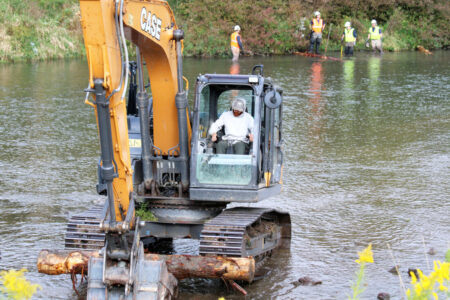
In total, there will be 24 structures built, including log frame stone deflectors, modified mudsills and more.
According to Sausser, log frame stone deflectors help narrow the stream, filling the sides with stone and logs. Each of the structures were designed by the fish and boat commission. All the equipment being used on site is owned by the commission. Almost 2,000 tons of stone and 200 logs are being used. The stream will then become deeper with them in place.
"Over time, that's what we will accomplish... On the downstream side of it, it will capture natural material and it will further enhance the narrowing of the stream channel," Sausser said.
Currently, the stream channel sits at about six inches deep. According to Sausser, trout are not able to reside in six inch deep water.
The point of using log structures, which line the stone along the banks, is to reintroduce wood back into the system. It helps fish have a source of protection as well as a food source.
"The trees and wood are extremely important. Wood is very good for the systems, it provides habitat overhead cover, gives shade protection and it also provides a food source because bugs are falling out of the trees for trout to have something to eat. Some of the aquatic insects need to lay their eggs on overhanging brush. When the eggs hatch, it all falls into the stream narrow to make water deeper to make it habitable for trout as another food source," Sausser explained.
Once the structures are completed, the stream banks will become stable and allow vegetation to grow back.
Another major structure being implemented in the stream behind the Mill Hall Fire Company building are modified mudsills. The mudsills help stabilize stream banks and provide overhead cover, creating fish habitat. Each of the structures will also help as platforms for anglers to fish from.
As phase one was completed this week, phase two is set to start early next year.
By next spring, the already completed structures as part of phase one will be vegetated, according to Sausser.
The workers on the structures are a part of the Chesapeake Bay Habitat Unit and funded through DEP. The unit accomplishes about five to six miles of stream habitat improvement per year within the Chesapeake Bay Watershed.
Since the project has begun and half of the structures have been built, the trout population is already becoming noticed.
Prior to the project, a survey was conducted by the fish and boat commission's fish management group.
"We are already seeing, through the fish surveys, trout moving in and using these habitat improvement structures. We are already seeing anglers following the structure devices. Every morning we show up, there is a different angler already fishing from these structures," Sausser said.
The structures will also help with flood efforts and improve water quality of the Chesapeake Bay in the process. By narrowing the stream channel width and deepening the water depth, it will increase the volume capacity of flood control to maintain flood waters within itself, according to Sausser.
"We're here in Mill Hall but we've got to realize where the water is going. It impacts lives all through the entire water system," he said.
The project originally began as an idea by Tom Shavinski, who worked for the PA Fish and Boat Commission and was a board member with the conservation district, according to Jodun.
"A couple years ago as I took over as manager, Tom started the idea. There is such potential to really restore fish populations here. Then we linked up with the PA Fish and Boat Commission," he said. "They said the water quality is here but what we don't have is the habitat. It is sort of that, if you build it, they will come axiom. With the correct water quality here, all we have to do is find the habitat and in this case, we are going to start by artificially building."
Much of the project's existence is with help by the Mill Hall Borough council. Council member Derek Berry helped facilitate the engagement from the borough with unanimous support. The district approached Berry and the borough back in January.
"What we really wanted was a partner in the borough because this stretch runs through their town. For years, there has been a running policy to keep all the vegetation down, keeping the trees off this bank," Jodun said. "We approached Mill Hall Borough and Derek and said 'look, we've got a project here and we want the support of the borough and need to understand this needs to be vegetated."
An avid fisherman himself, Berry wanted to help improve the community and revitalize what Mill Hall has to offer.
"This is important. This is a vein that runs right through the heart of Mill Hall Borough and our community. Anything that we can do to help the lifeblood pumping through our community and Clinton County in general, I stand behind wholeheartedly. If you look at this area, there is a huge number of hunters and fishermen around, the economic growth -- fantastic," Berry expressed.
Once completed, the Fishing Creek Rehabilitation Project will have a lasting impact for Mill Hall. It will leave a legacy by those who gave efforts to preserve local conservation.
"To leave behind a legacy with something like this that my grandkids and my great grandkids will be out here, enjoying something that I had a little piece of myself. It's so cool to think about that," Berry expressed.