
Trending
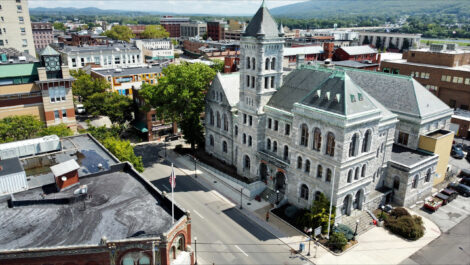
The Scranton-area developer who wants to buy Williamsport City Hall will have to wait, but isn't withdrawing his offer to buy the historic, condemned building at 245 W. Fourth St.
By a vote of 6-1 Williamsport City Council decided to table the bid, delaying a decision on whether to sell the former City Hall building.
After a process to put the bids out with assistance from Fish Commercial Group, the offer of $555,500 bid by JBas Realty and owner John Basalyga, of Jessup, will be further reviewed, council said. Councilman Jon Mackey was the lone no vote.
"Five yes, one no to sell the building in January. I guess now some of us have changed our minds and I guess that is OK," Mackey said.
Work needed to reopen City Hall and bring it into accessibility compliance is more than cosmetic, he said.
Mayor Derek Slaughter presented the proposal without knowing the full limit of the city debt load and with pending audits and investigations into financial management prior to when he took office in January, 2020.
Afterwards, Basalyga expressed disappointment in an interview with the Sun-Gazette, as he has undergone prior tabling of votes while the city officials decide what they want to do with the condemned and historic structure.
Dejected about the wait
"To me, it is sad because that building restoration could have been started ... for the benefit of the community," Basalyga said.
His proposal is to convert interior second- and third-floor space into 25 market-rate apartments and create a common gathering area, an event space to honor Williamsport's history and legacy, a retail area for perhaps a cafe or similar shop, and look at the structure of the roof for perhaps a roof-top area for tenants.
The building has been condemned since Aug. 4, 2021, after storms in July of that year resulted in heavy water damage. Slaughter had the building checked by codes and, meanwhile, had employees relocated to various office spaces on a temporary basis. An indoor air quality test was done, the results of which indicated evidence of high humidity as it would in a building without proper heating and ventilation operations and some mold -- though at a level that could be remediated. Interior tours of the building indicated presence of foul odor and more evidence of mold on its walls.
JBAS Realty expressed interest in January, as it was renovating the former YMCA building into apartments, a project that continues, at this time without state grant investment, though Basalyga has asked for $1.1 million from the city in American Rescue Plan funds.
"I am doing this and completing the apartments," he said. "My initial attraction was ... as you know I am doing another building (the former YMCA) with 35 apartment units give or take, and I need to hire some management for the property, of course, such as people to do groundskeeping and leasing, so having another building within a block or two from it was ideal for me."
"They are talking about trying to locate finances," he said. "The city is never going to have the finances to restore this building like I can."
During the meeting, Slaughter was again pressed repeatedly by several on council about providing a long-term plan as to where government be headquartered, as opposed to leasing room space in Trade and Transit I and II, a former transportation museum and River Valley Transit Authority.
He responded, as he did in a recent ed-op piece in the Sun-Gazette, that city remains in the process of working with auditors on prior-year and current-year audits, trying to calculate debt load and waiting on results of investigations of spending and use of grants by former city administrators.
No other option
The consensus of council, by vote and statements made, was that Slaughter has not provided them with any other option but to table the bid. Council members also wondered how the city can continue to find funding available and work with consultants and federal and state lawmakers on the recertification of the levee while unable to get the funding for city hall.
"It is irresponsible to make a decision that can involve taxpayer dollars without a fully defined plan and without fully exploring the available funding options," Councilman Vincent Pulizzi said in a follow up with the Sun-Gazette.
Slaughter said that city consultants have said there is no money available in the form of grants to restore the building, which is on the National Historic Register, Pulizzi said.
"If that is so, then we want to see empirical proof," Pulizzi said, adding the mayor should bring in consultants (Keller Partners and Co. and Delta Development Group) to show council the limitations of grant possibilities.
Moreover, Pulizzi said he wanted to see evidence of written requests going forward to state and federal representatives (U.S. Senators Bob Casey, D-Scranton; John Fetterman, D-Braddock; U.S. Rep. Dan Meuser, R-Dallas and U.S. Rep. Glenn GT Thompson, R-Howard, and state Rep. Jamie Flick, R-South Williamsport, state Sen. Gene Yaw, R-Loyalsock Township and state Rep. Joe Hamm, R-Hepburn Township). Pulizzi said he wants to see where the administration has sought grant or funding opportunities with any or all of these state and federal lawmakers.
"We as a city have no plan, no real desire to be in the real estate business," Pulizzi said, as others on council expressed the same point.
Nonetheless, Pulizzi said, the city is renting space for government offices and the council has, to date, no plan for how or when that may come to an end, he said.
Appraised value of the building reveal?
The administration should release the appraised value of the building to the public, which the council also knows, Pulizzi said.
Christopher H. Kenyon, of McCormick Law, who is providing legal representations to the city on the issue, cautioned the city should be wary of releasing the appraisal.
"This is relative to the way the right-to-know law applies in appraisals for real estate," he said issuing the following statements: "They are exempt during a period of time the property or asset is contemplated for sale," he said.
Because the city hall was put out for bid, until it is resolved relative to the idea of 'we are no longer selling city hall' or whatever is decided, the appraised value is not releasable under the right-to-know law, Kenyon said.
That is because it would be unfair and take away the ability of a municipality to negotiate terms, he noted. The city doesn't have the ability, such as a school district would, to go out and sell the building on the open market to a real estate agent, according to Kenyon.
"The city has the ability to put it out to bid or auction it," he said.
Again, the city administration does not want to stymie the process of people knowing what the value of property is because they potentially could bid higher than the appraised price, Keynon said.
In reality, the true indicator of value is what a buyer is willing to pay for it, he said.
The city should not want to get itself in a situation in which the price of the value of real estate is given and the bidder knows what somebody else said the value is, Keynon said.
Developer counters
Basalyga said the city remains at risk of not only letting the building remain idle and gather more damage over the winter but also "bid rigging," in that he submitted a high bid and that number is out there.
"I understand and it is an emboldened statement," Kenyon said of the developer's assertion.
"However, the city has not identified someone who they want to buy the property and conducted themselves in a manner predetermined who the successful bidder would be," he said.
The council reached a decision to sell the building, put it up for bid, agreed to do that and officials are now struggling with the idea of whether or not to sell the building.
"Ultimately," Kenyon said, "If the conclusion is to reject the bids -- they are done."
Should they decide to go through the exact same process -- advertise, accept and open bids, and determine who the highest bidder is and approve it -- everyone who bids would have the same chance, he said.
Basalyga said that is unfair because he put in a "strong bid" in order to buy the building.
Kenyon said the developer has a point -- but so does the city.
"I think the council is asking 'should we even sell this building at all?' " the attorney said.
"I made it clear to them and they understand they are to sell it to the highest bidder. Nothing put out there gives them the ability to be restrictive on the use or how it is used. ... The process is 'give us your best price. And that is what they have to make a decision on and they can negotiate with the high bidder," he said.