
Trending
The dreaded spotted lanternfly was first spotted in Pennsylvania in 2014, and although some progress has been made, the fight to manage this invasive species is far from over.
"It's still a problem," says Brian Walsh, horticulture educator for Penn State Extension. "From all indications we've seen a really dramatic fall in some areas, which doesn't mean they're gone, there's still that danger of accidentally shipping them."
"But, in comparison to the last couple of years, there were at least five counties added to quarantine this year, so it's still expanding," he said.
"As researchers, we have struggled with delineating what the population is," Walsh said. "We can't track an individual lanternfly. We're unable to really gauge how far the population is. We can measure individual areas, individual trees to get a sense of numbers that way."
While initial fears of the bug killing off trees native to the area have proven to be unfounded, the infestation poses a danger to established industries in the northeastern region of the country.
"There are two great concerns: First of all, they're absolutely a destructive pest for grapes," Walsh said. "They can kill grape vines out right, and from where you are to the winery regions of southern New York is not that far. They are a preferred food source, and if left unchecked, they can destroy them pretty quickly. So, that's the biggest, immediate threat."
"The other concern is that because it's disruptive to grapes, the countries of the wine-producing countries in the European Union are very, very concerned that this insect might accidentally be shipped to them from the U.S.," Walsh said. "And, when you think about the hardwood industry in Pennsylvania, it has a huge economic impact."
"The worst case scenario," Walsh said, "would be the European Union deciding they don't want our hardwoods from Pennsylvania."
"Something like that, an external quarantine from our training partner, you can imagine what that would do to the economy of especially northwest Pennsylvania, and the logging industry."
Walsh says an important part of the efforts to combat the pestilence is public awareness.
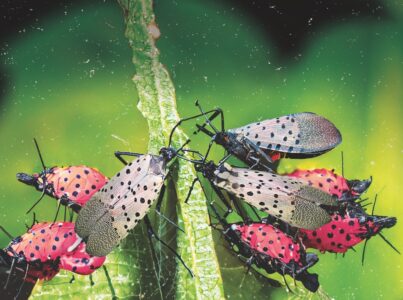
"Adults are about an inch long, with the females a little bigger," Walsh said. "Their abdomens are often black and yellow this time of the year."
"Their four hind wings, when closed, are very nondescript, gray with spots, so they blend in really well with bark on trees, but when they fly, behind their wings is bright red and it is very distinct. There's not a whole lot like it at all in our environment."
"In comparison, the eggs are really nondescript," Walsh added, "When they're laid, they are covered with a waxy covering that almost looks like a dab of mud and may be up to an inch long, and the eggs are really tiny, with 30 to 50 eggs under that little blob of mud."
There are several steps the public can take to help researchers combat the insect that is a native of China with no natural predators in the U.S., including submitting reports to the PSU Lanternfly Extension.
"If they find it, particularly, in an area that it hasn't historically been present in, please report it, " Walsh said. "That helps give a feel for where the population may have moved to, and that can help guide their mitigation efforts."
"If you know you're in an infested area," Walsh continued, "check your vehicle before you move to an area that's not infested, particularly now that it's egg laying season. You don't want to accidentally move them to a new area."
"That's really the best thing people can do; that and be educated and understand what the risks are and and the realities of this insect," he said
Walsh says current guidance still calls on those who find the pest to kill them if possible.
"You definitely want to try and kill it. Record a picture if you can and, again, always report it, again especially if it's in an area where it's not historically been."
Though the eggs are much tougher to spot, Walsh advises those that do to either squish them or scrape it into a bag with rubbing alcohol and dispose of it."
"Don't use homemade chemicals and homemade mixtures to try and stop them, because that is, A, against the law, and B, not safe at all," Walsh said.
"I would say that the most important thing is to make sure that people have an accurate source of information," Walsh said. "While there are very real dangers, this is not the time to panic or overreact."
For the latest information and educational tools, please visit https://extension.psu.edu/spotted-lanternfly.