
State Sen. Gene Yaw focuses on Lycoming County’s population at recent legislative breakfast
Trending
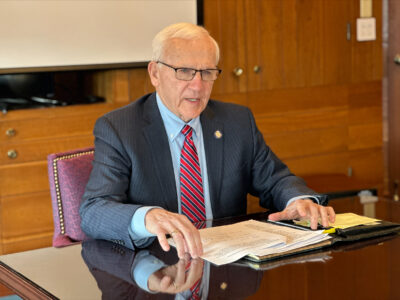
State Sen. Gene Yaw, R-Loyalsock Township, predicted energy policy and Pennsylvania's population figures will be two major issues political leaders must confront in the near future at the Williamsport-Lycoming Chamber of Commerce's legislative breakfast recently.
"You can look at the numbers and say they're scary or you can look at the numbers and say we have opportunities," Yaw said.
He cautioned that if the population decline continues, rural Pennsylvania will have its legislative input diluted.
"We need to get people to come her and say, 'we like it here, we want to stay,'" Yaw said.
Yaw said he's currently working on requiring bonding for solar panels, limiting the use of PFAs in firefighting foam, legislation that empowers people with terminal illnesses to make detailed decisions about the type of care they want, supporting a project to construct baseball and softball tournament fields at a rehabilitated industrial site in Williamsport and addressing the reliability of the electrical grid.
He said non-thermal sources of power, such as wind, solar and hydroelectric, account for about 10% of the grid's electrical supply while thermal sources, such as fossil fuels and nuclear power, account for 90%.
"We're retiring thermal generation faster than we're replacing it," Yaw said.
He said he will attend a hearing next week with Ohio legislators on electric grids and supply and has testified to the board of PJM, which governs Pennsylvania's grid. Yaw said he had the opportunity to meet with Gov. Josh Shapiro for about 45 minutes to make the case for his energy concerns.
He said he believes the governor is more willing to make compromises than former Gov. Tom Wolf.
"There is a significant difference" between the two, Yaw said.
Another aspect of energy policy Yaw believes will be important is hydrogen hubs.
"Carbon capture is an integral part of hydrogen hubs," he said. "Pipelines are a critical part. Pipelines are the only way it's going to work."
Yaw noted the gas drilling impact fee, which he said of which many people were skeptical when it was proposed, has brought $7 million to municipalities in Lycoming County this year and $70 million to municipalities in Lycoming County since its implementation. He added that it additionally brough $4 million to the county government this year and $42 million to the county government since it began.
He touted his support of the gasoline tax because of its role in funding the Central Susquehanna Valley Thruway – which was the "largest road construction project in North America" when it began – and in changing the state's fireworks laws "so Pennsylvanians could buy the same as everybody else."
He touted his work with Lycoming College to make the hellbender the official state amphibian and to secure it a dedicated license plate.
"My hope is that the hellbender license plate becomes the bestseller that PennDOT has," he said.