
Trending
"It's a simulation, not a game."
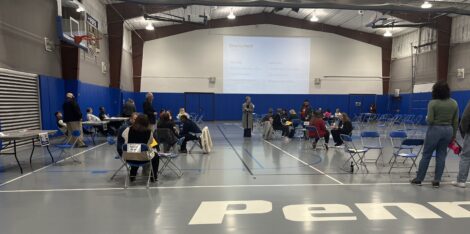
Monica McCarty, school outreach specialist at BLaST Intermediate Unit (IU) #17 and poverty simulation proctor, stressed to participants at the poverty simulation event held at Pennsylvania College of Technology's field house last week. The event was formed through the partnerships of BLaST IU #17, UPMC, the United Way, and Penn College of Technology.
McCarty added to the aforementioned statement, saying "in the same way that being unable to make ends meet isn't a game."
"An interactive, immersive experience, the Community Action Poverty Simulation gives participants a glimpse into the structural barriers, as well as some of the personal and emotional repercussions people in poverty face," McCarty said.
"The objective is to shift our assumptions about poverty away from being seen as a personal failure and toward understanding that there are structural factors impacting a person's ability to make ends meet," she said.
"In the simulation, up to 80 participants assume the roles of up to 26 different families facing poverty. Some families are newly unemployed, some are families where the spouse recently left, some are homeless, and others are recipients of TANF (Temporary Assistance for Needy Families), either with or without additional earned income. Still others are senior citizens receiving retirement or pensions, or grandparents raising their grandchildren. The task of the families is to provide for necessities and maintain shelter during four weeks," said Ron Frick, President of the Lycoming County United Way.
Majority of the participants in the event that took place this week were employed by UPMC. Volunteers were sourced from a variety of partnering organizations such as BLaST IU #17, the Central Pennsylvania Food Bank, UPMC, and the United Way. Volunteering for an event such as this is open to anyone willing to commit the time.
Participants at the event each wore name tags identifying their roles in the simulation. The simulation covered the span of four 11 minute weeks and four 2 minute weekends. "Families interact with community resources and services, staffed by volunteers," said McCarty, "These services include a bank, Community Action Agency, employer, utility company, pawn broker, grocery, social service agency, faith-based organization, payday and title loan facility, mortgage company, school, community health center, and childcare center."
A factor that makes completing these tasks much more challenging is transportation. In the simulation participants were given a set amount of transportation passes to divide among members. Adults working full-time required five passes to get to work, and part-time employees required three. School age children didn't require passes to get to school, since in most real life scenarios this is provided, but did require them to go anywhere else. The only family members who didn't require a transportation pass were infants represented by small dolls in the simulation. Additional transportation passes could be purchased at the payday and title loan facility, but participants had to be mindful in order to not run out.
McCarty noted to participants that transportation is a luxury many may not even take the time to think twice about. Lack of transportation can be detrimental to a family struggling through poverty.
"For example, if you get a flat tire and have that unexpected expense, that's bad enough, but if you live in a rural area with little or no public transportation, your job might be in jeopardy now because you've lost your way to work. How do you get to the store to pick up milk? How do you get to court or to college to take courses? That's real life," she said.
To mimic the unexpectancy of life, the simulation proctors walked around the gymnasium randomly selecting participants to choose a card indicating something either positive or negative had happened. For example, while at the social service agency, a participant was chosen to draw a card. The card indicated that the participant had the flu and needed to go to the doctor.
"I think this simulation really helps to open the eyes of the community. We 'know' that there are people struggling to make ends meet, but we typically only think about those who are out of a job and not bringing in an income," said Dr. Andrea Schmucker who works as part of the training and consulting staff at BLaST IU #17 and poverty simulation proctor, "We have a HIGH percentage of ALICE (Asset Limited, Income Constrained, Employed) families within Lycoming County, and even higher in the more rural counties we work with. My husband has his Master's degree and I have my Doctorate and even with our education, we are one emergency away from becoming an ALICE family. The economy has made it more difficult for everyone to make ends meet and we simply cannot expect students and families to be giving us their all at school when they are worried about house payments, transportation, where their next meal is going to come from, etc. I know how much unpaid bills can weigh on your mind and I've had months where I've stayed awake at night worried about how I am going to make ends meet. I want the community to understand that it's not for lack of trying -- it's that our system is set up in a way that makes it nearly impossible for families to get ahead."
Each family unit had at least one person to start who was either employed full-time or part-time. Full-time and part-time employees and school aged children each were given a minute to get to their station before being considered late. Full-time employees and school aged children had to stay at their station for seven minutes and part-time employees had to stay for four minutes.
During the third week, the school was closed so families had to figure out how to take care of their children at home rather than the reliability of school. The four weeks and four weekends went very fast as participants scrambled around the gymnasium trying to make their goals to keep their families sustained.
"BLaST IU 17 received a grant from the First Community Foundation Partnership in 2019; the focus was, and continues to be, providing community education awareness programs addressing families in poverty," McCarty said. "The IU, in partnership with the Lycoming County United Way, provided a professional learning series and purchased the simulation kits. The goal is to help educators have a better understanding of how school and community can work together to support academic achievement and disrupt the impact of poverty in education."
"I began working at BLaST in May 2021 and helped coordinate the professional learning series as part of my work with marginalized populations. Since then, we have provided 10 simulations to almost 400 participants, with the support of over 80 community volunteers, across the 4 counties in IU 17 (Bradford, Lycoming, Sullivan, and Tioga)," shared McCarty. "I'm thrilled to have the support of our IU administration and facilitation team, the United Way, and our regional community. It's been a tremendous collaboration between educators at all levels, human services and healthcare agencies, community, and school board members."
The circumstances and situations present in the simulation reflect those of real life scenarios. According to the ALICE report, in 2021, 40% of households in Lycoming County worked and could not make ends meet.
"Inflation and wage stagnation have not improved these conditions. Many folks do not qualify for programs like TANF or free or reduced lunch for their kids," McCarty said. "That's real. We cannot ignore that. In the controlled environment of the simulation, I watch the stress build if a family can't make their rent or if they struggle to find someone to watch their child when there's no school. Maybe one of their kids gets sick, and they have to miss work to go get them -- which means they just don't get paid for that missed time."
"ALICE families are households that earn more than the Federal Poverty Level (and so don't necessarily qualify for assistance programs, but they still earn less than the basic cost of living for the county. While conditions have improved for some households, many continue to struggle with the cost of household essentials (housing, child care, food, transportation, health care, and a basic smartphone plan). These folks are working, contributing -- and still struggling," McCarty shared.
At the end of the simulation participants took part in a reflective time to debrief their experiences in simulation. Some participants indicated that their family ended in a better spot than it began while others indicated the opposite was true for their experience. Almost all the participants indicated that their family unit in the simulation experienced some portion of time where they had little to no food, were unable to pick up medication, and had experienced a family member having job insecurity.
"I'm hopeful that the memory of that stress and vulnerability from the simulation helps people to take a moment to consider someone else's circumstances or, in the best case, change the way we do things to minimize the impact," McCarty said.
"We hope to continue these events into the future," McCarty said. "We consistently hear from both volunteers and participants about how they're impacted by the seriousness and reality of these circumstances. About how they hadn't considered any of this before. That's important to me, and I want those conversations to continue."
"The future is BRIGHT for this simulation! It's gaining momentum in most of our districts and counties because people understand the value of it," shared Dr. Schmucker. "We already had one district train all of their staff and another offering it to their entire staff in March. Teachers and community members who have participated truly leave with a deeper understanding of what many of our students and families are living on a daily basis. Monica and I hope to continue growing this simulation together and work with these districts to create action plans based on knowledge. We want to take this from just understanding where the struggles are to actually making changes to help lessen the load and allow students (and their families) to feel more successful, peaceful, and supported."
"We would LOVE to have more community members get involved through participating in the simulation or volunteering. Our IU is able to offer this simulation to any agency, school, community resource that would be interested in hosting," Dr. Schmucker said. "Host a simulation! Participants have included school districts, human services agencies, and postsecondary students, faculty, and staff."
McCarty said, "If you want to volunteer, give a call to BLaST IU at 570-323-8561. We will put you on our list and reach out when we host an event."
"We are also always looking for volunteers to work one of the 'community stands' during the simulation, so if anyone would be interested, we have a growing list of volunteers who are willing to help," added Dr. Schmucker.