PennDOT offers tips for driving safely in the winter
Winter is here, whether you like it or not, so there are some things you need to know to keep you safe, especially if you are planning to head out on the road when snow is falling.
The first is, according to information from the state’s Department of Transportation, if you don’t have to drive — don’t.
“Of course we want you to avoid unnecessary travel if you can. If you can stay home, stay home…it just gives us a better chance of clearing that road. If you get stuck in traffic, we’re stuck in traffic too. So it makes it hard for our drivers to be able to get out there and clear those roads if there’s a lot of traffic on the roadway. So we do ask that you stay home if you can,” said Kimberly Smith, safety press officer for PennDOT’s District 3 Office at Montoursville.
District 3 encompasses a nine-county area, including Tioga, Bradford, Lycoming, Sullivan, Union, Snyder, Northumberland, Columbia and Montour counties.
“We do understand that sometimes you do have to travel out on bad roads, so we want you to check 511PA, which is a free app or website you can go to and on there you can see things like what the road conditions are, what the weather expected is, if there’s any closures or lane restrictions because of any crashes, but also you can track our plows so you can actually see where the state plows are in two-minute increments,” she said.
If you know that it takes two hours for the plow trucks to come by your property after a snowstorm and it’s been about one and a half hours since they’ve been there, then you know that it should be about a half hour until they return, Smith explained as a way to determine when roads will be passable.
“It’s just kind of an easy way to see what roads have been cleared because when the snow is falling, we can’t keep the roads clear…but we do our best to make them passable,” Smith said.
So, the snow is falling, but you need to travel to work, the doctors, or whatever, Smith offered advice on what to take with you as a safety precaution in case your car and you get stuck somewhere.
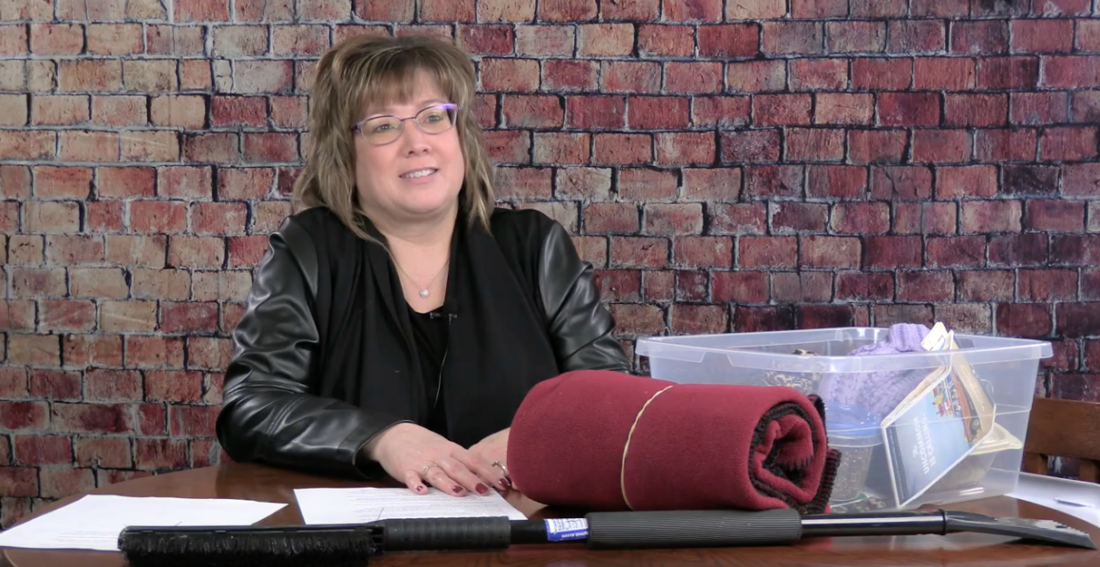
“So really anytime of the year but especially during the winter, we want you to have an emergency kit in your car,” she said.
The container doesn’t have to be big, but it should show you what is in the kit. Smith listed the items that she carries with her for emergencies.
“For winter weather, I do want to have something to keep me warm, so I have a hat and a pair of gloves. And then I also have a small blanket that I can use if needed. I have a little bit of kitty litter — you can use sand or you can use rock salt — just something to carry with you so that if you do need to get some traction for your tires, you can just kind of sprinkle it around and gain some traction there. Another little tip you can use is your floor mats. If you are stuck in the snow and you can’t get out, use your floor mat to give you a little bit of traction and once you get into a safe spot then you can retrieve your floor mat,” she said.
“You want to have things like a bottle of water, some non-perishable food that you can use in case you’re stuck for a long period of time. Most of us carry cell phones these days, so you want to make sure you have a charger. I keep a little pack of hand warmers because you never know. I also keep a flashlight and some extra batteries. You can’t really run your car the entire time if you’re stuck for a long period of time because you run out of gas. So you want to keep your car on for about a couple of minutes every hour just to kind of keep the heat on. So you want to have a flashlight for those dark hours,” she continued.
“I always carry a map with me everywhere I go. A little first aid kit, just some batteries, some gauze and a little bit of ointment, in case I need that. If you are on life-saving medications you want to make sure that you carry a couple of extra with you. Check with your pharmacist to make sure that your medication can withstand the cold weather, the cold temperatures to keep it in your car all the time. I travel with my pets so you have to think about things that your family or you might need so I keep some dog food and a little collapsible dish so I can give my dog water or food if needed. If you have a baby or travel with young children, you want to make sure you have some things for them. Think about what you might need in an emergency and keep a couple extra in your car,” she said.
Another important thing is to keep your windshields, windows and car free of snow that could either obstruct your view or blow off and obstruct the view of cars or hit pedestrians around you.
“Causing a crash because of snow or ice on your car that might fall off and cause another vehicle to crash or cause injury to a pedestrian or bicyclist or something — that’s going to get you some pretty steep fines in our state. But also for your own safety. You want to be able to see clearly out your entire car so all of your windows should be ice and frost free,” Smith said.
“If you only clear a little spot, you’re basically cutting off your peripheral vision. You can’t see anywhere else but also if you have snow on the hood of your car, or ice on your car, that can actually blow up over the top of your windshield and block your view. So it’s really important — not only is it a law, but for best practice to clear all the snow and ice and frost off your car before you travel,” she said.
PennDOT has been preparing for the winter season for some time. Routes have been assigned to drivers; the focus being on primary roads like Interstate 180, Routes 15 and 220 which carry a higher volume of traffic in this area.
“They’re our priority routes, and then we go from there based on the average daily traffic as far as ranking priority, but our drivers that have these assigned routes actually go out usually in October and do what we call a dry run. They’re out there looking for obstacles or things that they need to mark or be aware of, so when they’re out plowing they’re aware that they’re there. They’re becoming familiar with the routes. And then of course you always make sure we have plenty of stock of salt and grit and gravel and brine,” Smith said.
Brine is a mixture of salt and water that is sprayed on roads as a proactive measure to melt the snow or ice as it falls. If a storm starts as rain and then changes to snow or ice, the brine will be washed off the road.
“We have to look at each forecast individually and plan an attack on the roads that way,” Smith noted.
If you’re driving and encounter a snow plow, Smith said the best thing is to stay at least six car lengths away from them.
“They are releasing salt and grit and even brine sometimes, so you want to make sure that you’re staying back from them, but also because of their blind spots. They cannot see directly behind them. So if they have to brake suddenly and they don’t realize that you’re behind them, it could cause a crash,” she said.
“The safest place for you to be is behind the plow. We don’t want you trying to pass a plow especially when they are pushing snow because the snow coming up over the plow blade can obstruct your view of where that plow blade ends. And we have a lot of minor crashes that way where people are trying to pass it. They haven’t moved over enough to pass the plow and they don’t realize that they think it’s just snow falling over the plow,” Smith said.
Drivers also need to keep a following distance in inclement weather double the normal three to four seconds.
“If you are following a vehicle and they pass a speed limit sign it should be three to four seconds before you pass that speed limit sign as well. It’s kind of how you can track that. We want to double that in inclement weather. So not just snow but mist, fog, rain, anything like that. You want to increase your following distance,” Smith said.
“You want to break gradually, you don’t want to slam on your brakes. Make sure you know what type of brakes you have. If you have antilock brake system, you need to know that and know how it functions. There’s a great website that you can go to to learn about your vehicle. All the different features that they have. It’s called mycardoeswhat.org,” she said.
Besides increasing following distance and understanding how a car’s brakes work, Smith stressed the importance of adjusting driving speeds to road conditions.
“Speed limits in Pennsylvania are set for ideal conditions, when the weather is dry and you have sunlight that you can see. Any other time you do want to lower your speed limit, increase your following distance. Make sure that you’re prepared with your car having proper tire treads, they’re inflated properly, your brakes are working well. You’ve got plenty of wiper fluid, that type of thing. Make sure that your car is ready for that as well,” she said.
Snow squalls present another challenge to drivers. Often coming suddenly, without warning, squalls can create a white-out condition with limited visibility.
Smith shared advice on how to handle these situations.
“The first thing we tend to do is slam on our brakes because we can’t see, right? But if cars are coming behind you that’s super dangerous. So what you want to do is try to slow down gradually, especially if you’re on a highway. Slow down gradually until you can get off the exit or safe spot to pull over. But definitely don’t slam on your brakes. Just gradually lower your speed. Make sure your headlights, your full headlights are on, that way the back of your car is also illuminated for the cars coming up behind you. And then just gradually get off when you can and wait for that squall to pass,” Smith said.
Top News
Muncy Township special meeting ends quickly with no actions
Commissioners still tweaking the TDA
After months of deleting positions from the TDA (Table of Distribution and Authorization), the Lycoming County ...
Habitat for Humanity plans ‘blitz’ in June
“Something incredible is happening on Scott Street in June,” a news release from Greater Lycoming Habitat for ...
A journey through time, told through our communities
Tax increase included in Loyalsock Township School District tentative budget
The Loyalsock Township School Board began the process of passing its 2026-27 school year budget at its monthly ...