



Trending
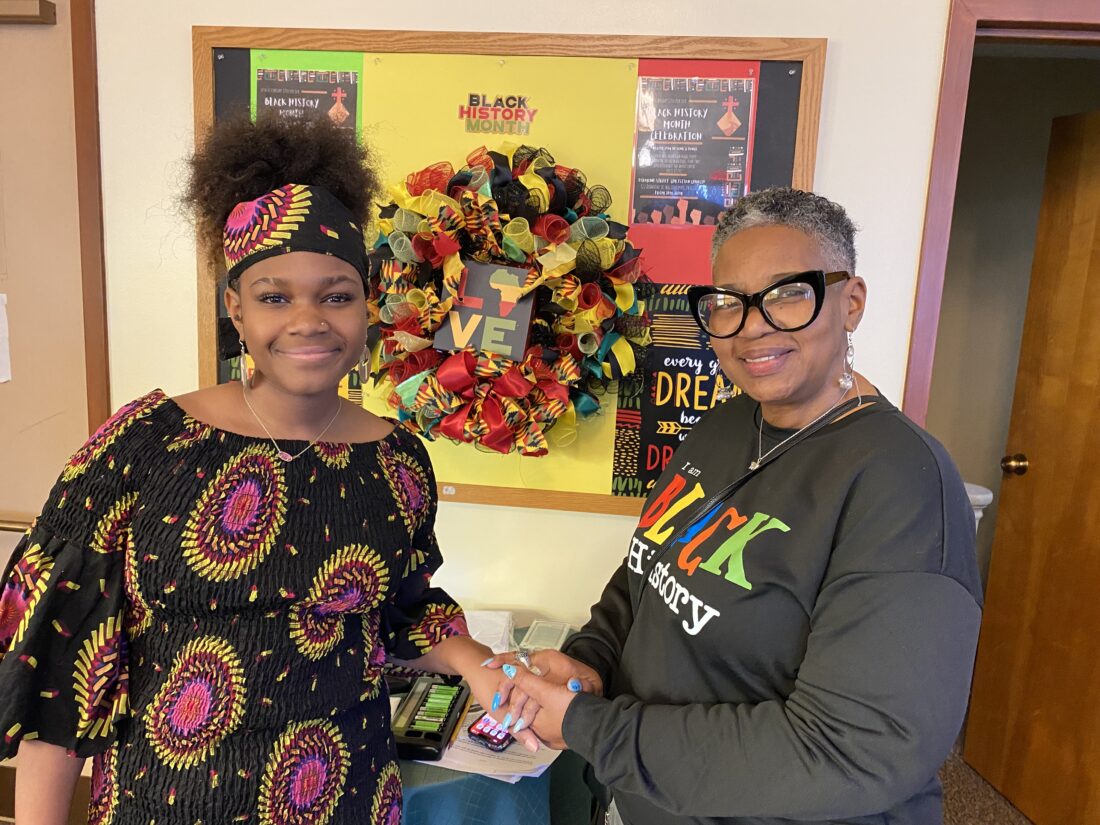
People from all backgrounds recently celebrated Black History Month at the Diamond Street Christian Church in Newberry with "One Step into the Past, Two Steps into the Future."
People came together to celebrate African American History with poetry, scripture, dance, song, speeches and events which marked African Americans' release from oppression, bondage and slavery.
"We were told we were not very much, but we have such a rich heritage," Deaconess Lesha Durham said in the opening welcome. "And we are going to find something out about it."
In the beginning of the celebration, Ron Taylor performed the historical speech on equality, "I Have A Dream" by Dr. Martin Luther King Jr. on Aug. 28, 1963.
Pastor Belton Mobley Jr. and his wife, Monique Mobley, welcomed all participants into Diamond Street Christian Church. They believe, in order to "teach their young children to have dignity in their history, they need to teach it through scripture."
Pastor Mobley strongly suggested for others to read "Beyond Roots: In Search of Blacks in the Bible" and "Beyond Roots II; If Anybody Ask You Who I Am" by William Dwight Mckissic Sr.
"These books hit the nail on the head of teaching African American History from Scripture," Pastor Mobley said.
One of the African American speakers, Lawrence Brown, in his speech that included a film of his own family pictures, "Black Achievers: Black Butterfly," stated how "our young people need not to be judged by their Jordans."
He said they need to respect their history as "they would not be here if it was not for their ancestors who succeeded through all their struggles."
"For centuries the church has been the distributor and disseminator of information of the history of people of African descent," Pastor Mobley said. "When history is taught in our schools, they leave some serious gaps in the curriculum especially when it comes to the history of Africa and the history of influential Blacks in America. Somehow, they get subdued, hidden sometimes and sometimes it's taken away."
"The History of Africa is important, especially the people of the past. It is important for our young folks, not just Black, white -- it's every race, Black, white, red, yellow -- all of us need to know about the history of the descendants from Africa," he continued. "It should be part of the curriculum."
Pastor Mobley referred to the highly publicized Florida case in which one of the standards requires teachers to teach middle school students that under enslavement, some African American gained skills which later benefited them.
"The intent of this message is not to accuse anyone of being racist," Pastor Mobley said. "My purpose is to focus on the different viewpoints, most of which are misinformed and inconsiderate, to the Black race held by some European Biblical commentators. Now, I hope to direct the attention of all people to think more thoroughly at the issues at hand. Think for yourself and not rely on others to teach us about our ancient and Biblical history."
"The pastor and his wife welcome everyone," Latoya Washington, youth choir director of the Diamondaires, said. "I have met transgender, caucasian and Muslim people. They open their doors to everyone to grow in the Lord. As the Bible says, 'Come as you are,' and we hold near and dear to this scripture. You come as you are. You are welcome here. Come for an encouraging word that could take you for the rest of your day, the rest of your week, and the rest of your life."
Washington, who said she came to Williamsport in 2015 from New Jersey to take care of her sick father, not only teaches the young children's choir, but she also did the choreography, which was celebrated in the dances "Stand Up," "Open Heaven" and "Praise," which were interpretations of the travel of African American people from slavery to freedom.
Pastor Mobley's granddaughter, Senai Statton performed the well-known poem, "God, why did you make me Black" by Jada Giavanna Jones, 2016 which boldly questions African American features yet ultimately marks African American beauty.
In response to these questions in the poem, God, played by Sharif Mercer, powerfully replied, "Why did I make you Black? Get off your knees and look around. Tell Me, what do you see? I didn't make you in the image of darkness, I made you in the Likeness of ME!"
Christine Worthy spoke of all the "Black Achievers" starting with Nate Alexander, the first African American Inventor to patent a folding chair featuring a book rest in 1911. Then she went on to tell of how next time you are stopped at a traffic light, think of Garrett Morgan from Ohio, the inventor of the 3-way traffic lights patented in 1923, after witnessing an accident at an intersection.
"Did you know? The first African American Woman judge, Constance Baker Motley was inducted in United States Judgeship in 1939 and she worked with many employers to hire many people because of their skills, not their race," Worthy said.
Judge Motley was involved in NNCP, Child Welfare League and many others. Another first – "Bessie Coleman was denied pilot training school in the United States and went onto get her pilot certificate in France in 1921 to pave the way for a new generation of diverse pilots, like the Tuskegee Airmen and the Blackbirds," Worthy said.
Worthy also mentioned the one of the first African American Women Doctors, Dr. Eliza Grier, who was "an emancipated slave and the first Black (person) licensed to practice medicine in Georgia...it took her seven years to get her medical license because she alternated school each year picking cotton to pay for her tuition determination."
During the celebration, Mary McLeod Bethune's poem titled "Legacy" was recited by Kathy Smith as she read, "If I have a legacy to leave my people, it is my philosophy of living and serving. I pray then that my philosophy will be useful to those who share my vision of world of peace, here is my legacy -- I leave you love, I leave you hope, I leave the challenge of developing confidence in one another, I leave you respect of the use of power, I leave you faith, I leave you racial dignity, I leave you the desire to live harmoniously with your fellow men and women, I leave final meeting a responsibility to our young people."
Whitney Houston's "The Greatest Love of All" was selected and performed by Tamaka Carter, "MLK Has Disappeared" by Carlos Brown, the "Black Family Pledge" respecting elders performed by Ron Johnson, the Black National Anthem or "Lift Every Voice" and many others were performed.
After the ceremony, when asked what the most important message is to convey today to the younger generation, Pastor Mobley answered the younger generation has "been lost for a long time. Now we are getting some exposure. Information that was once denied -- we came over in slave ships. They would not let us read books; we couldn't learn how to read. Progressively we are getting better and better, now with social media that is another door, the fights over critical race theory, Florida is a big example, but this has been going on for hundreds of years and education is key, and fundamentally I am a Christian, knowing what God says and then we will get the rest."
He emphasized that it's going to start at home with the older generation.
"Parents need to teach their children about our history and there is a problem of unity in the community," Pastor Mobley added. "Just recently the basketball courts were reopened two years ago which we politically had to fight for ... we need to keep unity in the community. Education goes beyond George Washington Carver and Eli Whitney. There's so much more. Black History is World History!"