
Trending
It was July 11 in the late 19th Century where soldiers gathered on an open field. What had once been farmland became a military encampment called Camp Maloney.
The camp itself was "of a Patriotic Character, with the clanking sabres of the Calvary escort, and the neat dress blue uniforms of marching posts, with tinselled banners...thousands of people crowd the line of march (with) impressive services today in the shade of the wooded hill."
Soldiers from all over Central Pennsylvania gathered to stand in a "line with steady nerve until justice trod down the standards and the steel that shadowed the soil of slaves."
These men were "defenders, who fought until liberty stretched out her arms unrestrained from where the proud Pacific chafes her strand to where the waves of the dark Atlantic beat upon the eastern coast."
This grand meeting occurred on farmland not far from where the J. Henry Cochran Primary School, on Cherry Street in Williamsport, and the UPMC Williamsport Hospital built on High Street, Pine Street and Rural Avenue would stand.
According to the Grit, on July 12, 1891, it would be called a " Military Vallamont," where soldiers from veteran posts all over Pennsylvania would arrive, set up camp and tell tales, sing songs and hear sermons relating to the American Civil War.
After the encampment would leave, Vallamont became a section of Williamsport just as defined as Millionaire's Row, Newberry or Jaysburg. Today its uniqueness has been absorbed into the greater totality of Williamsport, but what the area offered the community could never be forgotten.
According to the "History of Lycoming County," edited by John Meginess, at one time it was called the Rose Farm. Later, the farmland belonged to Hezekiah Packer, brother of Governor William Packer. In 1890, "a syndicate of gentlemen purchased the farm...and laid it out in lots and drive ways as an addition to the city."
The area was described as extending "up the hill to the summit affording a very fine view of the city and the valley."
It was hoped that "neat cottage residents will be built on the most eligible sites." It added that "other improvements (to be) made...will make Vallamont a very desirable place."
According to one source, the name came about during the sale of the farmland from one group of men to another. It was Judge Henry Clay McCormick who came up with the name Vallamont.
"He aptly suggested the beautiful name...which he coined from the French 'val'…meaning 'valley,' and the French 'montaque'…meaning 'mountain,'" said the writer.
After the sale of the land, then-Williamsport city engineer Robert Faires "surveyed the entire plot and laid out the...land into building lots, which were immediately offered for sale."
According to an article from the Grit newspaper on Aug. 7, 1898, the Grit mentioned the highway committee of the city council would consider Vallamont residents' access to the sewer system.
The Williamsport government was "holding under consideration a petition from a number of persons resident in Vallamont requesting permission to tap the City sewer system." All that needed to be worked out was to figure out a "payment of a just sum."
It was further stated in the article that "Vallamont will someday be a part (of) town can hardly be questioned."
When it became a part of the town, Meginness's "History" book noted that nearby were the "grounds of the Athletic Association" where "baseball and other sports are indulged in."
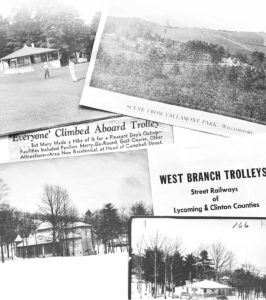
By the turn of the 20th Century, trolley lines were built to take local residents of the community up and down Williamsport to the Vallamont area.
In 1953, one writer recalled "the days when Williamsport families packed picnic lunches in anticipation of spending the day at old Vallamont Park" in the Aug. 21 issue of the Williamsport Sun.
The park was opened in 1890 and closed in 1915.
"But everyone (recalled) climbing aboard trolleys at Market Square or elsewhere along the line as they headed out Campbell Street toward the park," the 1953 article recalled.
Vallamont Park was "located along what is now Belmont Avenue, between Walnut and Campbell streets."
The 1953 article mentioned that "facilities at the park consisted of a glass-enclosed amphitheater, a pavilion, a band stand and a merry-go-round." The Williamsport Country Club also organized a nine-hole golf course.
Park goers would come to the amphitheater to view "a scene of many a melodrama" and many featured actress Clara Turner and her stock company. She was "well liked by Williamsport theater-goers" and she would be seen around town "in a cart drawn by two ponies."
"Children of all ages flocked to the merry-go-round," the 1953 article said. The band stand always featured concerts."
It was becoming so popular that on Dec. 18, 1911, the Gazette and Bulletin detailed that the "citizens of Vallamont will get together for the purpose of considering the advisability of making [an] application for a borough charter."
The article added that "it is understood that considerable opposition has developed to the program of the advocates of a borough government."
However, "many small property owners...fail to see where they will reap the benefit from being (its own) borough government."
Ultimately it was decided not to pursue borough status and Vallamont became part of Williamsport.
One group of city residents viewed Vallamont as a "treat."
According to the Evening News of Williamsport, on Aug. 4, 1900, the "inmates of the Home for the Friendless were given a treat yesterday afternoon."
Meginness's book stated the "Home for the Friendless" was a "philanthropic institution, was founded by the ladies of Williamsport in 1872. It affords a home for aged and infirm ladies, as well as children and infants."
This group of 100 residents "witnessed the production of 'His Society Wife,' (as) the guests of (the pavilion theater manager). They enjoyed the play. (The streetcar manager) gave them transportation over the entire Vallamont system. They enjoyed the ride a great deal."
Yet by 1915, the park was dismantled and the area became blocks, homes and neighborhoods.
However, history will recall long before the park on a summer day in 1891 when veterans of the American Civil War, who lived in the Central Pennsylvania, encamped the Vallamont area to share one moment of patriot pride not just with each other, but the whole city.
"…a parade started," the July 12, 1891 Grit article said. "It was headed by a calvary company of 50 mounted veterans, followed by a half dozen carriages containing the department officers. The Fisk military band came next, in advance of the [Lycoming] Reno post firing squad followed by the post and the representatives of numerous other Grand Army posts."
It followed up by saying the parade marched from the then-train depot on Market Street "to Fourth to Mulberry, out Mulberry to Third, up Third to Pine, out Pine to Fourth, west on Fourth to Walnut, and out to Walnut" to Camp Maloney in Vallamont.