
Trending
A productive discussion on modern policing related to race and community relations was held at Pennsylvania College of Technology recently.
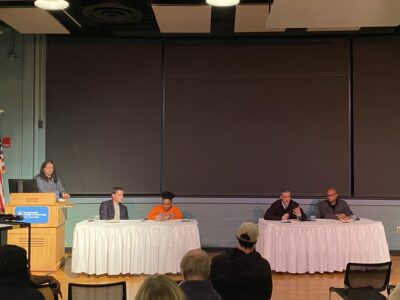
The town hall meeting was part of Penn College's Discussion Series and featured leadership of the Williamsport Police Department and community representatives.
Each of the discussion points highlighted a different and complex facet of the relationship between the community and police. Each concluded with major takeaways in how policing has changed in recent years.
When asked what police do well and how to expand on those successes, Assistant Chief Jason Bolt highlighted the changes he's seen.
"This is not the police department we were 20 years ago," Bolt said. "We are a younger department. We are more adept and trained in dealing with mental health emergencies."
Both Bolt and Chief Justin Snyder discussed the increased focus on empathy when doing the job.
"We are doing more to ask the important questions when arriving on a scene," Snyder said. "We want our officers to look at each unique call more in depth than at face value. Policing with empathy is important and we are always working on that."
Former Lycoming County commissioner candidate and community activist Denitra Moffett discussed her views on modern police's movement away from traditional community policing.
"A police officer knows their community better than most," Moffett said. "That's if they are active in the community. I feel as if we've gotten away from that with modern policing, which contributes to the loss of faith and trust in the system."
David Bjorkman is the lead faculty member at the college's program in Emergency Management and Homeland Security. Having held various on-the-ground roles with the Baltimore Police Department during the height of the city's zero-tolerance policing strategy, Bjorkman said he was there to offer a wider perspective of policing in other places.
"Law enforcement officers are tasked primarily with order maintenance," Bjorkman said. "But community relations is a large piece. Despite our best efforts, we think we're better at it than we are."
Bjorkman said the issue lies in needing to specifically define what community policing looks like.
"What does that model look like?" he asked. "We need to first define it. Because walking patrol went away with squad cars, historically. We need to adjust what we view community policing to look like today."
All of the panelists had ideas on how to improve this relationship. All agreed that the effort needs to be mutual.
"We've inherited a department and we're getting up to the times," Snyder said. "We are working to build these relationships through events like Shop with a Cop and Community Cookouts. This won't all happen overnight, but what we're trying to do is lay that foundation so that in 5, 10, 15 years this looks a lot different."
Many in the audience wondered what happened to the traditional model of community policing where officers would be out in the neighborhoods on foot. The increasing demands of the job, understaffing and technology have made that model uncommon nationwide.
"We'd love to be out there in the community more," Snyder said. "But we simply cannot keep up with the call volumes."
Snyder said that a city of this size with the call volume this high needs 68 officers, but they are operating with just 48.
"This is something we can work on," Bolt said. "A piece of this is also that you need to invite us in. That was my favorite part of patrol, was talking to people. It's hard to do that with the personnel issues we have, but you'll see both of us at every community event."
Moffett agreed that community participation is an important piece of improvement.
"They advertise many different events," she said. "I went to a community dinner with a cop event and I think eight people were there. We can do better at getting to these events."
Transparency was a common point of discussion Tuesday, with city police officials urging the community to take advantage of the new administration's efforts to show the community what they do daily.
"How many have had a bad or negative experience with the police?" Bjorkman asked. "How many base their opinions on that one experience? How many have done a ride along? I strongly encourage you to sign up for a ride along with city police. Ninety-nine percent of the positive things that we do as police officers you will never see."
In a transparency effort, Bolt and Snyder said they are working on keeping more detailed statistics and sharing those to the Williamsport Police Crime Watch page, which is available online.