
Rise Up Village Bakery teaches formerly incarcerated people how to rejoin communities

Valerie Peters and Luna Babcock talk as they clean up at Rise Up Bakery Tuesday morning. The bakery will produce hundreds of rolls each week and about 50 dozen cookies. Trainees in the program come from a variety of local agencies, some from probation and parole and some from transitional living. The trainees learn about not only baking but also get work skills like resume writing too. DAVE KENNEDY/Sun-Gazette

Luna Babcock puts out chocolate chip cookie dough balls onto a tray to be cooled at Rise Up Bakery Tuesday morning. The bakery will produce hundreds of rolls each week and about 50 dozen cookies. Trainees in the program come from a variety of local agencies, some from probation and parole and some from transitional living. The trainees learn about not only baking but also get work skills like resume writing too. DAVE KENNEDY/Sun-Gazette

Wendy and Marty McCormick, program managers for Rise Up Bakery hold a tray of freshly baked cookies made by the staff and program clients Tuesday morning. The bakery will produce hundreds of rolls each week and about 50 dozen cookies. Trainees in the program come from a variety of local agencies, some from probation and parole and some from transitional living. The trainees learn about not only baking but also get work skills like resume writing too. DAVE KENNEDY/Sun-Gazette
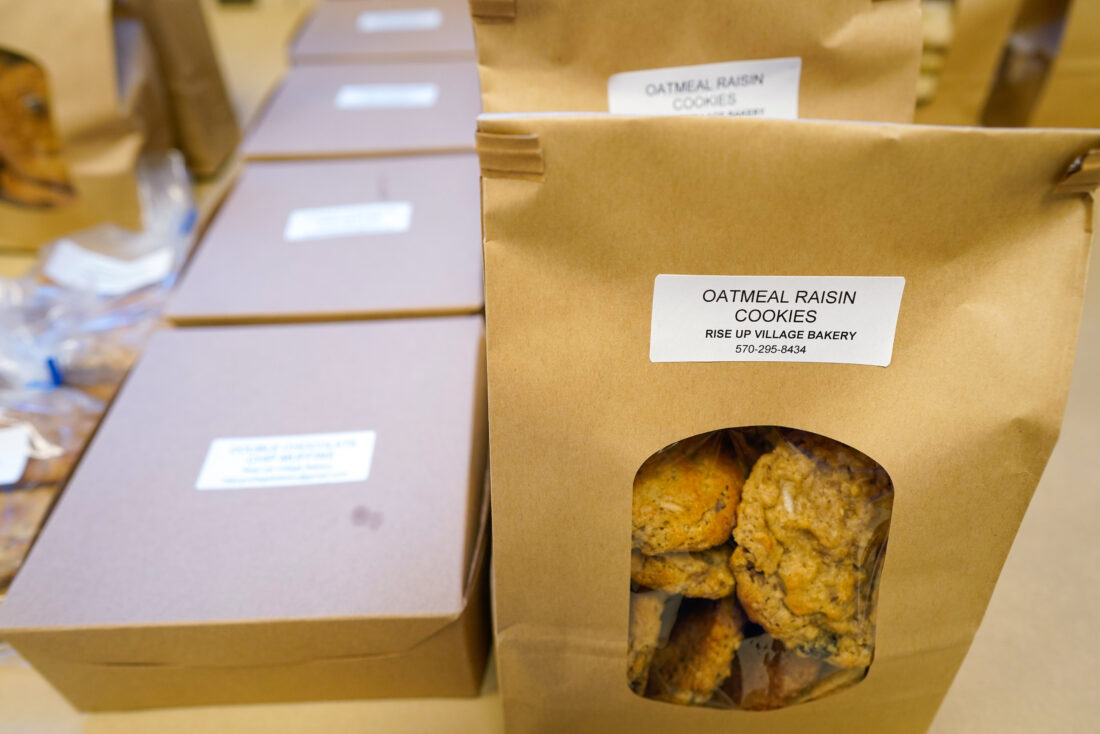
Bagged and boxed up baked goods wait to be purchased at Rise Up Bakery Tuesday morning. The bakery will produce hundreds of rolls each week and about 50 dozen cookies. Trainees in the program come from a variety of local agencies, some from probation and parole and some from transitional living. The trainees learn about not only baking but also get work skills like resume writing too. DAVE KENNEDY/Sun-Gazette
Valerie Peters and Luna Babcock talk as they clean up at Rise Up Bakery Tuesday morning. The bakery will produce hundreds of rolls each week and about 50 dozen cookies. Trainees in the program come from a variety of local agencies, some from probation and parole and some from transitional living. The trainees learn about not only baking but also get work skills like resume writing too. DAVE KENNEDY/Sun-Gazette
Luna Babcock puts out chocolate chip cookie dough balls onto a tray to be cooled at Rise Up Bakery Tuesday morning. The bakery will produce hundreds of rolls each week and about 50 dozen cookies. Trainees in the program come from a variety of local agencies, some from probation and parole and some from transitional living. The trainees learn about not only baking but also get work skills like resume writing too. DAVE KENNEDY/Sun-Gazette
Wendy and Marty McCormick, program managers for Rise Up Bakery hold a tray of freshly baked cookies made by the staff and program clients Tuesday morning. The bakery will produce hundreds of rolls each week and about 50 dozen cookies. Trainees in the program come from a variety of local agencies, some from probation and parole and some from transitional living. The trainees learn about not only baking but also get work skills like resume writing too. DAVE KENNEDY/Sun-Gazette
Bagged and boxed up baked goods wait to be purchased at Rise Up Bakery Tuesday morning. The bakery will produce hundreds of rolls each week and about 50 dozen cookies. Trainees in the program come from a variety of local agencies, some from probation and parole and some from transitional living. The trainees learn about not only baking but also get work skills like resume writing too. DAVE KENNEDY/Sun-Gazette
Trending
There is more than delicious baked goods being created at the Rise Up Village Bakery. There are lives being changed as formerly incarcerated people are given a chance to learn a new skill that they can carry into the workforce.
The bakery, which operates out of the basement kitchen at New Covenant United Church of Christ, began as an idea of Marty McCormick and his wife, Wendy, almost two years ago, when the first trainees were brought on board.
Although they went through a bumpy period at the end of last year, as Marty said, "working through a lot of issues that any new organization has," the new year at the bakery has seen an expansion of the program.
"We've found that we're really doing a good thing with the people that we're serving. At that time, we were having difficulty getting trainees on board and now we have five trainees at one time," Marty said.
"We're doing very well I think," he added.
Trainees mostly from various local agencies, such as probation, parole, the Transitional Living Center, and from the American Rescue Workers.
"I don't take people off the street. I take them through an agency. And so I've got people from Freedom House, I got somebody from Oxford House. I got two people who are living on their own now. They were in prison," Marty said.
There have been some people who have "graduated" from the program and have been able to get employment on their own, although not always in the baking business.
"We have two trainees that started with us early on, and we've kept them on at this point to be trainers. They'll be moving on to at some point, but we have used them since they've learned how to do it, they've been training the new ones," Marty said.
The program incorporates much more than learning the skill of baking-it includes learning how to re-enter the community after spending time in incarceration.
"I do a group with the trainees each week, on job skills, job interviewing, resume writing, learning their strengths and skills, so that they can present themselves well into the program," Marty said.
"They've got that barrier alone, the fact that they have a criminal record. Some of them that have been in prison incarcerated for a long period of time have a lot of I would say anxiety about getting back into the community. You know, they've not been able to do those kinds of things for a long time," he said.
Some of the trainees also have restrictions through the parole system and regulations that need to be followed.
"We get comments from our trainees all the time about the fact that we've given them some incentives, some encouragement to see that there's a future, that there's hope for them. That they have confidence now to go out and get involved in the community at one point or another," Marty said. "I think the fact that we have such a family atmosphere there. We're a well oiled machine. These people work and help each other. And of course we keep notice of what kinds of things they need to learn better."
There are performance reviews of the trainees that Marty does to help them see where there are areas that need improvement.
"Everyone was doing so well," he said of a recent review.
"They get more out of it than just learning baking skills. They get some feelings of competence and you know, that they're worthwhile and that what they're doing is a meaningful thing in their life," he said.
A typical week includes a prep time on Mondays and prep, baking and distribution on Tuesdays. Orders are taken by email the week before. There are also extra items for sale on pick-up day.
Although the amount of baked goods vary depending on the orders, Marty said that they typically bake anywhere from 10 to 20 loaves of bread and a couple hundred rolls. They also bake items for non-profits on a donation basis.
Cookies are also another item offered by the bakery.
"We've done as many as 80 or 90 dozen cookies. A typical week right now is about 45 to 50 dozen. We also do either muffins or mini breads and the orders can vary with that to you know 15 to 30 orders of those," said Wendy, who is the business manager for the bakery..
Since it began operation there has been an increase in interest from the community and an increase in sales. Because of that most of the expenses are covered by the donations they receive for the baked goods.
"We have been totally self-sustaining with keeping even with the donations for the baked goods and what our expenses are and then we've had donations that have been able to buy the mixer and prepare the oven," Wendy said.
There has also been a lot of support from the community for the bakery.
Looking ahead, the McCormicks would like to see the program expanded.
We have lots of dreams and wishes but we hope to expand the program in terms of the number of hours that we have for the trainees and probably some new skills that they can learn," Marty said.
"We would like to have contracts with some cafes and restaurants where we can sell some of our baked goods wholesale to them. Right now all of our products are given to customers for a donation. So we were looking to doing that," he continued.
"And, you know, I'm always willing to talk to any employer that might be interested in knowing more about our program and how hiring someone who has a criminal record is a good thing, the benefits and the reasons why it's a good thing," he said.
For expansion to happen, more volunteers are needed.
"One of our big needs in order to expand any further is to have at least one if not two more volunteers who are willing to kind of take on a management role in the kitchen," Wendy said.
"We really have maxed out the volunteers that we have. We have three really fabulous ones giving us two days a week and ourselves. To go any further we need to have someone or a couple of people who have experience working in the kitchen and can do a leadership kind of role," she said.
"We've been blessed with volunteers, but we can always use more," Marty added.
Marty and Wendy are both retired, so planning an expansion of their work seems almost counter-intuitive.
"I've always had a good heart to help others that are less fortunate. And we've both been working in teaching and in social service counseling fields. After I retired from counseling, I volunteered at the Clinton County jail for five years as associate chaplain and found that most of those people I was working with didn't have any opportunities or resources once they left. So I thought, well, What can I do to help? I went online and did some research and found that the food industry is the biggest employer of people with a criminal record. And that's especially bakeries and restaurants. So I just felt the need to try. It took us a little while to get started. You know, just to get out here and do it, but it's been rewarding, and we're glad we're here," Marty said.
"The reason I got into it is because after over 50 years with him, there was a task that one person couldn't do. Marty had the vision and the ideas, but the nuts and bolts of keeping track of things and ordering that needed a second person. so it was love," Wendy said.