
Regional elected officials learn how to respond to medical emergencies
Trending
A bleeding extremity. An opioid overdose. A heart arrhythmia or cardiac arrest incident.An individual despondent and considering suicide.
These are among many kinds of medical emergencies that those representing the public and the general public may encounter.
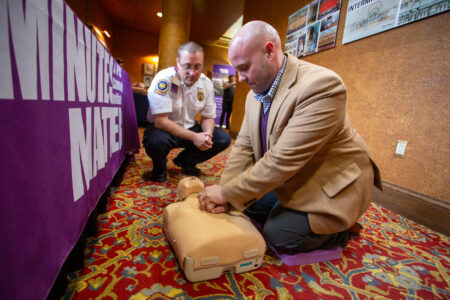
Recently, paramedics and emergency medical staff from UPMC interacted with regional elected officials unveiling an initiative called Minutes Matter inside the Capitol Lounge at the Community Arts Center in downtown Williamsport.
Williamsport Mayor Derek Slaughter; state Sen. Gene Yaw, R-Loyalsock; state Reps. Joe Hamm, R-Hepburn Township and Jamie Flick, R-South Williamsport, and their staff, were among the guests at the training session.
The paramedics and other UPMC staff provided the latest access to basic emergency information and education about life-saving interventions.
"We are out in the public all of the time," said Yaw, whose district covers five counties.
"How many know how to operate an automated external defibrillator?" he asked, explaining how this training and information can become critical for his staff and others in the public.
"It is not unusual to come upon a vehicle accident," Yaw said.
Paramedic Aleyah Walter showed Yaw's staff and others the importance of controlling an emergency bleed. Not only did the Stop the Bleed kit contain packing material that can be put into an open wound or pressed against a cut, but it had a tourniquet.
"Put the tourniquet high up on the extremity as possible," Walter said, demonstrating how the device could be wrapped around an arm or leg, for example, and then tightly strapped on and twisted. "It is going to cause the individual pain," she said.
Tony Bixby, director, Prehospital Services, UPMC in North Central Pa. and chief Susquehanna Regional EMS, demonstrated, along with other paramedics, how to use the nasal spray Narcan, which can reverse opioid overdoses.
This distribution of the life-saving spray is free of charge and is not harmful to an individual who might not be in an overdose, he said. Bixby went further by describing how individuals who come upon someone who might be suspected of having overdosed on a narcotic or opioid may manifest decreased respirations, might be turning blue and might be in respiratory or cardiac arrest.
A table for suicide prevention included paramedics explaining the preferred use of dialing 988, a nationwide hotline with mental health professionals who can speak to whoever called and direct that person or family and friends to outpatient resources if needed.
A new mobile device application PulsePoint offers information on where the closest AED might be in a public location such as a library and how to stop an emergency bleed.
Local businesses are becoming more aware of having basic emergency medical training and devices to save lives on hand.
Every minute matters when someone suffers a cardiac arrest and having access to an automated external defibrillator can make all the difference for survival.
Through a donation made by First Quality Enterprises LLC to UPMC and Susquehanna Health Foundation, 100 AEDs will be accessible in public spaces in communities across Lycoming and Clinton counties.
Any group, church or community resource can reach out to UPMC about these devices which can recognize whether an individual is in a heart arrhythmia and can provide an electric jolt if approved by the device reader to restart the pulse in event of a cardiac arrest or other cardiac emergency.
The American Heart Association says when cardiac arrest occurs in a public space, 90% of victims who receive a shock from an AED within the first minute, survive.