
Columnist’s search for ‘real life’ stories leads to talk with Israeli soldier
Trending
"My daughter, Kaila, went to Israel more than 10 years ago to study in a religious program called Mayanot," Clifford Rieders told the Sun-Gazette in an email. "After she completed her year with Mayanot, she asked to be drafted in the Israeli Army, since she had become a dual citizen. After some nagging on her part, the Israel Defense Forces drafted her. She served throughout the country, but mainly in the north."
Rieders, a Williamsport attorney who frequently writes op-ed columns for the Sun-Gazette, noted his daughter's service was not only during the time of ISIS infiltration into Israel, but also during one of the limited operations to try to restrain Hamas' continual rocket barrage. After her service, Kaila attended law school in Israel at a dual language law program, where she met her husband, who was also a law student.
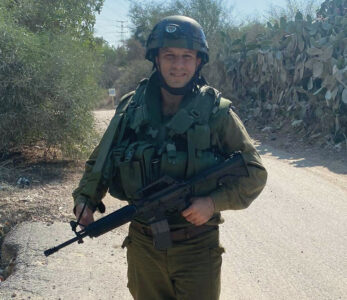
"One of my new son-in-law's friends turned out to be a young man from my own hometown, Great Neck," Rieders said. "Sam Emery was a fellow that my wife and I came to know well. We were always impressed with his thoughtfulness, commitment and seriousness about life. Sam also served in the Army, the Givati Brigade, one of Israel's top combat units. After the Army, Sam attended medical school in Israel and fulfilled his dream of becoming an internist."
On Oct. 7, Emery was called up by the Army, even though he had served as a combat soldier more than 10 years previously, Rieders said.
"I asked Sam whether he would let me interview him, since I knew that he would be straightforward, unadorned, and honest," Rieders said. "He immediately agreed. What follows is the story of a combat soldier, who became a doctor committed to saving lives. While much as been written of the horrors of October 7th and the cruel war of annihilation waged against the Jewish people, and Israel in particular, there are not as many stories about the real life experiences of people who have been in Gaza in the role assumed by Sam Emery."
THE INTERVIEW:
RIEDERS: I am trying to get into the head of a soldier who came to this county at age 18 and studied medicine; now you are in the infantry in the middle of a war. Can you tell me what battalion you were in previously, or what unit?
EMORY: I came to Israel when I was 18 and I studied in Yeshiva for about 2 years. then in my second year I decided to stay in Israel and make Aliyah and go into the Army. I went into the Givati Brigade, which is one of the main infantry brigades of the IDF. I went in with - first four months was a basic training, and then I had another 3 ½ months of intense training. And then I was about a half a year on the Gaza Strip, basically on the border. I went in the army in August 2009 until about, it was January 2011.
Tunnels
EMORY: one of the things that we had to keep in mind were tunnel, tunnels that Hamas dug from Gaza into Israel. Okay, just because you're covering the fence doesn't mean they were secure. Because we had to be ready for tunnels. There were terrorists that infiltrated on the 7th of October that we didn't find yet. we had to be ready for that situation, they're still around, they're still scattered, they're still in the wilderness. They could be 50 meters from us hiding in some forest. We did find them eventually. About 3 to 4 weeks of that. And that was our job, to secure the border.
Cameras
EMORY: That's their strategy. When we went into certain areas of Gaza, I remember when some of the guys that were with me, they would go into these houses or buildings and they would see a camera on the wall. Why was there a camera on the wall? Because underneath the ground in the tunnels they were looking through - the camera was coming into the house. When they would see somebody coming into the house, they had a camera, they obviously have a bomb in the house waiting for them whenever someone would come into the house. The way that they would know if someone was coming in was because there was a camera. We learned right away and it plays in as follows. When you see a camera, that's equivalent to a bomb, which is equivalent to a tunnel. So if I go into a house and we see a camera, that means there is a bomb waiting for us to be detonated very soon, they are just waiting to see us on the camera to detonate it. it also means there is probably a tunnel somewhere in this area. I don't know where, it could be the house next door, it could be underneath this house, could be in the room next door. We don't know.
Job of a Doctor
EMORY: We only went in about 2 weeks after the invasion started. And when the invasions first were started, they sent in all the younger guys, like the 18, 20 year olds, in their regular service, and on a daily basis unfortunately they were seeing casualties. There were sliders that were getting killed. And they put me in the area near the border in an area where all the wounded and even the soldiers that unfortunately were pretty much pronounced dead, came to this area and it was our job, as the doctors - I was one of the doctors - to treat the wounded or basically proclaim death, announce death on a soldier. If infiltrated on the 7th of October that we didn't find yet. we had to be ready for that situation, they're still around, they're still scattered, they're still in the wilderness. They could be 50 meters from us hiding in some forest. We did find them eventually. About 3 to 4 weeks of that. And that was our job, to secure the border.
Job of a Doctor
EMORY: We only went in about 2 weeks after the invasion started. And when the invasions first were started, they sent in all the younger guys, like the 18, 20 year olds, in their regular service, and on a daily basis unfortunately they were seeing casualties. There were sliders that were getting killed. And they put me in the area near the border in an area where all the wounded and even the soldiers that unfortunately were pretty much pronounced dead, came to this area and it was our job, as the doctors - I was one of the doctors - to treat the wounded or basically proclaim death, announce death on a soldier. If soldier was treated, we basically decided this soldier gets taken by helicopter to the center of the country or to one of the closer hospitals of the south. I unfortunately had to certify the death of three soldiers. That was very difficult for me, because as somebody who's internal medicine, I'm very used to - it's my job to certify death of, let's say, an 85-year-old woman with dementia, who died of pneumonia. But a 21-year-old boy who is killed in line and his chest is full of blood, and you know, his pupils are not dilating to light, are not reacting to light, excuse me, no pulse. The first time I had to do it, I got very emotional. It's very tough. That's something I was not ready for. Emotionally speaking.
Hamas Strategy
EMORY: Hamas, they were under the grounds. They tried every single opportunity that they could – what their strategy was, was basically to pop out of a hole in the ground when we were not looking and then take an RPG and shoot at one of our tanks - some of the guys in our tanks or a few guys walking in a certain area, and then jump right back into the hole. That was - that was their strategy. And we're not talking about like, you know, like D-Day, you know, like - imagine like, an army versus an army. No - it wasn't like that! this is - this is an army that is - that - like they are trying to take cheap shots when they can.
The Enemy
EMORY: The attitude is, is the enemy is Hamas. Hamas is bad news. So the enemy is not a woman who - a pregnant woman walking, the enemy is not an 8-year-old child, although who knows what their - who knows what education they are receiving. But anyway, the enemy is Hamas. If you see, the orders were strict that if you saw anyone, a male above the age of 20 years old, carrying a weapon, it's Hamas until proven otherwise. The orders were that, if we saw any male above the age of, let's say 18, carrying a weapon, it is our duty to assume that they are Hamas until proven otherwise. The orders were clear that - that Hamas is our enemy. Hamas, Hamas. Not Arabs, not Muslims, not Gazans; meaning Hamas, Hamas, Hamas.
For the Kibbutz
EMORY: At our second mission we conquered - if you look on a map, kibbutz Be'eri, directly across from the kibbutz there's a city in Gaza. And it's the city that Hamas terrorists came from on the 7th of October. We conquered that city. Our unit was first ones to conquer the city. And before we went on our mission, they took us to see the houses that were burned and the massacre that occurred there. and they basically showed us - they said before we go on this mission, just see what they did to this kibbutz. This is our way of giving back to them. We're doing it for the State of Israel, but we're also doing it for kibbutz Be'eri. Because we're going in and we're going to conquer the city where terrorists came from to destroy kibbutz Be'eri. When you go into the kibbutz you see the burned houses and you see - I remember seeing a cradle that was burned.
The Experience
- Passion for Israel
RIEDERS: How did the experience change you? Do you look at life more seriously or in a more dower fashion, or maybe even in a more positive, you know, more hopeful way? I'm just curious how it's affected you.
EMORY: It probably turned me into more of what I already am, became more passionate about the State of Israel, how we need to defend ourselves. And also, we can't rely on the world. We cannot - we can't rely on the world approval to do things. For example, this whole mission in Rafah that is coming up right now. There is a lot of talk about a mission coming up in Rafah. There are all these reports that Britain is going against us, that President Biden is going against us, and the world doesn't want us to go into Rafah, for whatever reason. And, it's like in the news they're portraying that we need world approval. No! We don't need the world's approval and the world, throughout Jewish history, has turned their back to us. And nothing is going to change this time around. For me, it's another history lesson, that we can't make decisions based on the world's approval, even if it's our allies such as the United States and England. we have to be strong. We need strong leaders. That's my mindset. I am 34 years old, I remember the second Lebanon war a bit. I remember the two huge ground invasions in 2008 and 2014, but this war was really the first time I felt that I was really part of something, that I got to really live - I got to live through it and I was able to be in this country and see for myself. So it made me more passionate about where the State of Israel needs to stand and how we need to act, and worry about ourselves. Again, not wait for world approval. That's my feeling. That's my impression.
The Hostages
RIEDERS: There is a certain sentiment you hear in this country - and I'll make this the last question - that, release the hostages at any price, even if it means releasing every Palestinian murderer in jail. What do you think about that? Is that a broad sentiment in Israel or in the army?
EMORY: There are a lot of opinions - I think everyone has a different opinion. I know some people are obviously against releasing terrorists for the civilians. Some people are for it. and I'll be honest with you, I can understand both sides. Because on one side, if we release terrorists to civilians, we're going to see a common enemy. You want something, just do it again. What's going to stop them from doing it again? If anything we're rewarding their behavior. But on the other side, the State of Israel told the citizens it's okay for them to live where they lived. And there was no problem for them to live there they lived. They lived within the borders of Israel. 5 There was 100% authority to live there, it was approved by the Israeli government. Not only that, even the party, the nova festival party, they were allowed to have a party where they partied. And it's the job of the Israeli government and the IDF to secure the border. To protect civilians. And on the morning of October 7th, they didn't perform their duties. They failed. The system failed. And the argument that a lot of people have is, the State of Israel and the IDF, more so the State of Israel, has to now pay the price for this massive error of trusting Hamas. And there is a difference, I would say the general attitude I'm hearing from people is the difference between a soldier and a civilian. It's the job of the IDF to protect the civilians. I think this topic of bringing back the hostages is a very, very sensitive topic. I really do understand both sides. I don't have all the answers. I pray that everyone comes back home as soon as possible. And I hope that the government makes proper decisions for what needs to be done to bring them back home.