
Remembering Iwo Jima: Marine from Sullivan County killed in action 80 years ago
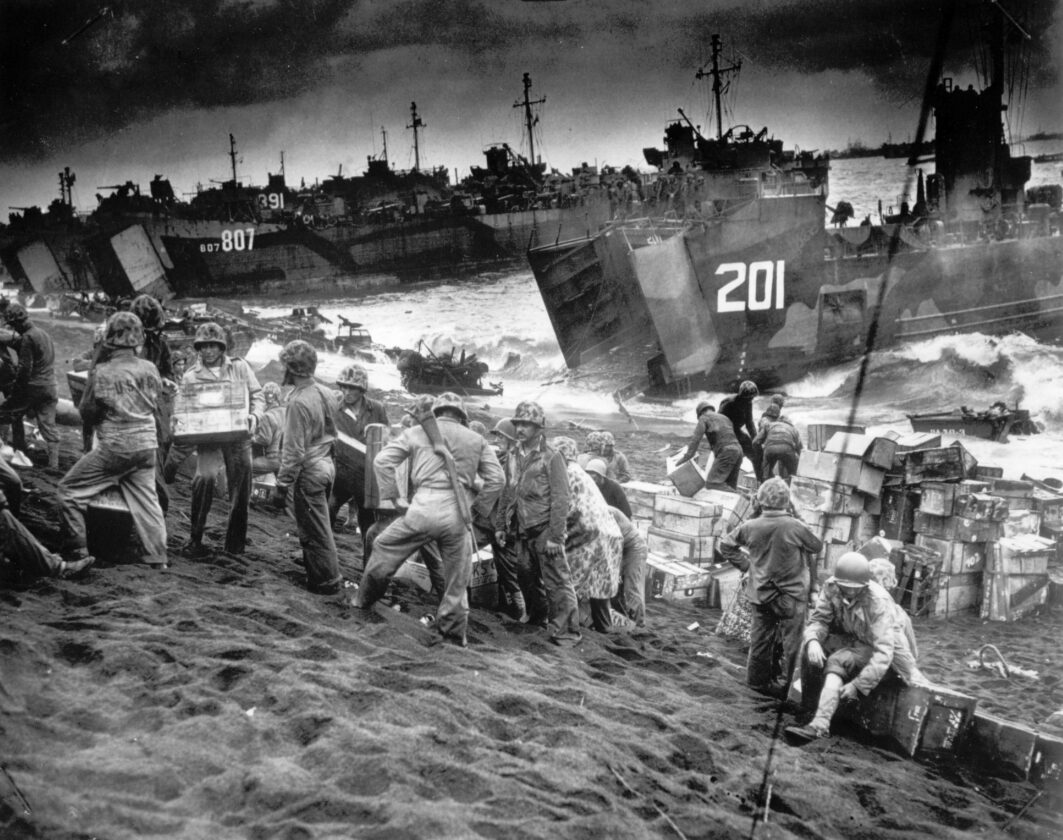
A few hours after the U.S. Marines gained a foothold on the island, war supplies are being unloaded from Coast Guard and U.S. Navy landing crafts onto the shore of Iwo Jima, in February 1945. (AP Photo)

A few hours after the U.S. Marines gained a foothold on the island, war supplies are being unloaded from Coast Guard and U.S. Navy landing crafts onto the shore of Iwo Jima, in February 1945. (AP Photo)
Trending
"No World War II battle represents the fighting spirit of the US Marine Corps better than Iwo Jima," according to a news release from Stories Behind the Stars. "In terms of its combat brutality and staggering casualties, it was the worst battle in the history of the Corps."
The Marines' 3rd, 4th and 5th Divisions led the assault of Iwo Jima with key support from the Army and Navy. Pacific Fleet Commander-in-Chief Admiral Chester W. Nimitz said that among America's fighters at Iwo Jima "uncommon valor was a common virtue."
The non-profit Stories Behind the Stars has written memorials about each of the 89 Pennsylvania Marines in the 4th Division who sacrificed their lives during the March portion of the battle's hostilities. Sullivan County was home to one of them: PFC Joseph Comiletti.
Comiletti was born on April 25, 1922 in Mildred to Romolo and Mary Comiletti. His parents were Italian immigrants who emigrated to the United States in 1921 and became naturalized American citizens. Comiletti had a younger brother, Albino, who served in the Army.
His father supported the Catholic household working as a coal miner and, later, as a laborer with the Works Progress Administration. Comiletti's formal education ended with the completion of two years of high school.
The lack of local employment opportunities resulted in Comiletti moving to Baltimore where he was hired by Lever Brothers. He registered for the draft in Baltimore on June 30, 1942, enlisted in the Marine Corps Reserves, and began active duty in Baltimore on Sept. 15, 1942.
Comiletti trained with the 5th Recruit Battalion and 7th Recruit Battalion at Parris Island, South Carolina, and with the 10th Separate Recruit Battalion at New River, North Carolina, through autumn 1942.
This was followed by his assignment for most of 1943 to Company H, 2nd Marine Battalion, 23rd Marine Regiment, 4th Marine Division at Camp Lejeune, North Carolina. By October 1943, Comiletti was serving in HQ Company, 2nd Marine Battalion, 25th Marine Regiment, 4th Marine Division at Camp Pendleton, California.
He deployed to the Pacific Theater of Operations and prepared for combat in Hawaii, according to the news release. Comiletti fought in the battle at Roi-Namur, Kwajalein Atoll in the Marshall Islands on Jan. 31, 1944, at the battle of Saipan from July 1-9, and in the battle at Tinian in the Marianas Islands from July 24 to July 31, 1944.
The 4th Marine Division's casualties at Saipan totaled 5,981 versus the death or capture of 28,000 Japanese military personnel on the island. The capture of Tinian came at a cost of 1,906 4th Division casualties.
"The resulting strategic control of the Marianas Islands isolated the enemy's bases and brought Japan's mainland within striking distance of US B-29 bombers," the news release said.
D-Day at Iwo Jima was Feb. 19, 1945. Allied military planners anticipated an "easy time" conquering the enemy, predicting victory in a three-day battle.
"The reality was a gruesome slog of 36 days from Feb. 19 to March 26, 1945, that historians have described as 'throwing human flesh against reinforced concrete,'" the news release said.
The island's determined Japanese defenders had the most ingenious and deadly fortress in military history. Their miles of interlocking subterranean hideouts, concrete bunkhouses and pillboxes proved to be some of the most impenetrable defenses encountered by the Marines.
The 4th division arrived off the island on Feb. 19 and commenced the assault. In the first two days, the division's losses already totaled 2,011.
By Feb. 26, Comilett's unit began working its way into the enemy's main defense line of prepared positions. For the next week, the 4th Division ground forward slowly, suffering bloody losses and engaging in the most savage type of close combat.
As of March 3, 1945, it had lost 6,591 troops. On March 6, the unit went over to the attack against die-hard Japanese defenders in the Minami pocket. The 4th Division's combat casualties rose to 8,094. On March 11, the 20th day after the landing, the 4th Division reached the ocean and overcame enemy resistance. On the division's right flank, the Japanese chose to make their last stand to exact as heavy a toll of Marines as they possibly could.
Comiletti was killed in action on March 1, 1945 during a combat mission at Iwo Jima.
"The ultimately victorious 36-day assault resulted in more than 26,000 American casualties, including 6,800 dead," the news release from Stories Behind the Stars said. "Iwo Jima was the only US Marine battle where American casualties exceeded those of the Japanese. Enemy combat deaths, however, numbered three times as many as American deaths."
Comiletti's remains were recovered and laid to rest at the National Memorial Cemetery of the Pacific (Punchbowl) in Honolulu, Hawaii, on Feb. 14, 1949
Stories Behind the Stars memorials are accessible for free on the internet and via smart phone app at gravesites and cenotaphs. The non-profit organization is dedicated to honoring all 421,000 fallen Americans from World War II, including 31,000 from Pennsylvania.
To volunteer or to get more information, contact Kathy Harmon at kharmon@storiesbehindthestars.org or visit www.storiesbehindthestars.org.