Sojourner Truth Ministries looks back on 25 years of serving the underserved
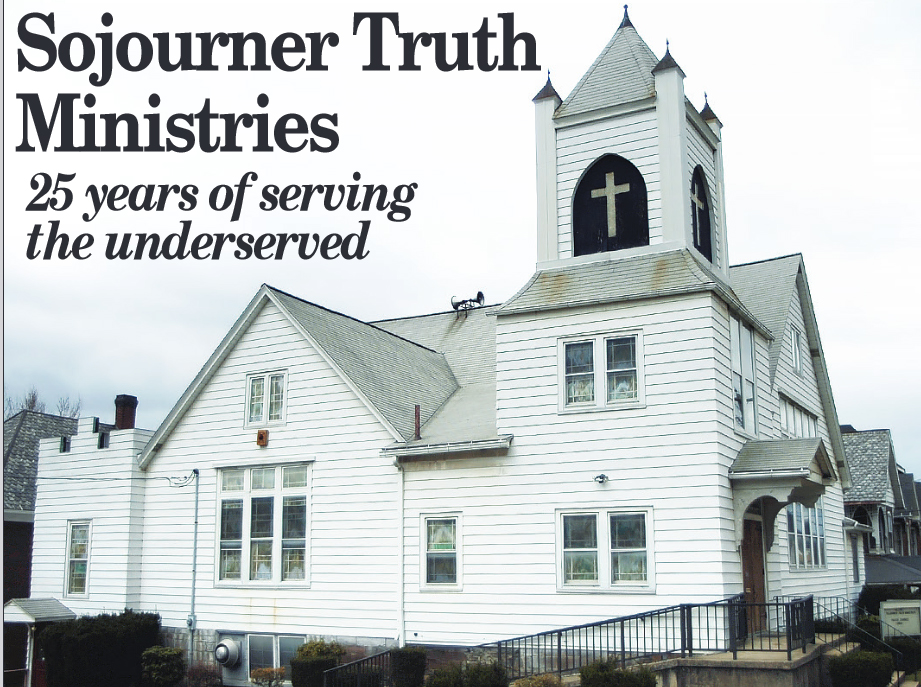
In the summer of 1998, several people with a shared concern for those in the community who were at risk of homelessness, morphed into a group called the Laity Empowerment Group-LEG for short-to see what they could do to help that underserved population..
“Today they would be called homeless. Then it was people who slept on the bridges and things of that sort,” said Dr. John Piper, a local historian and an informal member of LEG, due to the involvement of the church where he was pastor at that time.
“The category homeless was not as common then as it is today, I would say. But it was that sort of end of the spectrum,” he added.
At that time there was a ministry in the eastern end of the city, St. Anthony’s Center, which was run by Sister Henry Lambert, that offered meals and a health clinic for the underserved population in that part of town.
Even though the Civil Rights Act of 1964 had brought changes, segregation was still present in the country, and Williamsport was not an outlier in the way the city had divided along racial lines.
East from Market Street tended to be the “white side” of town and areas west of Market were predominately black, which was the focus of the group.
“This is the Black side of Market Street,” he said, as he sat in the boardroom at Sojourner Truth Ministries, 501 High Street, where he was sharing the history of Sojourner..
“The Black community began pretty much right around here and went west for about eight blocks. High Street was the northernmost point on it. The southernmost point was the old railroad bed, which is now Little League Boulevarde,” he said.
“That was pretty rigid,” he added.
On May 12 of that first year, the group met at Pine Street United Methodist Church and decided something needed to be done, Piper said.
Some of those members of that initial committee included, Ann Runnels, who is now pastor at St. Paul’s Calvary United Methodist Church in retirement; Pastor Bob Wallace, who was pastor at Third Street Church at the time; Norman Kaufman; and Kenneth Sterrett.
Sterrett, who was chosen chairman of the committee, approached the codes department in the city to discuss a site for what he called a sojourner’s church.
“So, they were actually thinking of these people as sojourners, travelers… without a home. Abraham was a sojourner, so it’s a very common theme in Judeo-Christian history, and they spent a lot of time at that initial meeting talking about whether a church building would be appropriate, because sojourners were turned off to churches,” he said.
They were thinking, “What if it was a church without walls,” Piper said.
What followed were prayer walk primarily in the western part of the city.
Although the group had decided that they did not want to build a church, they talked to the District Superintendent of the Methodist church who encouraged them to establish their project as a mission of the church through the Williamsport district. As a designated mission, opportunities for funding were opened up.
Piper explained what this meant for the emerging ministry.
“If you are a designated mission, you go to the churches and raise funds, you just can’t walk in off the street unless you know someone that’s willing to give you the platform. But if you become a district mission, then the superintendent has an office. He can advertise it, he can communicate it to all the pastors and churches, and there were a lot in the Williamsport Area-so that was a big deal,” Piper said.
Out of that came a decision to associate with a church in the area. The churches on High Street were right on the borderline between the eastern and western portions of the city.
Piper shared that the group was told they were welcome to meet at the church which is now Sojourner Truth Ministries home, just as the church was closing for financial reasons. The story is that the building was obtained for $1 for the newly created missional ministry.
“It’s one of those kinds of things-it’s great to get a gift…the reason that High Street was in financial difficulty is that everything needed to be fixed,” Piper said.
A board was created, containing clergy and laity, to try to find the funds to address the building’s issues, but ministry dollars were not easy to come by.
“It was a hand-to-mouth ministry — I mean, literally,” Piper shared.
Eventually churches, primarily Methodist, came on board as sponsors. Part of that commitment was that someone from the church would serve on the board. A director was hired with help from the Methodist district. Volunteers from churches performed various tasks at the building, although the custodians were paid what Piper called a “poverty wage.”
Over the years funding the mission has changed, too.
“We’ve been in existence long enough to attract some people with funds to name us in their wills, or churches give us money, with one church that closed, in Faxon, that gave us their mission funds,” Piper said.
“The board doesn’t know but that one gift alone…were more nickels than we had in the first five years,” he added.
Through the years, the directors at the mission have tended to be clergy with Pastor Angelique Labadie-Cihanowyz, currently serving that role.
From the beginning all services offered at Sojourner have been free to those who need them.
Both Piper and Labadie-Cihanowyz agree that one of the wisest things that Sojourner did was to become associated with the United Way.
“I became convinced on the board, and brought it up that if we wanted to get better known and accepted in the community, the United Way had a strong annual mission, fundraising, and we needed to get there,” Piper said.
Sojourner’s is not a church, it operates as a non-profit 501-C3.
“So, we’re independent, but a mission and so that’s to our advantage in different ways and it helped us to become part of the United Way,” he said.
The need at Sojourner has also increased over the years. Last year, they served 36,400 meals, that’s 6,000 more than the year before that and 15,000 more than two years ago.
“We have added brown bag lunches so people can take it to a neighbor or if they don’t have a next meal,” Labadie-Cihanowyz said.
It’s very hard to count how many people are served meals for the six days the mission is open because they have no way of knowing who is getting those brown bag meals.
“I know some are for shut-ins,” Labadie-Cihanowyz said.
“One person always brings an extra one to the bus station. You know, it’s just nice to neighbors. And I know several people bring them to another person that they know of who is, we’ll say, down and out. So several people do that. They’re looking after other people in the community. And, yeah, we don’t know,” she said.
The suspicion, they admitted, is that this is the only food that a lot of people get.
“Sadly, I have had people tell me, if it weren’t for this, you know, they may not qualify for food stamps; they may have just gotten out of incarceration…so many different things,” she said.
“There was one man I was trying to get to take something home and he said, ‘you know, I don’t want to take it away from anybody else, but, yeah, I won’t eat again until I come back here tomorrow,” she shared.
“So it’s hard to fathom here in Williamsport, where, you know, there are other places that also give a meal, for anybody to be hungry, I don’t know how it could happen, unless they’re just not connected with resources and just somehow don’t know,” she said.
There have never been requirements or guidelines that have to be met for people to qualify for meals at Sojourner’s. They have tried to have people sign in simply because, for one thing, they want to have statistics to report when applying for grants.
“Another reason that we’re doing it, though, is because we have so many people and a lot of new people, and I’m not gifted with remembering names, and so it’s a way we try and track back sometimes. Do you remember who that person is? What? What’s their name? Did they sign in,” she explained.
“And it helps us to have another kind of touch point with people, or if once in a while, people write their last names, and that helps if there’s a hospital visit needed or something, because I don’t get very far with a street name or a nickname or even a first name. So that’s some of the reasoning. But just trying to get a handle on, you know, trying to get to know people, because it matters. It matters if you come somewhere and people call you by name,” she added.
Every Saturday the tables are set up in what used to be the sanctuary of the church and “dinner table church” is held. Different churches and philanthropic organizations sign up to come in and often, according to Labadie-Cihanowyz they also offer to provide the meal so that the mission’s cook can have the day off.
“It gives them an opportunity to come and mix with people they may not otherwise get to meet,” she said.
“When you can come at things with multiple purposes, I think that has always been a very good steward of whatever your point is. So, we’re offering opportunities for our sojourners to meet and interact with new people. We are having food, some assistance with serving it and then the people who come to visit have opportunities to interact and often they’re very moved by their experience or they’ve connected with someone they might see, someone they knew in high school or things like that,” she explained.
Sojourner Truth Ministries also offers an after school program two days a week, with another day set aside for tutoring students who need extra help.
The children are provided with a meal, they get help with their homework and they have a bible storytime.
“Sometimes a lady brings her guitar. She’s like the pied piper,” Labadie-Cihanowyz said.
A few weeks before, a cellist visited along with a pianist.
“They got together and they played here for the children and literally had a children’s program-see if you can picture this animal in the music. Here’s how this works and here’s what these parts are called. And it was really neat. And they invited families to come for that,” she said.
Labadie-Cihanowyz has nothing but praise for the volunteers in the children’s program which she said were “nothing short of amazing.”
“I don’t know how they do it. All the children come from the neighborhood and situations I don’t know of intact families. Things are pretty hard for a lot of the kids…with two strikes already,” she said.
“These kids just need a chance and if they get that chance through education and coming to a place where it’s safe and there’s no conflict, or relatively low conflict when the kids get together. They fed and they’re loved on and they’re taught the love and hope of Jesus Christ. That’s wonderful,” she said.
Top News
City of Williamsport public works staff clean up dead tree from Third Avenue
Lawmaker optimistic about trip, manufacturing
‘Raise the Region’ nets $2.27 million
The First Community Foundation Partnership of Pennsylvania, in partnership with the Blaise Alexander Family ...
Williamsport Regional Airport Authority OKs control tower funds
BAYADA offers scholarship program to address nursing shortage