
Focus of Muncy Creek Township hearing on chicken farm plan turns to water issues
Trending
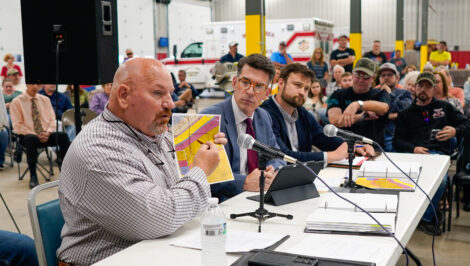
Once again, Muncy Area Volunteer Fire Department was packed with residents for a conditional-use hearing Thursday for a proposed massive chicken-raising and egg-producing farm in Muncy Creek Township.
Their primary concerns were potential ground water impact – in terms of draw and risk of possible contamination of their nearby wells and what long-term effects that operating five barns with a combined 350,000 free-range chickens might have on the water table.
The hearing was specifically for the township supervisors, two of whom will be eligible to vote as they received testimony for the chicken farm portion of the project.
The proposal before the supervisors is identified as Bollinger Solar LLC and is for a concentrated animal feeding operation (CAFO), a joint venture that would bring a solar panel array with 12 separate solar units, and the five barns, each housing 70,000 chickens, and their resulting eggs transported by trucks from the property.
The projects are owned by the Bollinger and Wagner families and would be named Sunny Side Up Farms LLC.
The township ordinance allows for CAFOs in the agriculture-conservation district. AgVentures of Lititz would operate the chicken farm with about five to six individuals, on average, daily.
A solar array-related hearing – that was continued previously – will take place at 6 p.m. Tuesday also at the fire station, while the chicken farm hearing testimony will continue at 6 p.m. June 26 at the fire station.
At Thursday's hearing, hydrologist Jason Sheasley, of Kimley-Horn and Associates, Camp Hill, testified as a witness on behalf of the applicant. Due to the time, he was the only witness for the client who spoke at the hearing. He went into detail about the bedrock and soil at the site and region, explaining how Bald Eagle Mountain came into existence. It was a quick "Geology 101" course, but also valuable for understanding the aspects of how the formations have water in aquifers, how fast it goes through and where it goes and the effect of layers of rock formations deep beneath the surface.
When asked questions outside his realm of expertise and purpose, Sheasley said he was "hired to identify locations for test wells."
He noted there could be either one or two wells on the site – depending on factors.
He said the land had four distinct geologic types: Sandstone, Marcellus Shale, Onondaga and Old Port.
Of most interest to the community, was an estimated "52 wells within a one mile radius of the site and 15 of those wells are in 'unconsolidated soils.'"
The closest residential well is about 100 feet from the proposed site, according to published information, he said.
For the layman, "unconsolidated" mineral or organic material is on the immediate surface of the planet and serves as a natural medium for the growth of land plants. Basically, above layers of bedrock is soil that contains such things as sand, gravel, silt and clay.
Sheasley also noted the water amount needed for the operation of the CAFO would be an estimated "17,500-gallons-of-water-per-day or 12-gallons-per-minute," a figure obtained at the Penn State Extension office. It is "within industry standards and will fluctuate potentially," he said.
Resident Harvey Stauffer asked Sheasley how many wells were planned for the farm. He was told that was "yet to be determined."
Concerns were expressed that should a mechanical failure of a well happen on a 90-degree day, and the public was told there may be a recommendation for backup water supply on the site.
Gary Phillips, a township supervisor who was asked to recuse himself from this matter, asked a question related to the 17,500 gallons per day. He asked if that was counted as water that might be used to cool down the birds on hot days.
Phillips told the Sun-Gazette previously he has been advised not to vote on the conditional use or land use or subdivision portions should it move to that stage of the development process.
A question arose about a potential for bird flu outbreak and what would occur. Sheasley said it was his understanding that the birds would be incinerated and not buried on site.
"Are you testing wells in the circumference of the proposed site?" Sheasley was asked.
Should private well owners near the site want to test their wells it could involve the owner not being able to use their wells for 72 hours prior to such tests, Sheasley said.
Layne Oden, a local attorney, said he would be willing to have his private well tested.
Sheasley indicated there would be aquifer performance tests that involve pumping a well at a specified rate and duration and measuring the amount of drawdown capable of sustained use. It can determine how fast groundwater moves through the aquifer. The connection between deep well and shallow wells will be part of the overall investigation, he said.
Dr. Steve Barrows, a family medical physician with a daughter who has asthma, said his primary concerns remain the health and safety of his patients and members of the community.
He asked questions such as whether the company would alert the community should a violation happen.
Nitrates are among the most common types of possible contamination along with fecal coliform bacteria and he also wondered if there were any plans by the company to monitor antibiotic resistant bacteria or E. coli. Previously, testimony indicated there would be a nutrient management plan.
"I did not prepare civil engineering plans for the project," Sheasley said.
Barrows further asked what attorney Samuel E. Wiser Jr., the counsel for the applicant, considered to be a hypothetical question regarding who would pay for the cost of well abandonment should there be contamination and, if there is no bond, would the community be saddled with the cost of cleanup of a possible Superfund-declared site.
Superfund sites allow the United States Environmental Protection Agency to clean up contaminated sites. It also forces the parties responsible for the contamination to either perform cleanups or reimburse the government for EPA-led cleanup work.
"I was hired to identify locations for wells," Sheasley replied. "I was not hired for plans for well head protection."
Rose Trevouledes, a registered dietitian and nutritionist, asked Sheasley if there were any studies related to cancer, lymphoma and association of these diseases that were specific to CAFOs and impacts of their operations on ground water supplies.
The project is strongly opposed by members of the Muncy Area Neighborhood Preservation Coalition. Many of those in this alliance have created hand-made, colorful Burma Shave-type signs they have placed on their properties.
There are about 300 private homes and some businesses in the general area of the site. Ward L. Myers Elementary School, in the Muncy School District, is located a quarter of a mile from the proposed farm.
The coalition leadership said it will be presenting its own experts in hydrogeology and civil engineering in the future.