Williamsport remains focused on blight remediation
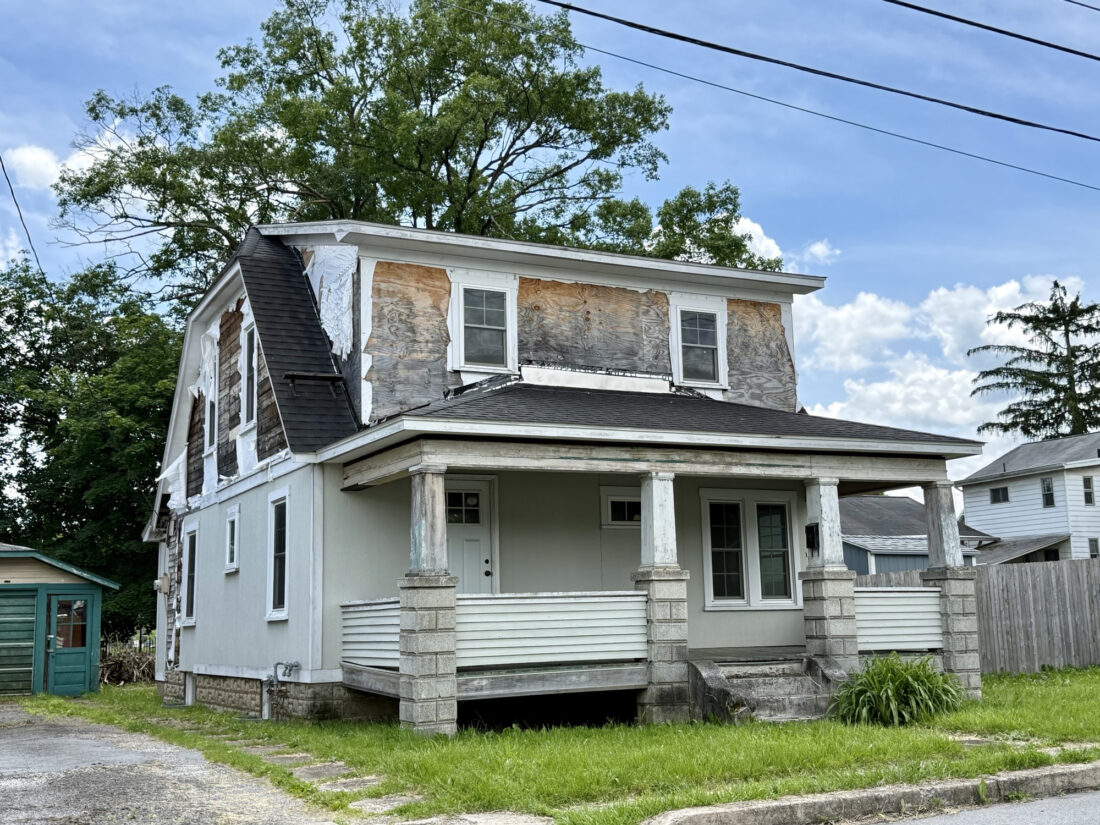
“We’ve been laser focused on blight remediation, blight elimination.”
That’s what Mayor Derek Slaughter recently told the Sun-Gazette in a video interview with the city administrative team where he addressed questions on a variety of city projects and services. The blight remediation effort is ongoing and is across the board, starting with residential properties and covering commercial/industrial blighted properties.
The administration and City Council initially allocated $2 million to the Williamsport Redevelopment Authority/Land Bank, he said.
That money came from the American Rescue Plan Act (ARPA) out of COVID-19 pandemic relief for cities and communities. The city was awarded $25.4 million in ARPA funds. The money for the RDA/Land Bank is to start to address the city’s blighted structures with the first residential “redo” done recently on Mosser Avenue, formerly a fire-damaged structure.
“I believe that was recently sold, which is exciting,” Slaughter said. “Not only does it address blight, and, again, positively impact the neighborhood – because we know if we take the worst of the worst properties in the neighborhood and fix that it transforms the whole neighborhood, but it also gets these properties back (to) owner-occupied, back on the tax rolls, quality of life, public safety all of the things we’ve been talking about.
The Redevelopment Authority/Land Bank is also working on a property next to First Church on Market Street on a home there that was recently demolished, he noted.
“Again, look at going to sell that parcel,” he said.
Across from the YMCA on Park Avenue was a home that had a hole in the roof for many, many years, and the authority had that demolished and that will have a single-family home on the parcel this summer.
“Then, that home will go up for sale,” Slaughter said.
It is a process of taking blighted properties, flipping them and putting them back onto the market and back onto the tax rolls, he said.
Additionally, there are a few other properties throughout the city that the authority is looking to address as city officials continue to look toward blight remediation.
“We’ve also been discussing with the Redevelopment Authority about some larger projects,” Slaughter said. That is because with this initial seed money being part of the American Rescue Plan dollars it has to be expended by December of 2026, he remarked.
“We’re confident that the Redevelopment Authority will be able to do that, but if they get a few larger projects then we can definitely ensure that that money will be spent by then,” he said.
The larger projects – such as commercial/industrial blighted properties – were a topic of discussion with council recently.
“What really will end up happening is it is just going to be a revolving loan in a sense,” Slaughter said.
“So the authority addresses the blight, whether it is rehabilitation or demolition, get a single-family home back on it, or sell the parcel to a developer and then that money comes back into the Redevelopment Authority and then this process just continues on that we can continue to address the blight throughout the city.”
Only the initial money has to be spent by December of 2026, he said. Once the money comes back in, from the sale of the property, then there are no strings attached to that money, he added. “It doesn’t have to be spent by a certain amount of time,” he said.
The effort now is to get everyone involved on the same page, from the Bureau of Codes, to the city Blighted Property Review Committee to the Redevelopment Authority, to make sure it is a priority – “which we now have done,” Slaughter said.
“We are excited, we are really excited to look at the blight throughout the city and start to work across the board to get our neighborhoods revitalized, vibrant, rejuvenated.
“I get calls all of the time of one house in the neighborhood that has been like that for 20 years,” he said. When the rehab happened at Mosser Avenue the neighbors, he said, were just “ecstatic.”
“It literally changed the feel,” he said. “One property can change the feel of the whole neighborhood.”
“We’ve started to do that across the city and we’re really going to make some good progress that we’re very much looking forward to and I know our residents in the neighborhoods are as well.”
There is a large commercial/industrial property, that the city is not ready to speak about publicly, that is being explored for potential blight remediation.
“There are others as well,” he said.
“I know some businesses next to some vacant commercial and industrial properties who have reached out to us asking about that (what can be done about the blight) and the answer is – ‘Yes,'” he said.
“Absolutely, I think over the next couple of months and years we are going to see many positive changes,” he said of residential, commercial and industrial properties blight remediation and elimination.
Top News
Yaw bill targets rural mental health care shortage by allowing psychologists to prescribe
Lawmaker serves role in managing opioid trust
Ludo the courthouse dog gets back to work
City of Williamsport OKs contract for interim consulting
The City of Williamsport has hired a familiar face for its financial consulting needs, a leader in her field at a ...
Opera House a community jewel in early 1900s