
Trash talk: An inside look at Lycoming County landfill operations
Trending
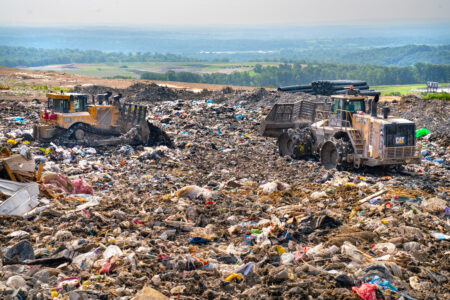
There's a certain horrific majesty a tour of the county's landfill inspires. The horror of a huge mountain that has been created by things that humans have discarded versus the finely-tuned plan that has been put in place to sort through and organize those things that can be recycled to a new life and used again.
The Lycoming County Resources Management Services operates the landfill on a site off of Route 15 and a transfer station in Williamsport. The entire property owned at the Brady Township site is 1,067 acres, although the actual landfill is about 110 acres and is operated by Lycoming County according to a Solid Waste Plan for a five-county region in the center of the state.
"We take waste from Union County, Snyder County, Columbia County, and Montour County. We also get waste out of Northumberland County and even some surrounding counties outside of that region. We average about 1,200 tons of waste per day. And we also operate a single stream recycling facility," Donald F. Hassenplug Jr., Customer & Material Resource Specialist, told a group from the Eagle Grange who were touring the facility.
Waste that is accepted at the landfill includes municipal waste, which is what is thrown away from homes; residual waste that comes from industries and factories; and sewage sludge. All have to be reviewed and approved.
Touring the landfill with a group from the Eagle Grange which included local people and some who had travelled to the area from across the country, it became apparent from their questions that not every place has a landfill equal to the scope of the one operated by the county. They also do not have a facility that incorporates various recycling opportunities like the one here.
The tour began with a short history of the landfill, which has been in operation since 1978. It's hard not to look at the manmade mountain created during those 47 years and just imagine where all the waste would have ended up in the past.
Although the landfill now has a 110 acre footprint, that was created in fields or cells of about 10 acres at a time. The landfill is currently in its 12th field.
On this particular day, the sun was shining and the skies were a brilliant blue. There was a strong breeze and while some of the Canada geese, which live at the landfill, were sunning themselves on the grassy slopes, others were flying by.
It was a positively pastoral scene only marred by the garbage haulers that drove past on their way to the summit. By the end of the day, whatever they had transported there would be covered with dirt by the earth-moving equipment stationed at the top.
To the left of the road is the leachate lagoon. Leachate is the liquid that is created by rotting organic materials or what Hassenplug called "garbage juice." .
"One of the major threats that a landfill poses to the environment is contamination of the groundwater. So our landfill sits first on a clay line and then on the clay liner is an engineered composite liner system," Hassenplug said, explaining that it's all done to protect the groundwater," he said.
"So when we place the waste and it rains, we try to shed as much water off the landfill as possible. We keep our slope graded properly...because we want the rain water to shed off as surface water and then into a stream or some sort of waterway as clean, fresh water," he explained.
But any water that makes its way down through the trash, think of it like coffee. You start off with nice, clean water, coffee grinds and you get black coffee. It's the same here. Water that infiltrates the landfill makes its way down through the trash and then it's collected on our liner systems. The landfill is engineered with a series of sumps and pumps so that we can actually pull that leachate out," he said.
The leachate storage lagoon can hold one million gallons of the liquid. Through aeration at the lagoon, the biological natural process to treat the water begins.
"We actually pump to one of two wastewater treatment plants where they do final treatment and then discharge the leachate into the Susquehanna River, once it's treated with municipal wastewater, so water that gets flushed down the toilet," he said.
All systems feature a double liner, including the leachate pond. If anything percolates through the primary liner it goes into what they call the detection zone where there is a pump and level measurements and flow meters, so that they know if there's a leak. Even the pipes that carry the leachate are double-walled.
"If we were to have a leaking landfill, we would know that we have our primary liner leaking into our secondary liner," Hassenplug said.
"That doesn't mean that it's leaking into the ground because we still have about a two foot layer of clay that is a good natural barrier to the groundwater," he added.
On the way to the summit, the tour passes by the oldest part of the landfill, some which has already been capped.
"If you dug down about two feet, you would find a plastic liner just like the landfill sits on, to close off some of the older sections," he explained.
The closure process also includes placing clay and topsoil and then growing grass on top of that. In this way, the water can no longer infiltrate the landfill, so less leachate will form. It will run off as surface water.
A certain amount of moisture however, is needed to break down the trash that's basically been buried.
The landfill is not just a repository of trash, it is also in the business of reusing and repurposing, offering single stream recycling.
"The facility is designed to have different materials coming in," said Lauren Strausser, Recycling Coordinator.
They have paper products, such as cardboard, mixed paper and shredded office paper.They also have plastic bottles and metal cans coming through the line at the facility. They also have a pile of wooden pallets that are periodically ground into mulch.
"What we do see a lot of is what we call wishful recycling," she said. Those are the things that people just throw in the recycling bins that are not actually acceptable materials.
"It's actually pretty harmful to make its way through," she explained.
Different materials go through the separation process, using the latest techniques.
Some things, like heavy materials-plastics, metal, glass-are sorted out through optical flotation.
"It's a band of light. The conveyor light going underneath identifies the type of plastic. Plastic number one, the soda bottles, is very clear, very opaque. That goes through in a different way that it would for a milk jug or a laundry detergent bottle. So, it's identifying each plastic," Strausser said.
Gary Staggert, deputy director, operations manager and interim director at the landfill, was also on the tour. Staggert, whose father also worked at the landfill, shared that at one point they had dug down after one of the earlier fields had been closed and had unearthed pages from a newspaper that were still readable.
"You had to be careful, but it looked like it was just put there the day before," Staggert said.
Tours of the landfill are open to groups and can be scheduled by contacting their office.