Former NBA player urges area students to rethink choices
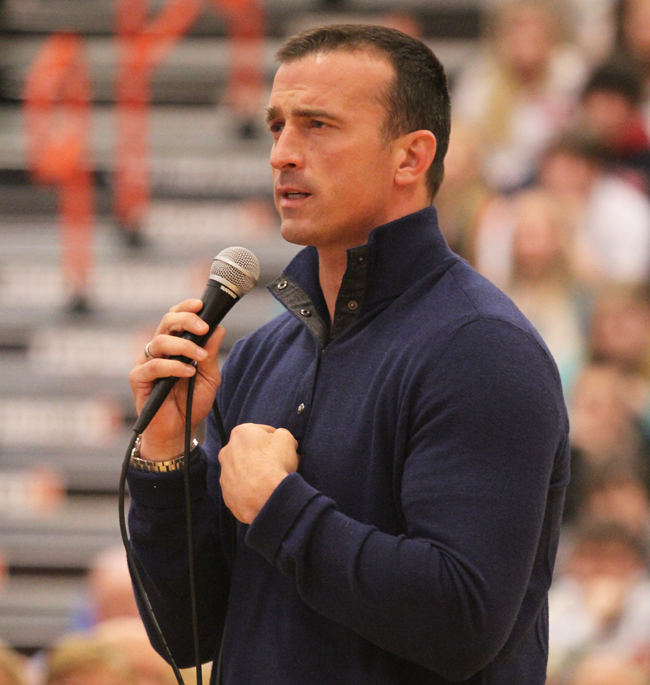
Muncy High School’s students probably are not much different than those in B.M.C. Durfee High School in Fall River, Massachusetts.
Durfee is where Chris Herren, 50, of Portsmouth, Rhode Island, attended and became the highest scoring basketball player in its history.
Herren went on to play for Boston College, Fresno State and was drafted into the NBA — playing for the Denver Nuggets and then Boston Celtics. He also played for several leagues overseas.
Sounds awesome, right?
“I wanted to shut the noise off,” Herren said, in an assembly before 9th to 12th graders Thursday at Muncy High School auditorium.
It was the reason why he said he turned to substance use as a teenager at home living with an alcoholic father.
“Eighth grade, ninth grade, I just wanted to get away and forget about who I was living with,” he said.
Herren was hoping he was reaching someone – a kid that had a hidden metal pipe or vape in his or her pocket, or who was planning to go to the beer keg party over the weekend.
“Ask yourself — why at 16 am I jumping into that world?”
“Why would I constantly even mess with that stuff?” he asked. “At the very least, understand why.” “Look within yourself,” he said. “Look around at the kind of people you are spending your time with.”
Herren has been visiting with students in 18 school districts in the region over the past two weeks showing them the perils of reaching the pinnacle of athletic success and living a lie. The speaking engagements were sponsored by Journey Bank.
“My why? My home was a total disaster zone,” he said.
In the presentation inside the home of the Muncy Indians, students and staff first watched a 20-minute video depicting clips of his achievements at every level — high school, college and professional — all while hiding a secret addiction to drugs and alcohol that later manifested itself for the nation to see.
Besides the accolades Herren received by writers in the Boston Globe, Sports Illustrated and Rolling Stone magazine, the press also covered his rollercoaster ride of drug use, becoming scorned by those in his community, seeking out rehabilitation, recovery and going on to become a motivational speaker with a foundation.
To Herren, catching the poor choices early is what matters most.
“I believe my alcohol use, my marijuana use picked up right before sports influenced that,” he said, to a student’s question.
He wished he had somebody earlier in his life to be there, hug him, talk to him, and ask him – why?
“If that little boy makes that decision, I’m going to hug him, man,” he said. “I am going to remind him how much he means to me. How much I love him and I am going to ask him one question – will you please just tell me why, buddy”
Herren was beloved. Adored by his classmates, coaches and community of Fall River, Massachusetts, where basketball is king and the Celtics are legendary. Herren was the central figure in a book about Durfee High basketball titled Fall River Dreams.
While Herren finished his career at Durfee High with a total of 2,073 points, the most career points in school history, and as he was named to the McDonald’s All-America Team, his life spiraled out of control.
After turning down offers from the University of Kentucky and Duke University to play at Boston College, before playing a game, he failed a drug test for marijuana and cocaine use.
On Nov. 25, 1994, after scoring 14 points, he broke his wrist and was ruled out for the season.
Within three months of his injury, Herren failed two more drug tests for marijuana and cocaine use, and was expelled from the team and the college.
But he was among the nation’s elite point guards.
Upon transfer to Fresno State to play ball for coach Jerry Tarkanian, known for gnawing on towels during games, winning seasons, and mentoring players, Herren was hailed nationally for his abilities.
It really did not matter because he failed another drug test.
After his senior year at Fresno State, Herren entered the NBA draft and was selected by the Denver Nuggets.
He then had a chance to realize a childhood dream of playing for the Boston Celtics.
Herren became emotional with the Muncy students as he spoke about the day he was selected to play for the storied Celtics.
On the stage before the media he said he actually was “drug sick” and only wanting to heal his aching body by finding his drug dealer.
The following year, while playing for Boston, he said he started to use painkillers such as OxyContin.
In December, 2004, clips the students watched showed Herren was charged with possession of heroin after passing out in the drive through of a Dunkin’ Donuts in Portsmouth, Rhode Island.
In June 2008, in Fall River, he overdosed on heroin and crashed the vehicle into a utility pole. Paramedics told him he was dead for 30 seconds.
Part of his presentation was about his intensive rehabilitation and how he’s been drug-free since Aug. 1, 2008.
In June 2009, Herren launched Hoop Dreams, a basketball player development company to mentor players on and off the court.
Herren penned a book with Providence Journal columnist Bill Reynolds titled Basketball Junkie: A Memoir. It was released May 11, 2011.
In 2011, ESPN aired a documentary, Unguarded, based on Herren’s basketball career and drug-related issues. The documentary was nominated for two Emmy’s: Outstanding Sports Documentary and Outstanding Editing.
In 2011, Herren founded the nonprofit Herren Project. In 2018, he founded Herren Wellness, a residential drug rehabilitation and treatment center.
For the Indians listening, Herren discussed how he overcame addiction through his faith in God and family.
Raised Catholic, his late mother, Cynthia, urged him to serve as an altar boy in the church.
During the presentation Herren could be seen frequently using his fingers on his chest in the sign of the cross.
He frequently would collect his thoughts, stopping briefly, as she shared his devotion to his mother. He was not going to be the father that he had.
“For the last 18 years I’ve been a dad I wish I had as a kid,” he said, choking up with emotion.
He and his wife, Heather, have three children, including Chris Jr., who also played basketball for Boston College.
“I waited until I was 32 years old to stop running away from myself,” he said. “I want to say to you guys it’s hard to put into words what this means to me . . . I want to say I have never felt so supported coming into a community to do these types of events,” he said of his two week stay in this part of Pennsylvania.
“I will walk out of here praying to God that maybe there is one kid, one adult who might be impacted by this,” he said.
Besides the warning about that first wrong choice to use drugs and/ or alcohol, Herren touched students who were seeking to bolster their self-esteem and make the right decisions through life.
Also part of the presentation was how he can use his experience to instill confidence and self-esteem in the broken-hearted and those with unshared pain. He told of once connecting with a girl who raised her hand during one of his talks.
That young woman, he later found out, was so distraught that she would cut herself from emotional trauma.
Among Herren’s reasons for speaking to students is to connect to anyone who might be thinking they are worthless, just like the girl who had the courage to raise her hand, who has since stayed in touch and thanked him for sharing his story that changed her life.
During a question period, a student raised a hand and revealed something to Herren and others in the room. It was a touching moment, as Herren thanked the student for having courage and gave a returned high five.
“This assembly doesn’t end when I leave, it’s an opportunity to kind of look within yourself, and look at the kind of people you are spending your time with,” Herren said.
For those with Journey Bank, which had some of its employees at the assemblies, it was a powerful message and means of the bankers and bank community to do its outreach in the region.
“I think as a bank we would all agree that we’ve done a lot of things that benefit the community outreach over the years, but this is as powerful as anything that we do,” said Lance Diehl, President and CEO, Journey Bank. “If we can help and or save one kid it makes this all worthwhile. Chris gives a great message and there is nobody who is immune from this situation,” Diehl said. “We all today know somebody, whether it’s family, friends or neighbors, who are confronted with these challenges.”
Ultimately, he’s won the biggest game – clean and sober, with a wonderful family, and a career that includes teaching basketball skills, mentoring youths, and motivational speaking.
“Don’t look at the drug addict at the end,” Diehl said of what he got out of the message.
“Let’s figure out where it started and why it started,” he said. “I think that is a very important message.”
“We attended 18 school districts over a two week period with Chris,” Diehl said. “We just feel like it is a responsibility that we have,” he said.
“Our communities make us successful so we want to give back to them in areas where we can help, so this is an area where we can do that.”
Top News

Clinton County’s Piper Museum announces expansion project
Coalition to host viewing of documentary
The Muncy Area Neighborhood Preservation Coalition and the Tarquinio family are presenting the documentary, ...
Lycoming County names new director of public safety

Geisinger Cancer Center in Lewisburg taking shape
Lawmaker on first-responder funding: Not ‘enough’
Gov. Josh Shapiro proposes an additional $30 million for fire and EMS in his budget and a state lawmaker thinks it ...