Looking back 30 years after the 1996 flood
-
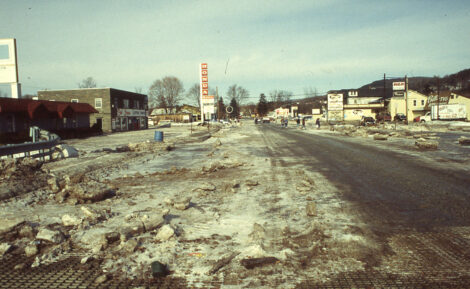
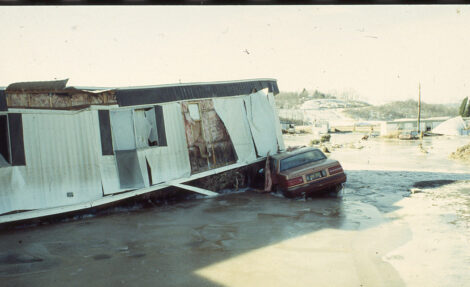
- SUN-GAZETTE FILES The Winter Flood of 1996 caught many people off guard. Who would have thought that, after watching 4 feet of snow pile up by mid-January, that the temperature would spike and 4 inches of new rain would fall to create one of the most significant floods in Lycoming County history? In top photo, firefighters and others search through flood debris. In the days that followed the flood, hundreds of people were listed as unaccounted for. The search was officially called off when the last missing person was confirmed as found.
-
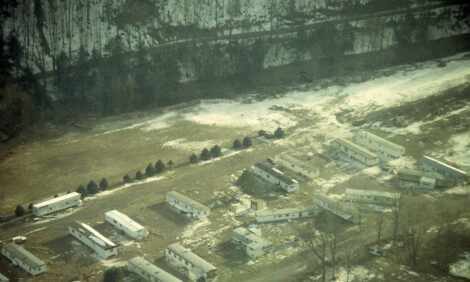
- SUN-GAZETTE FILES The Winter Flood of 1996 caught many people off guard. Who would have thought that, after watching 4 feet of snow pile up by mid-January, that the temperature would spike and 4 inches of new rain would fall to create one of the most significant floods in Lycoming County history? In top photo, firefighters and others search through flood debris. In the days that followed the flood, hundreds of people were listed as unaccounted for. The search was officially called off when the last missing person was confirmed as found.
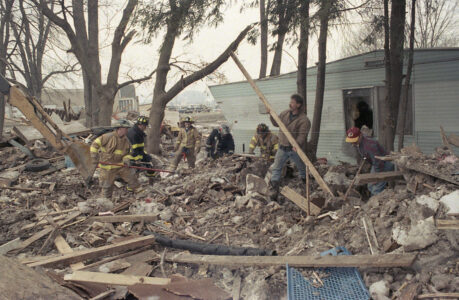
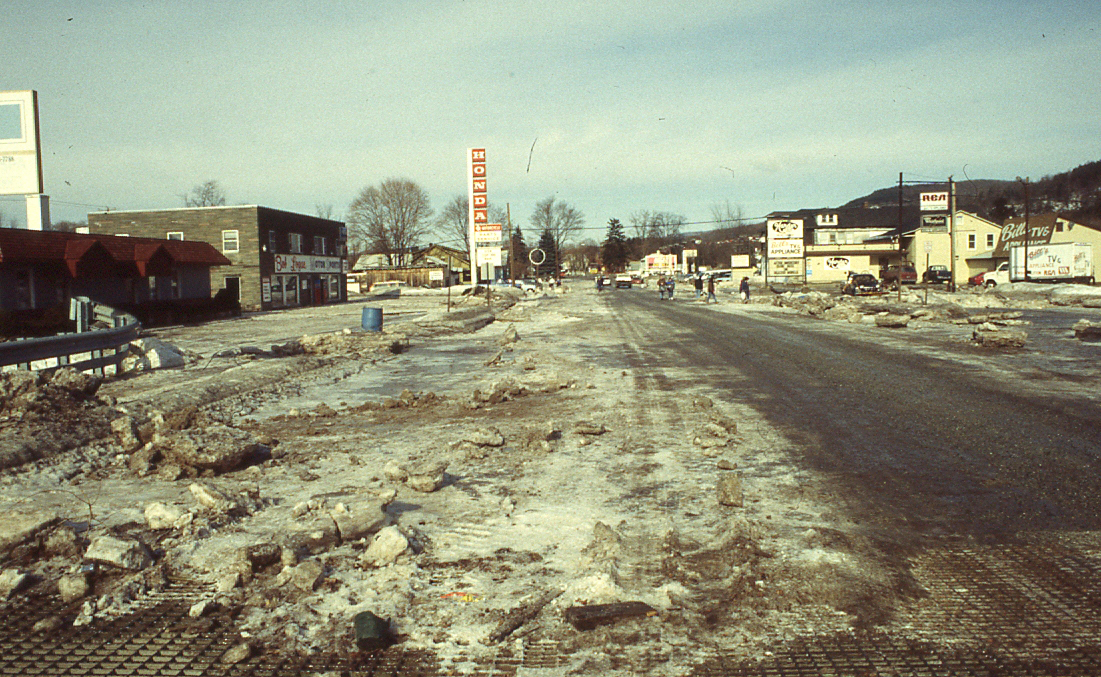
SUN-GAZETTE FILES The Winter Flood of 1996 caught many people off guard. Who would have thought that, after watching 4 feet of snow pile up by mid-January, that the temperature would spike and 4 inches of new rain would fall to create one of the most significant floods in Lycoming County history? In top photo, firefighters and others search through flood debris. In the days that followed the flood, hundreds of people were listed as unaccounted for. The search was officially called off when the last missing person was confirmed as found.
Thirty years ago this week, the state experienced a whiplash of weather conditions that resulted in catastrophic flooding across the region.
The area had already experienced an above average snowfall, seeing 69.1 inches total recorded in Williamsport from November through January, more than double the average for the same time period.
Then, between Jan. 6 and 8, came a powerful nor’easter, often referred to as the “blizzard of 1996,” that blanketed the area in an estimated four feet of snow.
That monster storm was followed less than two weeks later by a warm up that raised temperatures to to 55 degrees by Jan. 19.
The rising temperatures were accompanied by strong, southerly winds and more than three inches of rainfall in 24 hours in the Williamsport area, according to accuweather.com.
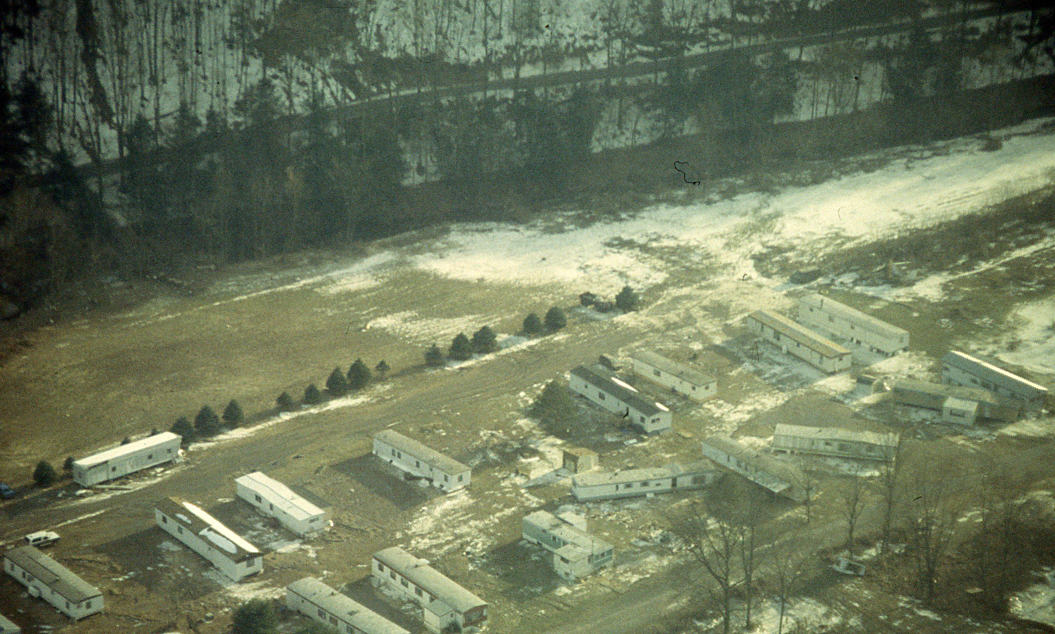
SUN-GAZETTE FILES The Winter Flood of 1996 caught many people off guard. Who would have thought that, after watching 4 feet of snow pile up by mid-January, that the temperature would spike and 4 inches of new rain would fall to create one of the most significant floods in Lycoming County history? In top photo, firefighters and others search through flood debris. In the days that followed the flood, hundreds of people were listed as unaccounted for. The search was officially called off when the last missing person was confirmed as found.
This confluence of factors led to conditions favorable for the melting of 40 inches of snowpack, causing massive amounts of runoff to enter the rivers and streams, pushing them over their banks.
For first responders in Old Lycoming Township, one of the hardest hit areas, the memory remains vivid.
“I remember that morning walking my dog and seeing all the snow on the roof of my house gone. I’d never seen snow melt that fast,” said Joe Hopple, then-EMS platoon chief for Susquehanna Health, and a volunteer fire captain at Old Lycoming Township Volunteer Fire Company.
“I was off that day, so I went into the station, and Joe Bertin, who was the Old Lycoming Township EMA coordinator at the time, and I heard that there was water in Ralston’s fire station. Joe looked at all of us and said, ‘we’re in for it,” Hopple said.
Burton’s concerns were well placed, as the fire station had been built above the water-levels reached by the 1972 flood caused by Hurricane Agnes.
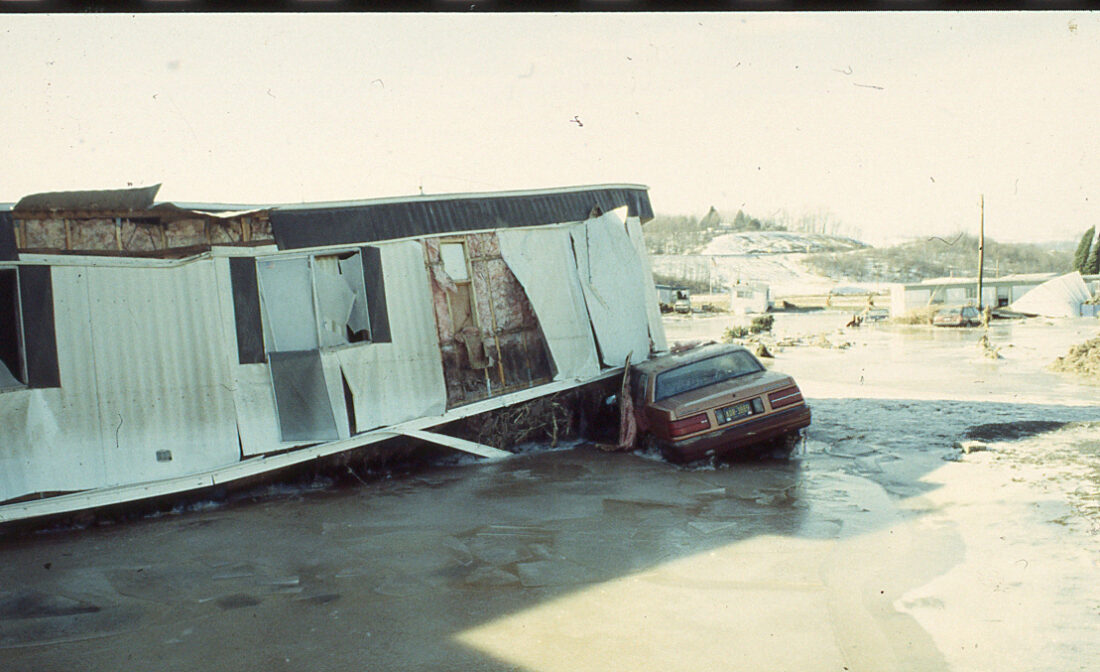
“It was one of the most devastating floods in this area, and I know for Lycoming Township, it certainly was,” said Tim Shumbat, who was Deputy Chief of the Old Lycoming Fire Company at the time.
Shumbat, who was also a manager in the paramedic department at Williamsport Hospital, was at work that day but left when his fire department was dispatched to Zuni Lane.
“There’s a trailer court up there at the top of Mahaffey Lane, and it floods frequently, and it sounded like they were having difficulty up there. It wasn’t the normal circumstance,” he said, adding the flooding came on with very little warning.
“When I got there, a number of the homeowners and residents were trapped in their homes, so we ended up calling for some boats,” Shumbat explained.
Help came from as far away as Woodward Township, who provided a hovercraft, with crews working for several hours to evacuate the trailer court.
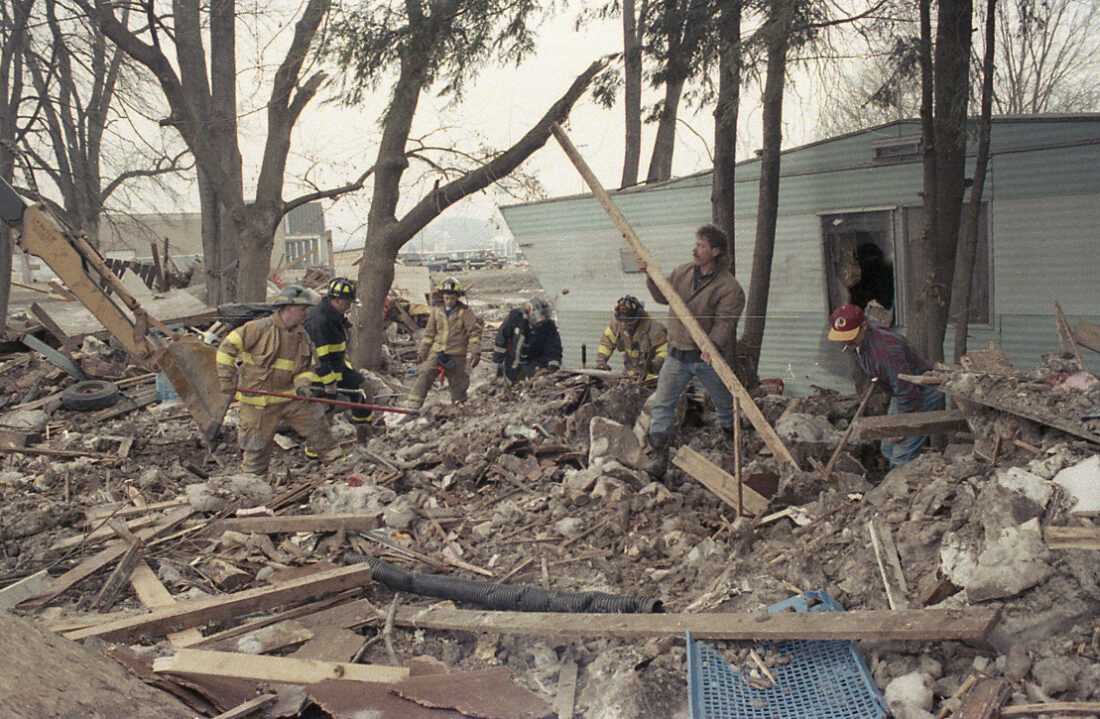
As those rescues continued, Hopple remembers hearing a call from a stranded medic unit at the high point of Route 14.
“It was safe, but it was trapped because there were flood waters to the north and south. And on our hospital frequency, I heard the on-duty platoon chief asked for help. He was up north, and I was one of the only ones that could hear him,” he said.
As the scope of the flooding became more apparent, an emergency operations center was set up at the fire station.
Despite pleas from fire and police officials for those in their coverage area to flee, many people ignored the warnings to evacuate, frustrating efforts even more.
Much of the department’s manpower was sent to the northern tier of their coverage area, including Beautys Run Road and the current Bimbo Bakery, where some people were trapped within the building.
“We had to do rescues up there because the water came down so fast,” he said.
“A lot of our effort was spent in front end loaders, rescuing people in that section that’s behind the Trail Inn, which really wasn’t our responsibility, but there were people that needed to be rescued,” Shumbat said.
“In fact, then-Mayor Capelli, came up to Old Lycoming’s fire station, and asked, ‘what do you folks need,’ and the guy that was operating our radio said, ‘we need every front end loader you have, so the city sent front end loaders up to us,” Hopple said.
As conditions deteriorated further, former Lycoming County Sheriff Mark Lusk, who was a corporal with the Old Lycoming Township police department at the time, put out a call to the Army National Guard, who sent Chinook helicopters, some of which were staffed by paramedics and fire crews from other areas.
“They had winches, and lowered them down to lift people off of houses,” Shumbat said.
Old Lycoming firefighter Rick Strauss, an employee of the former Stroehmann Bakery led half a dozen coworkers to the roof, where they were rescued by helicopter, Shumbat said.
“The helicopters kind of hovered over and put their ramp down, and they was able to climb up and get off of the roof,” Shumbat said.
“While he was on the roof, a car along Beauty’s Run Road washed up against the building, and the guy in the car had to climb out and get on some sort of vent that was outside there, and the state police helicopter dropped a rope down to him,” Shumbat said.
Strauss told Shumbat he and the others thought the building was in danger of collapse.
“He said there were logs and all kinds of things hitting the side of the building. They thought it was gonna knock a hole in the wall and the building would collapse,” Shumbat said.
“It was so widespread in our township, it hit more residential and commercial buildings than any previous floods had hit,” he said.
Surrounding the devastation were incredible acts of heroism.
“One of our firemen, John Breznak, bravely offered his vehicle to drive a family out, and they got stuck in the water along Lycoming Creek Road in Loyalsock Township. They ended up getting out of the vehicle, and he hung on to the windshield wipers, and they hung on to him. And one of the helicopters came in and lifted them up,” Shumbat said.
The firefighter’s vehicle was subsequently washed away as the waters quickly rose in an area that had not typically experienced flooding in the past, he added.
“All the victims were taken to the hospital because of hypothermia and stuff, but the helicopters couldn’t land on that helipad at the hospital because of how large they are, so they had to land in Flanagan Park,” Shumbat explained.
One of the most dramatic rescues Hopple was involved with that day was that of an adult male and a boy around the age of 13 that were stuck in a tree after their house was swept away by the raging waters.
“Both of them were the most profound cases of hypothermia I had ever seen. It was just a night that was not ending, because it went from being warm, all the snow had melted, to then freezing, and everything froze,” Hopple said, calling the entire situation, “surreal.”
Dave Shirn, fire chief at the time, shared the rescue of a woman swept away by the rushing water.
“He and one of our firemen were in a front end loader, rescuing people behind where the Trail Inn is, there was a lady in the second floor window,” Shumbat said.
“They told her to come down and out the front door, but not to bring anything with her, but she came out with an animal in a cage, and she got swept off the porch, and then the two firefighters had to jump into the icy cold water, and they did save her, but she would have been a goner if they wouldn’t have jumped into the water and got her out,” he said.
The destruction was so extensive that crews worked in morning and overnight shifts.
“I was the night shift guy. I would come in at 10 o’clock, get a briefing, and I had four or five guys that would stay, and we would take care of things, and only call for help if we needed it. In the morning, I would help out with a couple things, and then go home and go to bed, and the day shift guys would take over.
“We had to do that because if we didn’t, we would run out of resources. We had to start staggering our people in order to stop the fatigue, because you couldn’t do it. 24/7,” Hopple said.
Shumbat said that while his area was a challenge, damage was county-wide.
“In the east end of the county, up into Jersey Shore and Salladasburg area got hit pretty hard, and they had a major fire in Salladasburg at the same time,”he said.
Other hard hit areas included Ralston, Hepburnville and Trout Run, where people were trapped at Bittner’s trailer court, Shumbat said.
And while the rescues were a daunting task, some of the hardest work came after the waters began to recede.
“I left the hospital about three o’clock in the morning because I had to manage our people, because we had paramedics out in it, and I knew it wasn’t going to be over,” Shumbat said.
Shumbat met immediately with Lusk, and began putting together a plan of action.
“By that point you had crews that were just exhausted, but we needed to search house by house for people,” with an evacuation set up at the fire station, he said.
Hopple said that at one point, the list of missing reached close to 100 people, though the number of county residents killed settled at six.
As crews attempted to find survivors, temperatures plummeted and water began to freeze, making the task even more treacherous.
“It was a perfect storm. The amount of snow on the ground, the warm temperatures and the rain just brought it all together,” Hopple said.
“We spent weeks, probably almost a month or so going around, cleaning parking lots for the various businesses, washing their parking lots so they could get back open again,” Shumbat said.
The following day, then current Governor Tom Ridge, who would go on to become the nation’s first Secretary of Homeland Security, toured the area, stopping to hold a brief press conference from the station.
With people clamoring to get back to their homes, the late Chief Salvatore “Sal” Casale, chief of police at the time, took an unprecedented step to help explain why that was not yet safe.
“We had ruptured gas lines and other concerns. Chief Cassell got vans, and we drove them up the Route 15 bypass, so they could see down and what their neighborhoods look like from a safe spot,” Hopple explained.
In all, crews carried out 275 emergency rescues, according to county Emergency Management Coordinator Chris Smith.
1,500 vehicles were destroyed, with 2,000 homes and businesses affected, and property damages estimated at more than $100,000,000, Smith said.
Recovery was all hands on deck with Casale setting up a soup kitchen in the station’s social hall.
“There were people that came in and volunteered to cook and donate food, and we fed the first responders and anybody that was affected by the flood,” Shumbat said.
The department also had a clothing and cleaning pantry where those affected could get supplies.
“The fire company was all in to help the community recover,” Shumbat said, adding that then-current District Judge James Sortman helped man phones and radios at the station while crews were preoccupied with the aftermath of the flooding.
“That just shows you there was a total community commitment to it,” he said.
“I would never want to go through it again, but I was very glad to go through it with the people I did,” Hopple said.
If there is one lesson to be taken from the flood, it’s to take the warnings of first responders seriously when evacuation orders are given.
“We almost get angry about it, because you ask the people to leave, and you warn them, and you can’t drag them out of their houses if they won’t go,” Shumbat said.
“And suddenly, they’re trapped, and they call 911, and want help for somebody to come rescue them, and then you’re putting people in danger,” he said.
“Boats are a very risky platform to use to rescue people in floods because the fast moving water and all the debris that’s in that fast moving water that can flip a boat over, so you really are putting people at risk,” Shumbat said.
“When you have a flood warning, get out, because you can’t predict it, and people don’t understand how powerful water is during a flood,” he stressed.
“We don’t have any superpowers. We can’t overcome the flood,” Hopple said.
“We do have freedoms in this country, but those freedoms come with responsibilities to listen to what’s going on,” he said.
Top News

Police searching for man wanted for attempted homicide
Lycoming County’s allocations for outside agencies down from last year
Coming out of an admittedly difficult budget season, which saw many cuts in funding in order to produce a balanced ...
Commercial tax assistance actions taken by Lycoming County commissioners
Two resolutions pertaining to the county’s commercial LERTA ((Local Economic Revitalization Tax Assistance) ...
Looking back 30 years after the 1996 flood

Male driver sought after reports of shots fired in Woodward Township