
‘History in the making’: Late civil rights advocate brought efforts to region
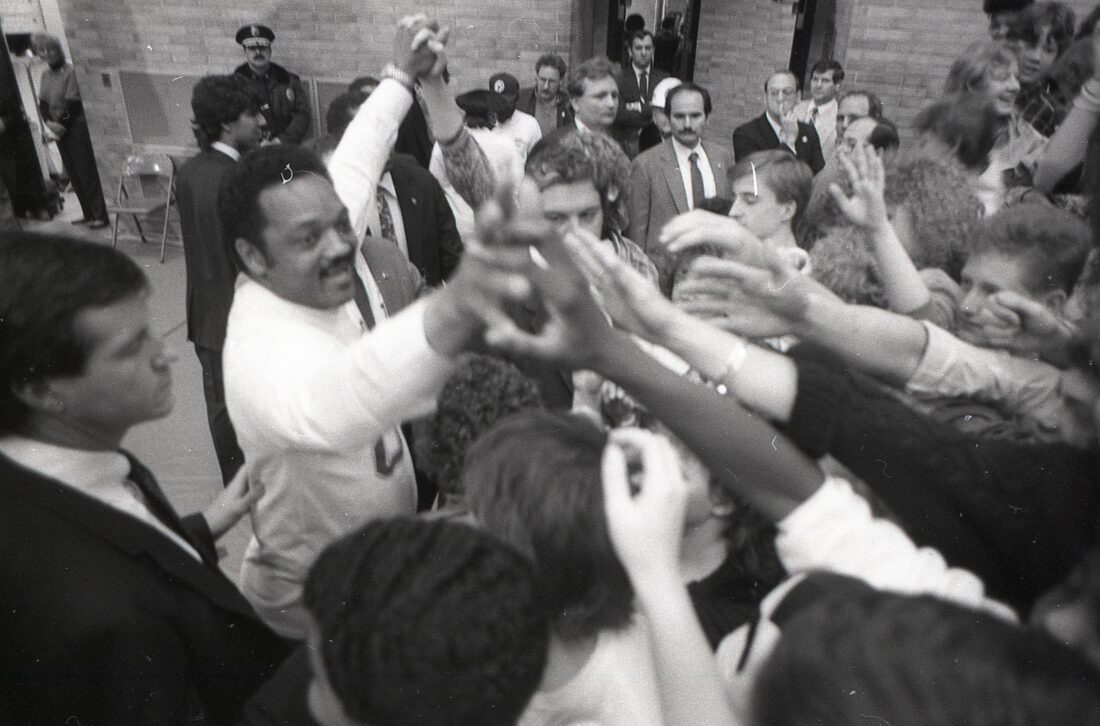
The death of Rev. Jesse Jackson on Tuesday brought an end to a storied career that saw him rise from a protege of Dr. Martin Luther King Jr. to a powerful force for social justice in his own right.
Jackson was a pioneer in many regards, including his historic run as only the second African American to seek the nomination for U.S. President as part of a major party.
Twelve years after former Rep. Shirley Chisholm, D-N.Y., the first African American woman elected to congress made history by receiving 152 delegates in the Democratic primary of 1972, Jackson would launch his first bid for the nomination, coming in fourth place with 485 delegates, according to ebsco.com.
Undeterred, Jackson would make a second run for the nomination in 1988, this time securing 1,023 pledged delegates, and coming in second place to the eventual nominee, then-Massachusetts Governor Michael Dukakis.
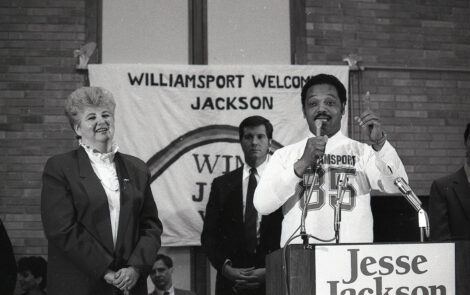
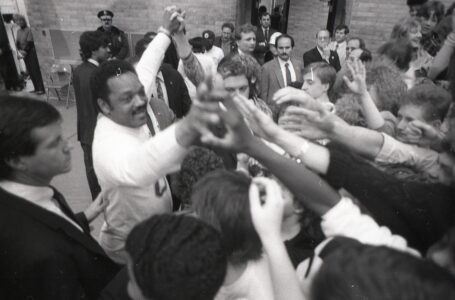
It was during this quest for the nomination that Jackson would make a stop at Williamsport Area High School in April, where he spoke with 2,200 students and an estimated 1,300 others, including faculty, district administration, and local Democratic leaders, such as then-city Mayor Jessie Bloom, who introduced Jackson, in the school’s gymnasium.
“I received a telephone call from Mr. Larry Moore in the Rev. Jesse Jackson’s presidential campaign office in Harrisburg. Moore was the former executive director of the Bethune-Douglass Community Center in Williamsport, and he needed a favor,” then-district Superintendent Oscar W. Knade told the Sun-Gazette in a recent submission.
“He asked if I could arrange an opportunity for Jackson to address the WAHS student body in a campaign appearance. I agreed to try, and put the matter to several school board members, describing it as a unique educational opportunity for our students and faculty,” Knade’s submission said.
The appearance was quickly greenlit by the school board, with high school principal, Wayne A. Newton, and his staff organizing the event.
Donning a high school jersey, Jackson touched on several issues central to his campaign, including ridding the country of illegal drugs, healthcare and job growth, according to Sun-Gazette reports published at the time.
During an impromptu poll, varying percentages of students acknowledged know someone who had contemplated suicide, who had died from, been incarcerated due to, or had at least tried illicit substances.
“Your responses raise several concerns,” he told those assembled, adding that each generation has its challenges.
“Drugs must stop coming in. With the drugs comes misery, violence, AIDS, crime, jail, death and danger,” Jackson said, asking the students to partner with him in stopping the flow of drugs into their bodies as he worked to stop the flow of drugs into the country.
Jackson also reminded the students of the “long-term pain” often associated with “short-term pleasure,” while taking on the topic of teen pregnancy.
Linking the issue of drug usage with the economy, Jackson told the crowd, “when jobs go out, our families disintegrate and hope goes out.”
“We must invest in our people and reinvest in America,” he said, adding that job growth could be produced by tackling the nation’s crumbling infrastructure, which would revitalize the iron and steel industries and create jobs for engineers, construction workers and inspectors.
Many of the issues touched on by Jackson are still prevalent today, including his push to see wages for teachers and general education spending increased.
“Obviously, it makes more sense to invest in teachers than jail wardens, in schools than penitentiaries,” he said.
But even as he spoke of the challenges facing the nation, Jackson’s address carried an unmistakable optimism.
“Young America is hope,” he told the students.
“We must always be willing to hope against great odds,” he said, while running through a list of tribulations the U.S. Has faced over the years, including the Vietnam War, suffrage for 18-year-olds and the fight to end racism.
“Against great odds, they struggled to make America better, and they won,” he said.
Nearing the end of his time with the students, Jackson led the crowd in the self-affirming affirmation, “I am somebody.”
“These students are not eligible to vote, but they are eligible to take drugs, to make babies, to go to jail,” Jackson, flanked by students, said during a press conference following his lecture. But to those in attendance old enough to pull the lever, Jackson’s message was clear.
“I want to be your President,” he said.
“We had a golden opportunity to bring contemporary history into the schoolhouse and provide our students with a chance to be a part of history in the making and participate in the presidential campaign,” Knade is quoted by the Sun-Gazette as saying at the time.
“That to me was worth a lot more than two periods of lectures in a civics class. There clearly weren’t any political considerations here. It’s purely and simply educational,” he said.
Top News
Muncy Township’s transparency and objectivity questioned in wake of delayed development
With controversies emerging about actions taken by the Muncy Township Board of Supervisors, who took office last ...
Rep. Dan Meuser helps secure $250K for Penn College Forest Products Training Center
Some $250,000 will go toward the Pennsylvania College of Technology Forest Products Training Center thanks to ...
Security a top concern during Rev. Jesse Jackson’s campaign visit 38 years ago
Media law counsel: New Muncy Township policy for employees ‘raises constitutional issues’
Muncy Township supervisors have placed what amounts to a gag order on the township chief of police and other ...
‘History in the making’: Late civil rights advocate brought efforts to region
Williamsport school board looks to fill empty seat with former member
With the resignation of board member Thomas Adams, effective Feb. 17, the Williamsport Area School Board agreed to ...