Rep. Joe Hamm calls out waste, fraud in state welfare system
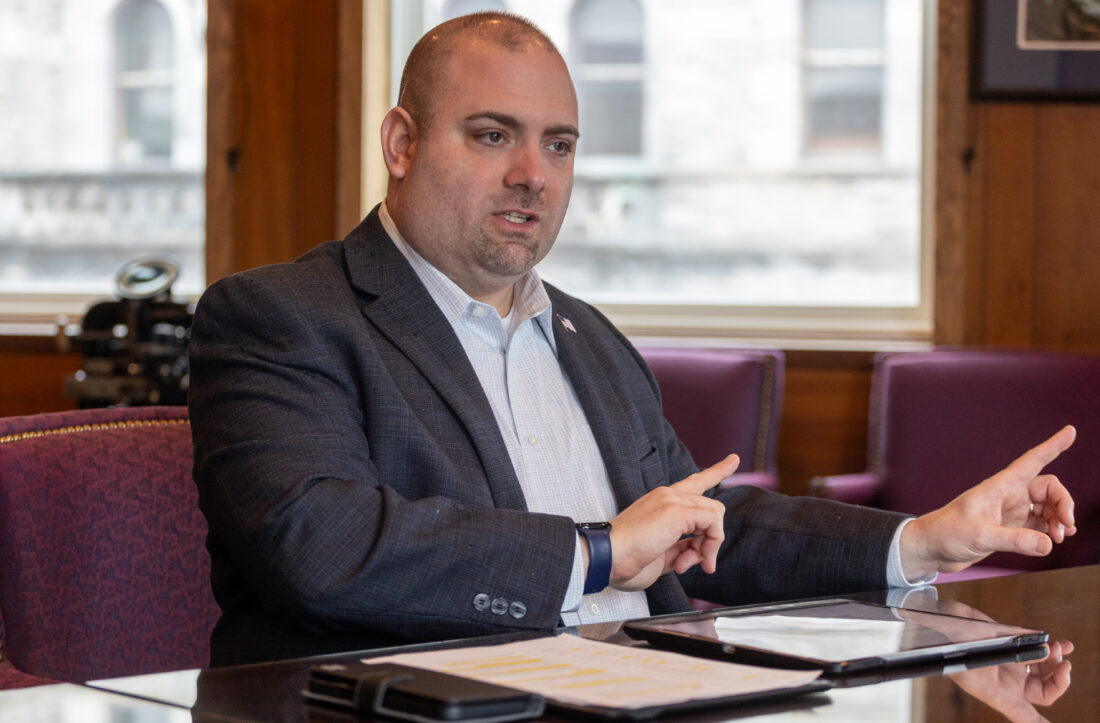
KAREN VIBERT-KENNEDY/Sun-Gazette State Rep. Joe Hamm, R-Hepburn Township, talks about the governor's proposed budget during a meeting with the Sun-Gazette's Editorial board in Williamsport.
A state lawmaker serving the region believes more emphasis should be placed on eliminating waste, fraud and abuse in the welfare system.
State Rep. Joe Hamm, R-Hepburn Township, serving the 84th House district, said he believes tackling that issue is among the ways to reduce the annual budget that has grown by more than $5 billion year-after-year and to finally address property tax reform.
“We have got to be serious about the issue and we’ve got to want to take it on,” Hamm said. “What I’ve seen in five-plus years in Harrisburg is everyone gives lip service to it. No one wants to roll up their sleeves and do the hard work.”
Billions in waste, fraud and abuse
“We have at least $3 billion worth of fraud in our welfare system . . . I didn’t say that, Josh Shapiro said that when he was attorney general,” Hamm said.
Hamm suggested the amount of waste, fraud and abuse in the system could be elevated since Shapiro’s initial pronouncement by at least $1 billion or more.
Notwithstanding that unresolved problem, any attempts at legislative reform have stalled because, as Hamm said, his Democratic colleagues refuse to move legislation.
“I want to be clear, I am not opposed to the welfare programs,” the legislator said, adding he firmly believed in preserving welfare programs for those who truly need it, among them seniors on fixed incomes and those in the disabled community.
Not making sense
“We have 14,000 individuals who have disabilities who are on a waiting list for help and yet we stand here knowing they are on the waiting list and we have at least $3 billion in waste, fraud and abuse of the system six years ago,” he said.
“I don’t know how you can look at people with a straight face and say to them ‘I am fighting for you, I am working for you’ while they are on a waiting list and you know this fraud exists,” he said.
“If we spent within our means, we absolutely could tackle the big problems on an annual basis and property taxes is one of them,” Hamm said.
Property tax increases and unaffordability are what he is hearing back from constituents.
“I hear back from (people) who’ve worked their whole life, raised a family, did what is right to reach retirement age and face a threat of potentially losing their home due to ever-increasing property taxes,” he said.
“Nobody is going to eliminate property taxes without shifting taxes somewhere,” he said. “You have got to still come up with the money to fund our schools and fund education.”
Asked if property tax elimination is not the ultimate goal, if there is some other methodology of lowering the tax rates such as expanding the homestead or farmstead rebates, Hamm prefaced how he would be 100% transparent in his answer.
“I don’t believe any of them are on the table in Harrisburg,” he said. “I believe, again, in Harrisburg we get lip service to the property tax issue. … Everyday I listen to my constituents who share their concerns with property taxes.”
But any step in the right direction, such as expanding the homestead, farmstead program — “let’s do it,” he added.
The goal should be that once a person reaches retirement age his or her property taxes should never increase from that point forward.
For those on fixed incomes, their property taxes also become fixed, so they don’t face a surprise on the next tax bill.
To accomplish that is a complicated process, but doable, he added.
“You’re going to have to shift the tax base,” he said.
Among the concepts being eyed has been looking at income tax changes, but Hamm doesn’t recommend that, suggesting that it would mean hardworking Pennsylvanians give more of their paycheck to the government.
“I struggle with that because I think that is why we are losing so many people,” he said. “People are going south to states that have no state income tax.”
“We are going to pay for school taxes one way or the other,” he said, adding “it is finding that sweet spot where we can eliminate property taxes and shift it to another form of taxation that will cover the cost of education.”
He said he preferred looking at the sales tax, which he believed made the most sense.
“They will say there is not enough to make up (deficits) in increasing sales tax,” he said. “They say, ‘you’d have to increase sales tax 14 cents to make it happen – untrue,” Hamm said.
“They are not telling you there are so many exemptions to our sales tax code and that is the reason we would not come up with the money,” he said.
He cited an example of purchasing ice at a store. “Technically, the clerk is supposed to ask what you use the bag of ice for,” he said. “The bag of ice is taxable if it is used to keep beer and soda cold, but if you are using it to keep water or food cold then it’s not taxable, that is what the tax code says,” he said.
That rarely occurs.
“We target every line item . . . and we make sure that we are getting an effective return on those dollars because the taxpayers expect us to do that,” he said.
“Ultimately, when they send us their tax dollars they are hoping it is being put to great use and if it is not then we should be certainly making sure that we correct that.”
Top News
Commercial developments eyed in Loyalsock Township
Montgomery school board approves a variety of items
The Montgomery Area School Board approved a range of measures during its monthly meeting this week. Following the ...
Rep. Joe Hamm calls out waste, fraud in state welfare system

‘God’s masterpiece’: Thomas T. Taber Museum celebrates America’s founding

Former Dushore fire chief and his wife killed in crash