Rep. Joe Hamm shares thoughts on Gov. Josh Shapiro’s proposed budget
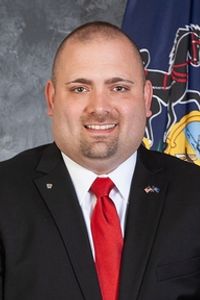
The process of legislators reviewing places to trim Gov. Josh Shapiro’s proposed budget, ahead of a deadline of June 30, has begun.
“He is proposing a $53.26 billion budget for 2026-27,” said Joe Hamm, R-Hepburn Township, who serves the 84th House district of Lycoming County and a part of Sullivan County.
That is a 5.4% increase year-over-year, said Hamm, who stopped by the Sun-Gazette to go over the proposed budget and pending legislation.
“The reality is this is a budget proposal — and I want to be clear it is a proposal — so we have a lot of work to do until the end of June to make sure that we pass a responsible, respectable budget for the taxpayers of Pennsylvania,” he said. “We have to be honest about that work.We have to be honest in what the numbers actually say.”
“Here is where it gets interesting,” Hamm said, noting how the state’s expected revenue is $46.5 billion or about $6.7 billion more than what is projected in this spending plan to arrive in added revenue.
“I talk to people all of the time,” Hamm said, adding he has heard sobering reminders from people in his district and nearby.
“I hear grocery store prices are outrageous,” and “our electric bills are continuing to go up and we can’t afford them,” he said.
Farmers have told Hamm that their margins are tightening, how they are unable to make a profit enough to keep and sustain operations, concerned about maybe having to give up their small family farms.
Hamm said he has spoken to chambers of commerce and small business owners, who also say their “margins are not there,” or “not making money,” or “just surviving,” and now they are “making decisions on whether to keep employees, whether to keep the doors open.”
“That is what I hear every single day and this budget is only going to make that worse because when you don’t spend within your means, you drive inflation upwards,” Hamm said.
Meanwhile, when inflation rises and spending continues beyond acceptable means, the burden is placed on the backs of small business owners, on hardworking Pennsylvanians, he warned.
The proposed budget adds anticipated revenue from sources that are not yet legal, Hamm stressed.
Essentially, it spends money that has not come in, or has not legally entered the state’s coffers yet.
Once again, Shapiro is proposing taxing recreational marijuana and Pennsylvania Skill games.
The proposal calls for a tax on recreational marijuana at a rate of 20%, with Pennsylvania Skill Games at 52%.
Shapiro’s budget includes combined reporting for businesses, meaning that businesses will see some increases in their taxes, Hamm said.
“He is already counting on all of those things,” Hamm remarked, believing that to be an issue because, those must pass legislatively before that revenue can in all actuality be counted in the budget, he added.
If those two items do not become law, it does not become part of the revenue-side that is included in the proposed budget, Hamm noted.
In actuality, if there is a $6.7 billion revenue shortfall, that figure could grow larger if Shapiro does not get those policies done that he has included in the proposed budget, Hamm said.
So, the question Hamm was asked by the Sun-Gazette was what might expected revenue be without recreational marijuana and Pennsylvania Skill Games fees?
Simple math, but it doesn’t add up
“First, add up what the governor viewed as potential revenue generation, which is $750 million from recreational marijuana, and a claim of $750 million from Pennsylvania Skill Games,” Hamm said.
Shapiro also said he would do those things in the last budget, with tax rates the same — 52% on Pennsylvania Skill games, and 20% on recreational marijuana.
“This is where it gets really interesting,” Hamm continued, making a reference to last year’s budget proposal with those same tax rates and how the governor anticipated about $300 million in revenue from each of the taxes between recreational marijuana and the skill games.
In this year’s proposed budget, that is supposed to be from $750 million in each item — with the same tax rate that he proposed in the last budget cycle.
“I don’t understand how we grow that much revenue by doing the same tax rate,” Hamm said.
What is occurring is essentially “front-ending” the licensure fees, so that anyone who would sell recreational marijuana in Pennsylvania, or would want to grow it, would have to pay a license fee upfront, Hamm said.
He is front-ending a lot of his projected revenue from it — from the licensing side of it, and not necessarily the 20 % tax, Hamm said.
With that said, Hamm said the anticipated revenue side is significantly higher than it was last year, and, if those two taxes are combined, that is $1.5 billion that would come out of the expected revenue, bringing that number closer to $45 billion — that is if that tax rate on recreational marijuana and skill games does not work out.
“Obviously, Hamm stressed, “that would grow our deficit even larger.”
Counting on many one-time revenue injections
The proposed budget included figures that count on a lot of one-time revenue injections, as the last budget had in it, Hamm said. Such one-time injection of revenue Hamm referenced is how the proposed budget includes heavily draining the state’s approximate $8 billion rainy day fund by $4.5 billion. “It’s going to empty our checking account,” he said. That would leave the Commonwealth with about $3 billion in the fund, Hamm said. “That’s it … that is all we would have in the rainy day fund, if his budget proposal passes as is,” he said.
Instead, Hamm said he preferred to lean on experts.
“I can’t be an expert in everything,” he said.
That’s where the Independent Fiscal Office (IFO), which is as the name implies — not political nor plays politics, which “is not their job,” comes into play.
Its purpose and job is to forecast Pennsylvania’s economy and its future, he added.
After the last budget passed, after missing the deadline by 135 days, the IFO report came out and the headline read: “Pennsylvania has a Budget Crisis.”
Again, after Shapiro’s proposed $53.26 billion budget was released, the IFO report was released as well. Soon after, Shapiro’s office issued numerous press releases, which among the topics included a promise of passing an aggressive budget with no new taxes and it is going to be great for the people of Pennsylvania.
Shapiro went onto social media sites such as Facebook to personally explain his proposal and how it would benefit taxpayers.
“OK,” Hamm said, agreeing to work with the governor or anyone on the state spending plan.
Notwithstanding the press releases, the IFO report said this budget proposal “will absolutely lead to tax increases in Pennsylvania,” Hamm said.
The IFO has projected, Hamm said, that the state will “run out of money in two years.” “There will be no more money left,” he said. “No rainy day fund, no money in the checking account – nothing – all the money will be expended at that point.”
If that would happen, the state lawmakers and administration have only two options: Cut spending or raise taxes, he said.
“I have been ringing this alarm and this bell for the five years I have been in the House,” Hamm said, adding, “I’ve been saying we can’t sustain the spending that we are growing or spending by and Pennsylvanian’s can’t afford it,” he said.
“If we continue down this unsustainable path it is going to lead to major tax increases,” Hamm said.
Top News
Chicken farm gets Lycoming County Planning Commission’s OK
The Lycoming County Planning Commission approved a land development plan that would see a chicken farm added to the ...
Rep. Joe Hamm shares thoughts on Gov. Josh Shapiro’s proposed budget
Open house to update public on plans for former Lycoming Mall
BAM bookstore to move into former Party City space in Loyalsock Township
Consultant again addresses revenues versus growing costs for City of Williamsport