‘The love of God’: Mobile food pantry travels to meet needs where they’re at
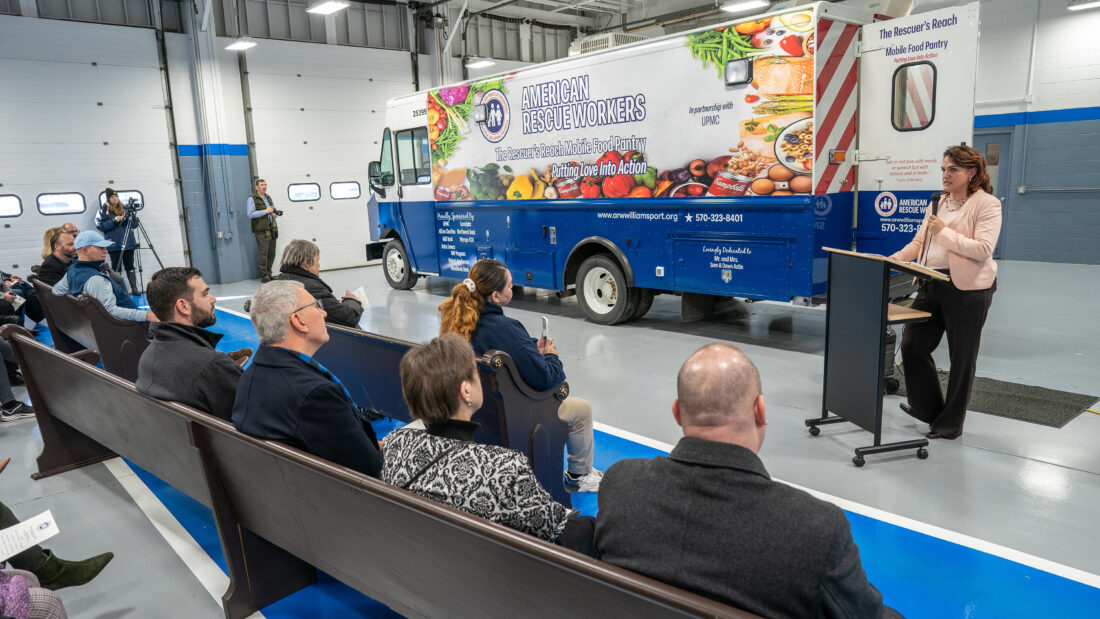
Jenn Rempe of the American Rescue Workers-Williamsport makes opening comments during the unveiling of the new “The Rescuer’s Reach Mobile Food Pantry” at Blaise Alexander Family Dealerships Auction location in Montoursville recently. The new mobile food pantry is the realization of months of work to acquire a vehicle and refit it so it can be used to reach people in the community who cannot get out to one of the local food pantries to get food. DAVE KENNEDY/Sun-Gazette
For many local residents knowing where your next meal is coming from is a matter of walking to the refrigerator, freezer or pantry and finding something to eat. But, for others finding something nutritious to eat is not guaranteed.
Those are the food insecure in area communities and their number is growing.
According to Jennifer Rempe, Director of Development & Community Engagement at the American Rescue Workers (ARW), one in eight people and one in five children in local communities are food insecure, which is defined as not having access to nutritious, healthy food.
“The food insecure have names and they are real people,” Rempe said.
Speaking to the group on what was her last day of serving as the business administrator at ARW, Dawn Astin said, “They are in wheelchairs, and they live on Grace Street, Hepburn Street and Randall Circle.”
“They are the seeing-impaired, the hearing-impaired and the elderly that do not drive and cannot navigate public transportation during minus-two degree weather while attempting to carry groceries, bread, milk and eggs that one could receive from our food pantry,” she continued..
“We will get the food to them so that the difficulties of just doing life seem fewer and our prayer is that they feel the arms of their community around them, as well as the love of God,” Astin added.
To reach more of those neighbors, ARW launched their new mobile food pantry, which will continue the mission of ARW which began in 1934, “to feed the hungry, shelter those without a home, and uphold the dignity of every person who seeks our help,” Rempe said.
“So our mission has never changed. What has changed is the level of need in our community, rising costs, stagnant wages, reduced public benefits, widening economic gaps have pushed more families into crisis than any point in recent memory,” she said.
“The Mobile Food Pantry is American Rescue Workers direct practical response, grounded in our history and built for today’s realities,” she added.
The client choice food pantry at ARW, a fixed operation, serves more than 1,200 families every month, Rempe said, noting that other local food pantries are also experiencing that increase in need.
“We’re big and we’re open every weekday, but every other food pantry that’s open maybe two days a month, they’re experiencing incredibly increased burdens on the way that they’re able to deliver food as well,” she said.
“Yet, even with this capacity, we face a hard truth, many of our neighbors cannot reliably reach the food pantry. Transportation barriers, limited routes, inconsistent schedules, lack of vehicles and physical limitations keep hundreds of households from accessing food each month,” she said.
There have been times that ARW employees have delivered food to people who were unable to come to the food pantry.
“We’re just getting in our cars and delivering that food, taking food down to the river, taking food to apartment complexes. People can’t get out sometimes, Rempe said.
“ARW has always existed to stand in those gaps. Historically, we’ve met people exactly where they lived. This is not a new idea. It’s a return to the practices that built this organization, strengthened with modern tools and expanded reach. Today, we commit to that calling to go where the need is, to serve with dignity and to ensure that no neighbor is left behind simply because they cannot get to us,” she added.
Following the unveiling, Astin shared a story about just one of many instances where someone could not get to the food so the food was delivered to them.
In this case, it involved a hearing-impaired woman who had messaged the food pantry by text asking for food. Since no one else was available Astin took the food to her home.
“I pulled up to the front door, and I was to drop it at the front door because she wouldn’t hear the doorbell. So then I did that, and then I left. A text message was sent to let her know her food was outside her door.
“That’s just one of so many that I mentioned that are just not able to come out into the elements. And if they are, if they can utilize public transportation, they can’t do all of the steps, do the sign language, manage the public transportation, come to the Social Service Center, get their things, try to get back to the bus, still doing sign language and then get on the bus and get home,” she said.
And this woman also was raising several grandchildren, so there’s so many challenges for our families that are food insecure,” Astin said.
UPMC is also partnering with ARW in launching the mobile food pantry. Patti Jackson-Gehris, president of UPMC Northcentral PA and UPMC Williamsport, pointed out the connection between food insecurity and health.
“It’s not just about eating heart healthy or having a diabetic diet, basic nutrition is necessary for people to stay healthy,” Jackson-Gehris said.
“We see in the hospitals and in our physician practices, people with food insecurity as an underlying cause to the main health issues they’re presenting and so it’s really important that we identify and make it easy for the people to get this nutrition,” she said.
By partnering with the mobile pantry, UPMC will be able to address not only food insecurity, but also the transportation issues by taking the food to where people live.
“This is a vehicle that’s going to allow us to go into those communities and have meaningful conversations, understand the other needs of these individuals, connect them with other resources and supports and provide health information, screening, education and prevention,” she said.
“We’re going to be delivering food, but we’re going to be delivering so much more in our communities with this vehicle every year,” she added.
Top News
‘The love of God’: Mobile food pantry travels to meet needs where they’re at
Incomplete records lead to adverse opinion on City of Williamsport audit
The City of Williamsport had a clean audit report for 2024, with an adverse opinion due to incomplete records from ...
Jersey Shore officials ready for what 2026 may bring
The borough government of Jersey Shore is ready for 2026. First, Borough Manager Sean Simcox confirmed there is ...

Passport Services at James V. Brown Library to end Feb. 12
Montoursville school board approves proposal for Lyter Elementary
The Montoursville Area School Board approved a proposal from SitelogIQ Construction Management for the Lyter ...