Virtual training system provides another tool for students at Penn College
-
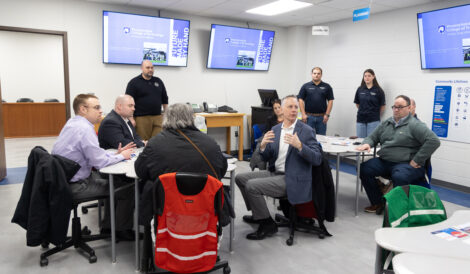
- KAREN VIBERT-KENNEDY/Sun-Gazette Penn College President Mike Reed , center, speaks during a tour of the Emergency Management and Homeland Security Department at the college in Williamsport on Monday.
-

- KAREN VIBERT-KENNEDY/Sun-Gazette State rep. Jamie Flick, R-South Williamsport,; State Rep. Clint Owlett, R-Liberty; Penn College students Katie Martin and Michael Gruber; State Rep. Joe Hamm, R-Hepburn Township; State Rep. Michael Stender.. R; and William Schlosser, Penn College faculty, take a photo during a tour of the Emergency Management and Homeland Security Department at the college in Williamsport on Monday.
-
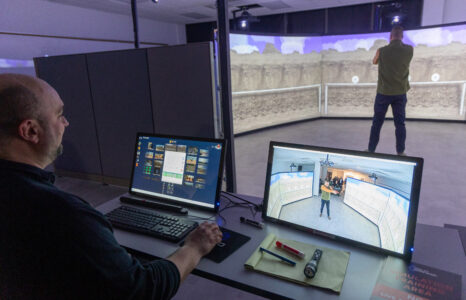
- KAREN VIBERT-KENNEDY/Sun-Gazette William Schlosser., faculty of Emergency Management and Homeland Security at Penn College, left., operates the MILO , while State Rep. Clint Owlett, R-Liberty, tries out target shooting in the MILO theater training simulator Monday at Penn College.
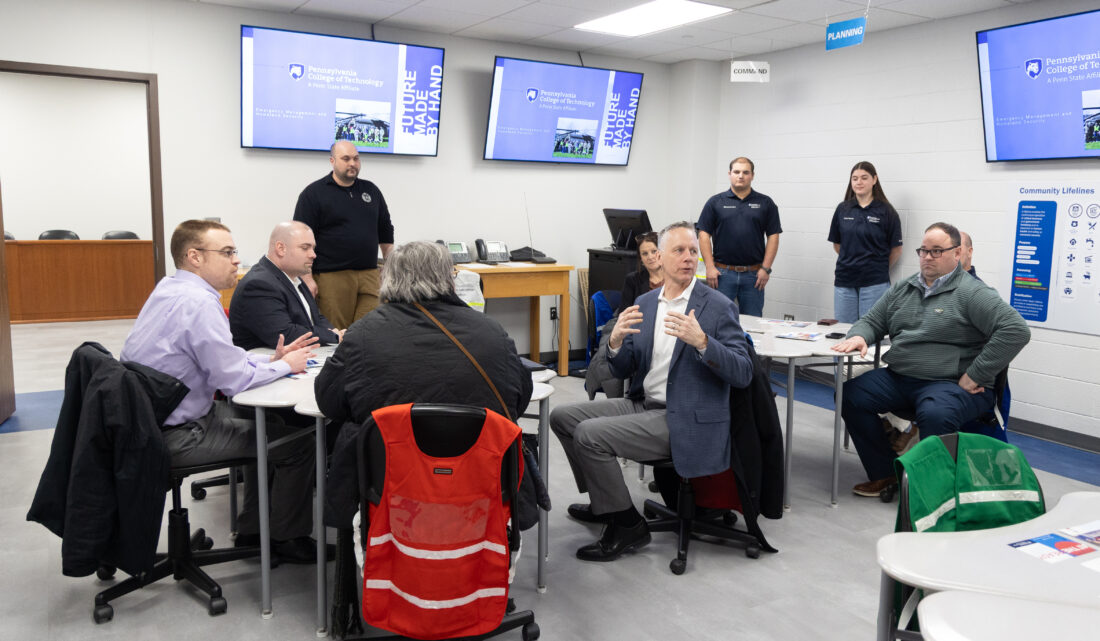
KAREN VIBERT-KENNEDY/Sun-Gazette Penn College President Mike Reed , center, speaks during a tour of the Emergency Management and Homeland Security Department at the college in Williamsport on Monday.
Students in the Emergency Management and Homeland Security program at Pennsylvania College of Technology now have a new tool to help them analyze and respond to emergency situations they could encounter post-graduation.
The MILO (Multiple Interactive Learning Objectives) Theater training simulation system is up and running at the college and a group of local state legislators had a chance to see it in action and to learn more about its potential beyond the classroom setting.
William A. Schlosser, an instructor in the program, detailed for the group what the emergency management program entails and how MILO enhances the hands-on approach to the subject.
“Think of us as really awesome
project managers that don’t really get upset,” Schlosser said.
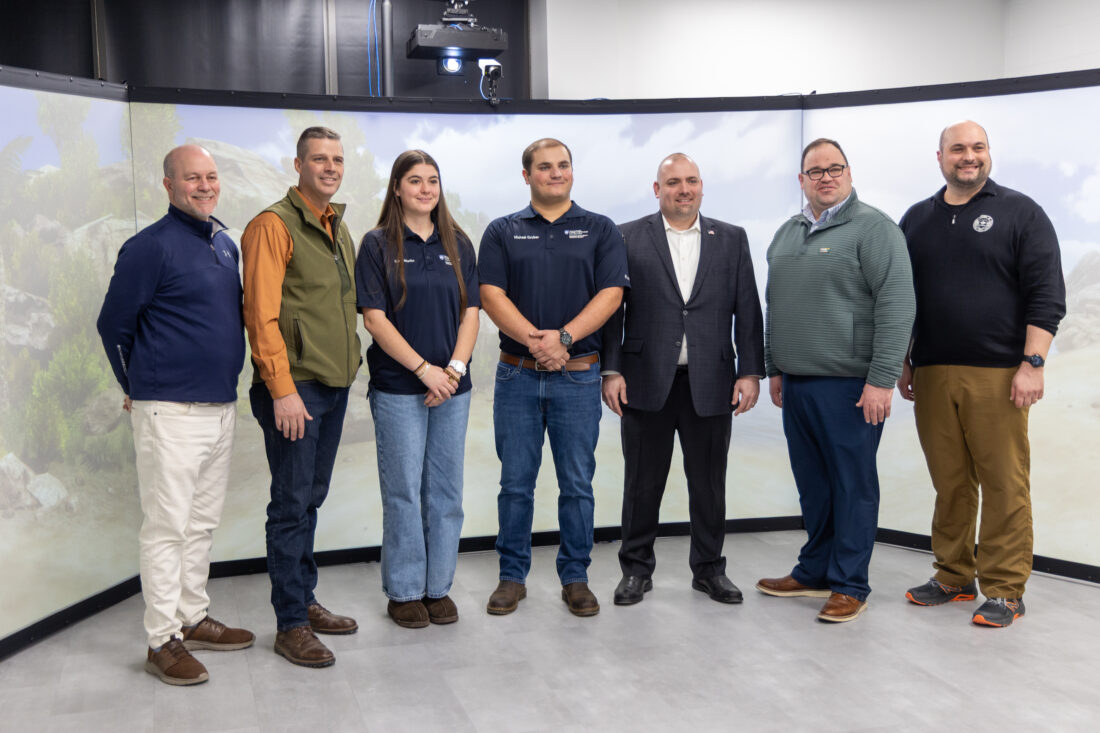
KAREN VIBERT-KENNEDY/Sun-Gazette State rep. Jamie Flick, R-South Williamsport,; State Rep. Clint Owlett, R-Liberty; Penn College students Katie Martin and Michael Gruber; State Rep. Joe Hamm, R-Hepburn Township; State Rep. Michael Stender.. R; and William Schlosser, Penn College faculty, take a photo during a tour of the Emergency Management and Homeland Security Department at the college in Williamsport on Monday.
“So when everything is falling down around us, we’re able to just kind of stand there and go, okay, what needs to happen? How are we going to get there? How are we going to fund it? How are we going to get people safe? That is our goal,” he explained.
For students new to the program part of staying calm in emergency situations is knowing how to react in different scenarios. That’s where MILO is beneficial.
Similar to a gaming system, MILO can be programmed to place the student in different situations to teach them how to respond.
“One of the things that I thought of was the two different kinds of scenarios that I envisioned building. One is from the control tower. What happens when you have a plane crash on the airfield, and how are you going to do the air traffic control part of that,” Schlosser said.
“A lot of people don’t understand that if you’re a firefighter at an airport, you can’t just go to the fire. You have to do all the radio calls to say, hey, I’m transiting taxiway Alpha, I’m going through. Can I have permission to cross the runway…? Like all of those things are important. But if you’re from the control tower, your heart rate’s up when the thing’s on fire in front of you and you can’t do anything about it. So this would give them the ability to do that,” he continued.
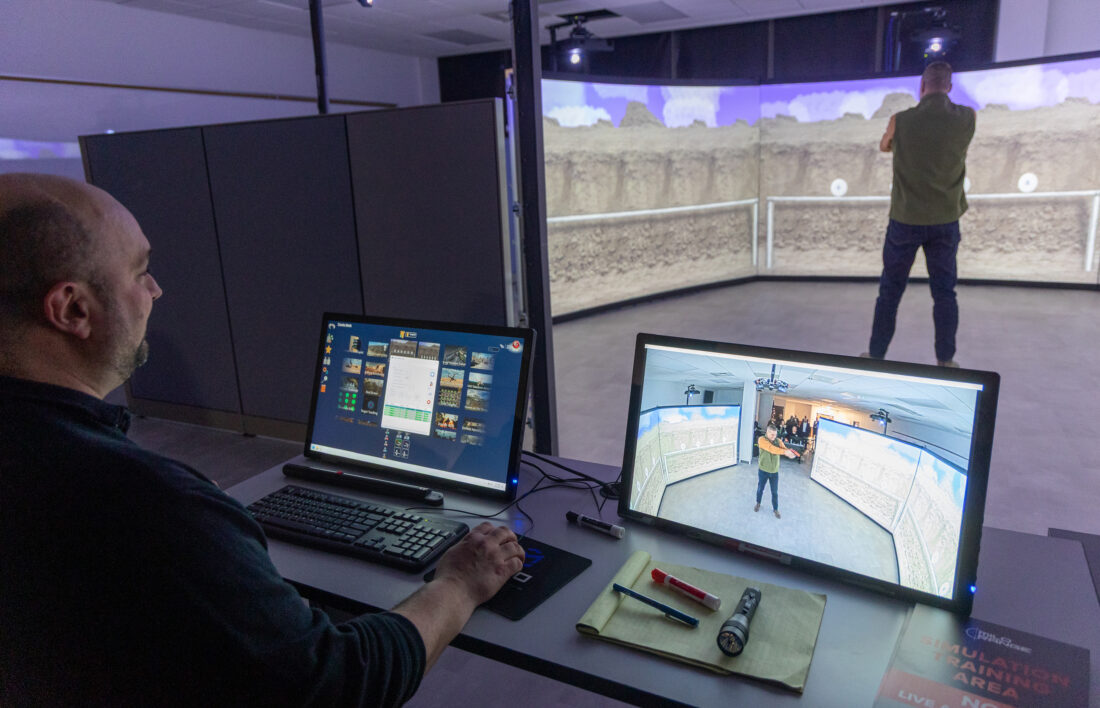
KAREN VIBERT-KENNEDY/Sun-Gazette William Schlosser., faculty of Emergency Management and Homeland Security at Penn College, left., operates the MILO , while State Rep. Clint Owlett, R-Liberty, tries out target shooting in the MILO theater training simulator Monday at Penn College.
The system does not use Virtual Reality headsets, which are common in police training, which offers a different perspective for the participants. The MILO system can also simulate low light level experiences.
“It’s one thing to run through a scenario where it’s…daylight. It’s another thing, one that I did, that made me a little like, okay, I’ve got to go back and mentally reframe, was suicide notification,” Schlosser said.
So, he created a situation where a person whose significant other has just committed suicide is encountered.
“In the scenario, the sun comes in, and so I didn’t see him at first, and so he starts having suicidal ideations at the same time. You lower the light, you lower your ability to understand the scenario in general. And so you start to introduce all the variables, so all of the video side-low level light,” he said.
The group also had the opportunity to try out MILO and Rep. Clint Owlett, R, 68th District, who is also a Penn College board member, decided to see first hand what students experience in the simulations.
The gun that is used is the same as the firearm typically used by law enforcement, but obviously without the fire power. Owlett managed to hit the targets that came up on the three-sided screens.
Students are also taught de-escalation techniques through the simulations.
“We do it from the emergency management program within each of our courses. So how are you going to handle your customer who’s getting really upset? Or, how are you going to handle that person that’s been in a disaster and they’re really upset, or you’re the emergency manager at a school bus crash, and the parents are going to come up to you and be like, I want my kid. How are you going to talk that back,” he said.
“We also partner with another program here on campus, Human Services and Restorative Justice, to also do that same thing. So some of our students take their classes and then their students come up and use a simulator,” he added.
Schlosser addressed the potential for MILO to be used by local law enforcement.
“One of the things that we want to be very, very methodical with is making sure that any live weapon system is taken care of correctly. So we had no place to store a live weapon, and so a police officer is not going to come into this room and say, ‘Here, hold my gun,'” he said.
So, lockers have been installed to store weapons.
“Lockers are for officers to put their live duty weapons in, their tasers, everything. So the officer that we had in here had a second officer with him that carried their weapon. So they did a safety check on them, made sure all the tasers, everything was off of them, so there was no weapon that could get employed in that system,” he said.
“We still have a couple things left, like there’s going to be a black and yellow tape that comes across here. There’s going to be a safety check and weapons check for the facilitator to come through. And, okay, show me your holster. Do you have a secondary duty weapon? Show me where you put your OC (pepper) spray. Show me where you put your taser. So they’re all empty before I give you the simulated weapons. And then you can cross that line. Nobody’s allowed to cross that line with actual weapons. We’re not there yet, so I can’t invite those other partners in,” he said.
Top News
City of Williamsport approves funding for River Valley Transit Authority, truck upgrades for public works
The local match for the City of Williamsport regarding River Valley Transit Authority operational needs as part of ...
Roads to Freedom Center for Independent Living temporarily closes office; services remain unchanged
Roads to Freedom Center for Independent Living (RTFCIL), 24 E. Third St., has a temporary change to its physical ...
Virtual training system provides another tool for students at Penn College

Grace the horse living well alongside fellow rescue Bimini the dog in Woodward Township

Public testifies over proposal for drilling on mountain