
State housing initiative works with Greater Lycoming Habitat for Humanity
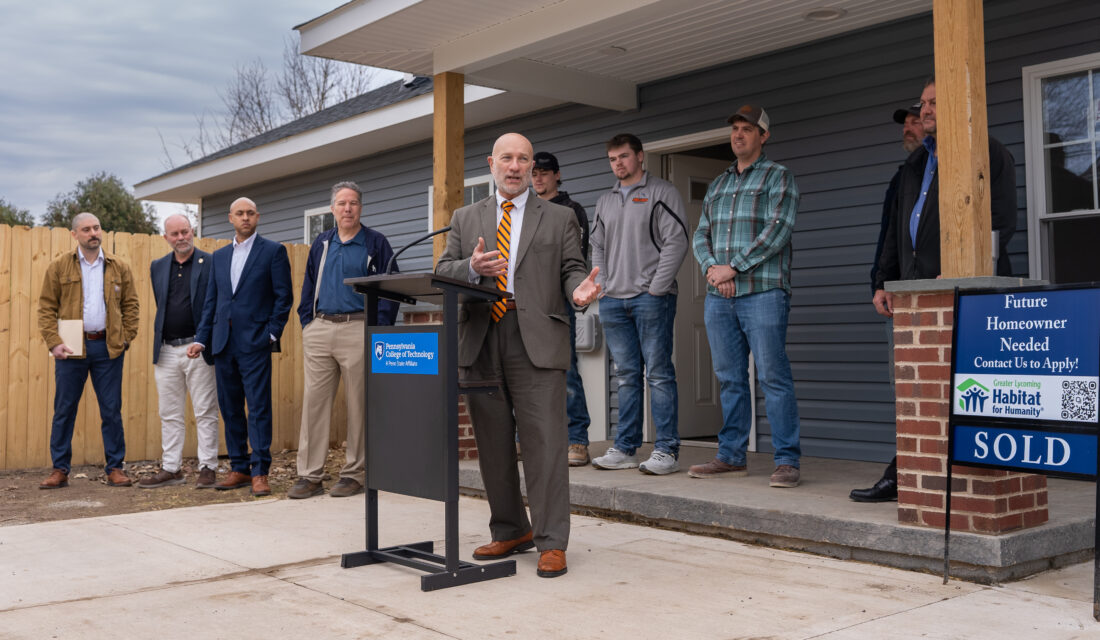
Deputy Secretary for Community Affairs and Development Rick Vilello talks about the importance of affordable housing during a press conference at a Habitat for Humanity house on 5th Ave. in Williamsport Friday afternoon. DAVE KENNEDY/Sun-Gazette
It was two years in the making but next month a family living in “a very unsafe environment” will be moving into a Greater Lycoming Habitat for Humanity house built on 5th Avenue in Williamsport – designed and built by Pennsylvania College of Technology students.
Their arrival is part of a statewide initiative by the Administration of Gov. Josh Shapiro to provide housing options and opportunity for families and to grow the economy and foster relationships with successful educational institutions that are turning out the next generation of building trades and construction professionals, such as graduates from Penn College.
“They are each going to be having their own bedroom, they are not going to be sharing one room with the family members,” said a jubilant Dana Borick Brigandi, director of development representing Greater Lycoming Habitat for Humanity at Friday’s conference and tour of the house at 508 Fifth Ave.
“We’re so excited the family is partnering with us to make these changes, to get the financial training and the construction training, so that they can be successful homeowners and keep this going for their lifetime,” she said.
The family will be introduced to the community later next month.
Pennsylvania College joined Greater Lycoming Habitat for Humanity on Sept. 19, 2024 to break ground at the site.
The house was built over the past two years by students with Penn College’s building trades and construction technology and others.
On hand for the event, state Department of Community and Economic Development Deputy Sec. for Community Affairs and Development Rick Vilello, who likened the new, nearly completed housing project to a flower, while also highlighting the urgent need to expand housing opportunity and increase affordability for all Pennsylvanians.
Shapiro recently unveiled Pennsylvania’s first-ever Housing Action Plan, which will build and preserve more homes, modernize housing regulations and zoning rules, and break down barriers preventing people from finding stable housing – all to grow Pennsylvania’s economy and improve Pennsylvanian’s health outcomes, Vilello said.
Shapiro’s 2026-27 proposed budget creates a new $1 billion initiative to provide flexible funding for major infrastructure projects across the Commonwealth, including building and preserving more housing, bringing new energy generation onto the grid, and upgrading school and municipal facilities, he explained.
“This could be the poster child project for what the governor wants to accomplish everywhere in Pennsylvania,” Vilello said.
He said the site included tearing down a nuisance bar, having a vacant lot, working with Lycoming County, working with the City of Williamsport, with Habitat and Penn College.
“If we go into a neighborhood and fix broken windows and plant flowers and paint a building and then the next door neighbors do the same thing, and go on each other’s porch, and talk to one another . . . it can change your whole area,” Vilello said.
It is the kind of progress that the governor wants to see happen everywhere, he said.
“It is not an urban issue,” Vilello remarked. “It’s not a rural issue. It is a Pennsylvania issue.”
As Shapiro tasked the department to develop an economic development strategy, housing led the way in that effort, Vilello remarked.
“We held 18 roundtables around the state,” Vilello said.
In every one of those roundtables housing became a topic of discussion, dominating the talks at every economic development roundtable, he said.
After the economic development strategy was completed, Shapiro tasked DCED with writing a Housing Action Plan.
Again, 18 roundtables were held. The strategies that came out of that was not just seeing there were more affordable or workforce housing options throughout the Commonwealth, but every type of housing.
One of the metrics revealed the state remains about 20,000 houses per year short statewide to meet demand.
“There are all kinds of things in the strategy that talk about addressing demand,” Vilello said.
One of those is the need for new construction. Another is the need for blight removal. Another is the need to renovate houses, as 25 % of the state’s housing stock was constructed before 1940, he noted.
All of these initiatives require a workforce, so when Vilello said he sees a partnership with Penn College, and when he drove by a billboard which advertised the college’s 98 % job placement, “this really doesn’t get any better,” he said.
“This house is an example of stuff that we need to get done everywhere.”
“In this case this house was built by the students,” said Paul Macknosky, Northeast Regional Director, DCED. Over two years of classes in building trades, he said, were put into this project.
“Really put up a lot of hard work, taking what they’ve learned from the classroom, bringing it here and finding out … you can learn a lot in the classroom but, certainly, it is a little different when you have trades crossing each other and you’ve got to figure this stuff out.”
The students are getting “a great first-hand experience and it is an overlap of our desire at the Department of Community and Economic Development,” he said.
“I hope to hear of more of these projects in the city and we will certainly support them any way we can,” Macknosky said.
“This has been a true bonus as it showed our students what can happen when they all come together to benefit communities,” said Ellyn A. Lester, assistant dean of Construction and Architectural Technologies.
Lester described how about four years ago Patrick Marty, Chief Government and International Relations Officer, Penn College, were at a Habitat event and Mayor Derek Slaughter was there and that is how this project began to evolve. She noted how blessed the college was with the leadership of President Michael J. Reed and Marty who supported the efforts of making the project a reality.
“We absolutely could not have done it without them and the donation of the land, jump started that effort,” Lester said.
This also could not have happened without the college’s amazing faculty, she said, especially Garret Graff, assistant professor, Building Construction Technology, and the on-site project manager.
“He was there from the beginning,” she said.
All of the faculty went above and beyond to transfer their classroom assignments to this site, she remarked. She observed how it is much easier to work independently in a lab and with the challenges of sequencing efforts and managing hold up, especially things like the weather – which is “kind of holding off on today,” she said, looking at the overcast sky and feeling a patter of rain above.
The college has seen tremendous growth across the programs that are represented by this house, over the years, she said. The project included building the home from start to finish, and site layout, heavy construction equipment technology majors digging the foundation and architecture.
Geoffrey M. Campbell, a retired assistant professor of architecture, involved students in a Fall ’22 architectural design class by tasking them to design energy-efficient homes for the site. By the time it was completed, the project had involved students from at least six Penn College programs, the college stated.
In addition to ensuring their own financial success, each of the students who participated in this project are making the governor’s plan a success also, and expanding opportunity for Pennsylvania, Lester said.
“So we’re very excited to be part of it, not only today for this house but what we are doing when we graduate students who go out into the community and are making a difference across our state,” Lester said.
She invited those gathered and others to return on April 30 when the college formally dedicates and turns the house over to Greater Lycoming Habitat for Humanity thus giving a local family a chance for a stable and sustainable future.
Top News
Muncy council acts on crosswalk safety project
Muncy Borough Council at its March meeting approved a change order for upcoming work for pedestrian crosswalk ...
State housing initiative works with Greater Lycoming Habitat for Humanity
Flick discusses his pending legislation on cameras in courtrooms
Cameras are on private residences, buildings and capture silly, action-packed, serious and, sometimes, regretful ...
Officials laud students who worked on project
“It’s the gentlemen behind me that need the loudest round of applause.” That’s what state Rep. Jamie ...
Housing project planned for Hughesville area takes another step
City council believes computer provided to public addresses access concerns
Williamsport City Council believes it has addressed the need for allowing public accessibility at its newly-formed ...