‘The best interest of your kids’: Lawmaker’s work on custody reform continues
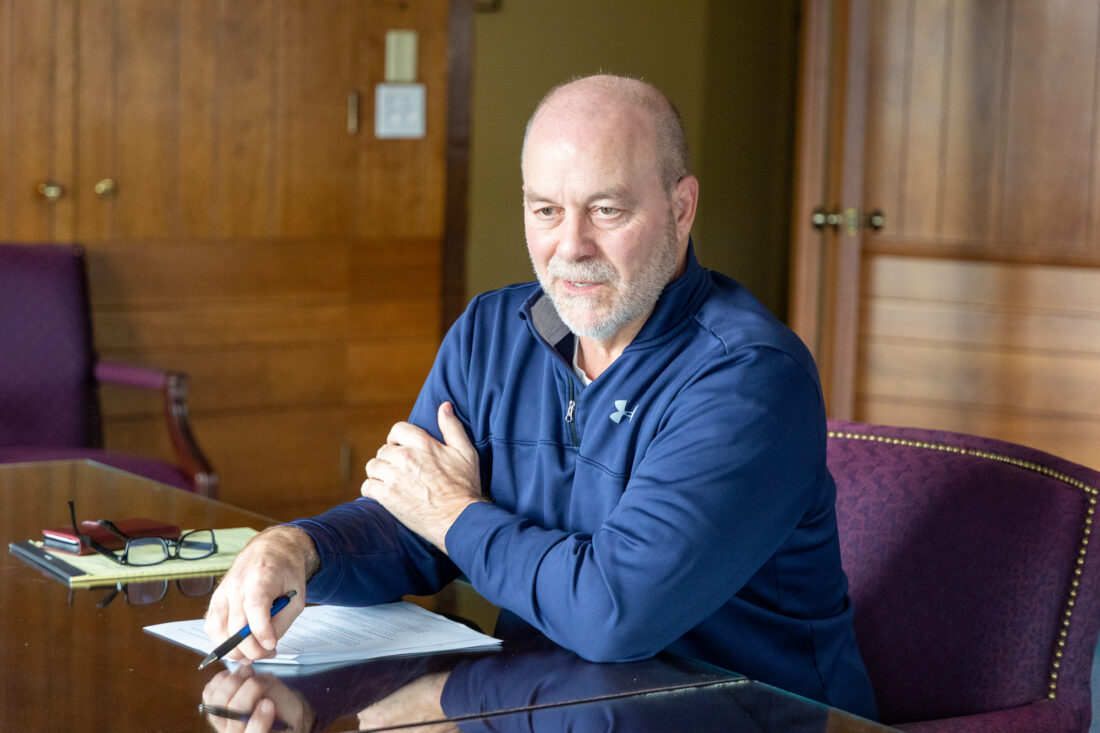
KAREN VIBERT-KENNEDY/Sun-Gazette State Rep. Jamie Flick, R-South Williamsport , talks about H.B. 1499, a bill for equal share custody for parents, that he had introduced.
Witnesses presented emotionally jarring testimony at a public hearing in Harrisburg last November on child custody.
The hearing was on Nov. 18, 2025, with the state House of Representatives Republican Policy Committee.
State Rep. Jamie Flick, R-South Williamsport, of the 83rd House District, had introduced several years ago H.B. 1499 – a bill for equal shared custody for parents who are fit, willing and able.
Because of his own personal life experience, going through a divorce, equal share custody rights has been one of the primary drivers for Flick, and a reason he ran for office. Flick, at the hearing, and most recently with the Sun-Gazette editorial board, discussed the issue important to him and so many parents around Pennsylvania.
At the hearing, Flick, who was first to speak after an introduction, was an open book, sharing how he didn’t have a law or medical degree, or a bachelor’s or master’s degree for that matter.
“Just a hard-working family man who wants what all of you want and that is what is in the best interest of your kids,” he said.
Before he ran for office, Flick admitted that he’d never been to a school board or township meeting. He said he was a good dad, one who changed diapers, rocked his kids to bed, taught them how to read, coached baseball, football, soccer and basketball. He was an Odyssey of the Mind coach, a band parent, a volunteer reader in school sharing stories with kindergarteners.
Flick also had dedicated 20 years of his time, before having children, mentoring a multitude of kids in the Big Brothers and Big Sisters program, and also the Fresh Air Fund, which takes inner-city children and brings them into the country to experience a time away from hustle and bustle of urban life.
Like half of America, Flick’s marriage, sadly, ended in a divorce.
“Basically my kids were kidnapped,” he said, adding it was a snatching away but not in the sense of what is seen on television shows, but by the court, he said.
“Every other weekend they were dangled in front of me and I had to do exactly what they told me to do, or they would keep my kids or give them to their mother.”
At the first court visit, in a matter of minutes, Flick said he was told he would be an “every other weekend dad.”
“No investigation, no due process,” he said. “I then spent what seemed like an eternity fighting to get my kids.”
Flick said he went through five attorneys – learning “how truly evil and how broken the system was.”
What happened next he could only describe as “bizarre.”
The same court that told him he was not worthy of seeing his kids, either 50 % or 30 %, then swore him in as a Court-Appointed Special Advocate.
“My job was then to make sure that foster kids were being treated fairly by their foster parents,” he said.
As part of the Fresh Air Fund, Flick said he was blessed to become a legal guardian to two children from Brooklyn, but, oddly, the court said he could not get 50 % or even 30 % of time with his kids.
“To be a legal guardian, a foster parent, per say, for four kids, two not my own, something smelled bad,” Flick said.
While this happened, opposing counsel attacked his reputation, he said, adding “he was treated like a murderer with the questions he was asked in court.”
On multiple occasions, that attorney asked that Flick be “put in prison,” according to this testimony.
“Simply because I would not stop,” he said. “I would go back time after time, motion after motion, to fight what you are all fighting for – your kids.”
What followed were ex-parte communications, false allegations, abuse of power … and a complete and utter lack of due process, Flick claimed.
Continuance after continuance to draw it out and motion after motion to not only draw time out but to draw money out – all of this in the so-called interest of the children.
This led to Flick having a severe stroke, and after months of speech, occupational and physical therapy and his ability to regain his strength to walk, he did so walking into his state representative’s office telling him that something needed to be done about the custody system.
Not happy with the answer, Flick said he looked the representative in the eye and said he was going to run against him.
Flick was elected to the seat.
By the time he got a custody trial, Flick said he had spent over $100,000, survived a stroke, was taking care of other kids, not his own assigned to him by the courts, and had over a dozen witnesses the day of the trial. The lawyers met, and he was told the courts were not going to give him 50-50 custody.
There were over a dozen witnesses, including coaches, teachers and mentors ready to testify as witnesses, he said. Ultimately, the court order was: “The parties agree that father should continue to pay child support to mother as though she has more overnights than father. In the event father seeks a court order based upon father having equal overnights the parties agree father shall no longer have his Thursday overnights, thereby providing mother with a majority of the overnights.”
“Meaning you wore us down,” Flick said of the court order. “We are going to give you 50-50 but you are going to keep paying as if you are an absentee dad. “That way the court, through … a federal incentive, is going to keep getting their money.”
Lycoming County makes roughly $1 million a year from this, Flick said.
Flick also broke down emotionally discussing how one of his constituents did not fare so well.
“He had fought to see his daughter for 15 years, but he gave up, took a gun, put a bullet in it, put to his head and shot himself,” Flick said.
“This insanity has to stop,” he said.
Also providing emotional testimony for the policy committee was attorney Gregory Fellerman of Harveys Lake. Fellerman, at times, read from his script, and had trouble holding his composure as the father of three, who said he was blessed with a step-daughter from a second marriage, discussed his journey, and highlighted a major intervening event that changed his outlook for life.
One of his daughters, who was “smart, beautiful and full of life, was killed by a wrongway drunk driver in Florida,” according to the testimony.
Such loss remains unimaginable, but it was compounded by the amount of time Fellerman said he battled with the court system, trusting in that system and ending up with a 65-35 percent custody order.
It was time spent in court that otherwise could have been spent with that daughter that was snuffed away in an instant by the intoxicated driver, he said. Others provided testimony in the hearing.
As of the visit to the Sun-Gazette, there were 68 co-sponsors with 24 of those co-sponsors Democrats. It is a bipartisan bill waiting to be moved on, he said.
It is sitting in the Judiciary Committee – which is made up mostly of lawyers – who are funded by political action committees, who spend millions of dollars a year in campaign ads and who want legislation that is not going to hurt their law practices.
“The losers are the divorce attorneys,” he said. “Children need to be at the center of every decision,” Flick said.
“This legislation asks a question – whether we can go further to ensure that when both parents are loving, capable and safe that children have the chance to maintain strong and meaningful relationships with both of them,” said state Rep. David Rowe, R-Union, Snyder, Juniata and Mifflin, which is the 85th House District.
It is a presumption to be close to 50-50 custody, and that is the benefit for children to have two parents, Flick said.
Of course, there are exceptions in the legislation for neglect or abuse.
“I would say that we have had great momentum since we have introduced that legislation,” he said.
Currently, though, the legislation is stalled in the Judiciary committee — however, there is a petition through Change.org, started by Sean Mclauglin, Jeff Steiner of Dad’s Resource Center, and Robert Garza of Texas. The petition is: Move HB1499 to a Vote in the Pennsylvania House Judiciary Committee – United States
To date, similar legislation has passed in four states.
“We get calls every day,” Flick said. “Sadly, almost half of marriages end in divorce and this is why it is such a hot topic — not just here but throughout the nation.”
Top News
Lycoming County commissioner revisits needs vs. wishes for buildings
Although the issue was resolved and the county saved a substantial amount of money in the process, comments by ...
Man accused of 2023 bus station stabbing pleads guilty as trial was set to begin
A city man accused of stabbing two acquaintances at the Third Street River Valley Trade and Transit Center in ...
Muncy Township supervisor addresses Sun-Gazette editorial
Muncy Township Supervisor Terri Lauchle offered further comment on recent supervisor meetings and on the editorial ...
‘The best interest of your kids’: Lawmaker’s work on custody reform continues
Fetterman casts deciding vote advancing Mullin nomination to lead DHS