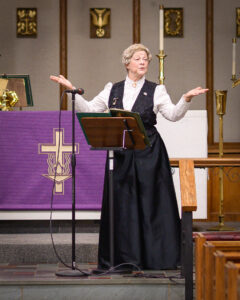
How a Muncy woman ended up on stage with President Lincoln
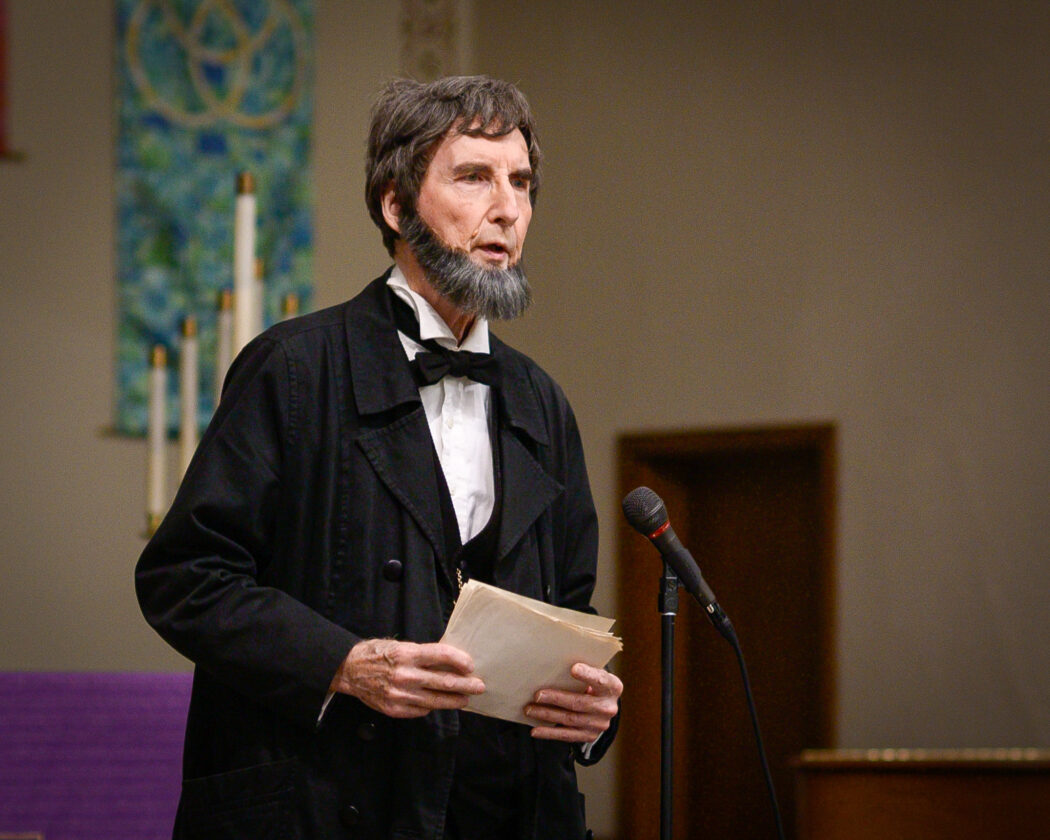
RALPH WILSON/Sun-Gazette Correspondent Bob Gleason portrays Abraham Lincoln, President of the United States during the Civil War, during a presentation by the Muncy Historical Society at St Andrew's Lutheran Church in Muncy on Sunday.
Sun-Gazette Correspondent
The Muncy Historical Society recently held a ceremony to honor six military veterans with quilts of valor, but just prior to the ceremony, attendees were treated to “The Road to Gettysburg,” a two-person performance tracking the divergent paths that led a Muncy woman and President Abraham Lincoln to share the stage shortly after the historic battle.
For the performance, Pat Jordan, of the Heritage Theatre Guild, took on the role of Anna Morris (Ellis) Holstein, a civilian nurse, who tended to wounded soldiers from the battles of Antietam, Fredericksburg, Chancellorsville and, ultimately, Gettysburg.
American Historical Theatre actor Bob Gleason donned the tall top hat of Lincoln, America’s 16th president.
“Her history is fascinating, and some of the most recognized and revered icons of our nation’s history would not be here without her direct efforts,” said Bill Poulton, president of the Muncy Historical Services in introducing Jordan.
Holstein was born April 9, 1824, in the Wolf Run area of Pennsdale to William Cox and Rachel (Morris) Ellis, and was educated at the Westtown School in West Chester, and began her nursing duties on May 19, 1861, along with husband, William Hayman Holstein, who was serving in the17th Pennsylvania Militia, according to www.susquehannafootprints.com.
Holstein’s maternal great-grandfather, Capt. Samuel Morris, was part of the first city troupe accompanying Gen. George Washington, throughout the revolution, according to the play, while grandfather Richard Wells, one of the first registrar generals, was also a friend of William Penn.
After marrying in 1848, the couple moved to King of Prussia, where she performed social services, including as a lady manager in the effort to salvage the Mount Vernon, Virginia home of Washington.
“I personally went to each and every Township and town in Montgomery County, and I must tell you, I canvassed as strongly as any legislator did for votes,” Jordan said, in her performance of Holstein.
“I was noticing at this point, slavery was the one issue that everyone was talking about,” Jordan, as Holstein said, stressing her commitment to social justice issues.
Following the election of Abraham Lincoln in November 1860, 11 states seceded from the Union, forming the Confederate States of America.
“Those storm clouds, those thunder rumblings that had been going on, were now becoming louder and louder,” she said.
“With the attack on Fort Sumter in South Carolina on April 12, 1861, the country was severed between the loyal states and those who chose to leave the Union,” Jordan said.
Though begged by her mother not to go, and concerned for her own health, Holstein, inspired by several friends who signed up to serve as nurses, did so as well, after hearing of the horrific death and injuries that occurred at the Battle of Antietam.
It would take some time for Holstein to learn to control her emotions amongst the chaos and destruction, though once she did, she immediately saw the positive impact she was making.
“These soldiers were so grateful for any little thing that you would do for them,” Jordan said, noting that the nurses readily helped both Union and Confederate soldiers.
“They were wounded people. They weren’t soldiers,” she said.
The following December, Holstein and the other nurses would tend to the more than 70,000 casualties in Fredericksburg and Chancellorsville, where their help was sometimes turned away.
“In March, we received the orders to go to Pennsylvania. It turned my blood cold to think that the enemy was going to be so close, bringing with it death and destruction,” Jordan said.
By mid-June, the army’s horses were being affected by the heat, and coming upon an unsafe bridge, the men were ordered to reduce their possessions by 20 pounds.
With many of them carrying precious family treasures, at her husband’s request, Holstein would sneak many of the items to Alexandria by carrying them under her dress.
“I did it for my country,” Jordan said, adding that the items then made their way to Washington, D.C. for collection, following the war’s conclusion.
While on the march into Pennsylvania, William would become ill, leading to his and Holstein’s return to their King of Prussia home, where she would speak to soldiers aid societies and schools, encouraging all to keep up their support for those fighting the war, though thoughts of the war persisted.
Jordan recounted Holstein’s treatment of a 16-year-old soldier who had been calling out for his mother, and was so weak that he was unable to feed himself.
“In some ways, I became the mother he might never see, and he became the child I’d never have,” she said, adding that in spite of her efforts, the soldier ultimately died.
Upon return to Gettysburg, Holstein was made matron at the Camp Letterman hospital, which treated nearly 3,000 wounded soldiers.
“I thought about these brave, brave men who had fought this battle, and it struck me with an idea that there should be some commemoration of all they did,” Jordan, as Holstein said.
Holstein was able to fulfill that commemoration by raising enough support that a 24 foot American flag was constructed and brought to Gettysburg, just in time for Lincoln to issue his famous ‘Gettysburg Address,’ during which Holstein and her husband sat 10 feet from the President.
“I don’t believe I have ever been so moved in my entire life,” Jordan said.
While Gettysburg was indeed a turning point in the war, it would continue on until the surrender of Confederate Gen. Robert E. Lee at Appomattox Courthouse, fittingly on Holstein’s birthday in 1865.
Throughout that time, Holstein would continue to care for the wounded, including former prisoners of war from Andersonville Prison, all while rallying support from soldiers’ aid societies and schools. William also continued his work as part of the Sanitary Commission, officially finishing up their duties and returning home in November 1865.
“There was nothing but rejoicing in the country that it was finally over, the union was saved, and we all just thanked good God. Sadly, the President was shot at Ford’s Theater on April 16, 1865. He died the next day, and America lost its North Star,” Jordan said.
Two years later, Holstein, moved by her experiences, would publish Three Years in Field Hospitals of the Army of the Potomac.
“I came to realize that if we cannot learn from the past and from its lessons, those lessons will be lost in a generation, and that loss would, of course, result once again, in pain, loss, sorrow,” Jordan, speaking as Holstein said.
“If our dear President Lincoln could be with us right now, I’m sure he would agree that we cannot forget the past,” Jordan said, reflecting on the current political climate of division.
“We fought a war for the same ideals of life, liberty and pursuit of happiness, as expressed in our Declaration of Independence. We never met, but we took different roads in our efforts to preserve our union, our republic, our country that is so dear to us,” she said.
“We hoped for peace, but it wasn’t meant to be, and so we did our duty,” Holstein said.
“Let us hope that this never happens again,” she said, with Gleason returning to the stage for the refrain.
Top News
Judge: Williamsport must repay attorney fees
A federal judge has ordered that the Center for Independent Living be able to recover from the City of Williamsport ...
Used fire engine prices jump 62% in 1 year
Candidates for governor face questions on detention centers
(EDITOR’S NOTE: Spotlight PA is an independent, nonpartisan, and nonprofit newsroom producing investigative and ...

Company fined $60,000 for Williamsport leak
How a Muncy woman ended up on stage with President Lincoln