
Don’t answer that phone: State Attorney General Dave Sunday Jr. talks ways to avoid phone scams
Trending
Technology, as everyone knows, is both a blessing and a curse. It has streamlined people's lives while also complicating and, sometimes, even endangering them -- particularly in the case of scammers who tend to prey on an older population that may not be as tech-savvy.
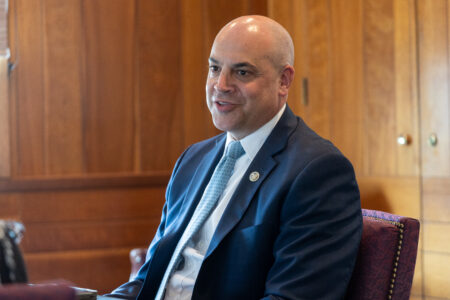
"It's not hyperbole to say that this is at a crisis level," said state Attorney General Dave W. Sunday Jr. on a recent visit to the Sun-Gazette.
"There's amazing things happening with technology. Innovation is putting us in places that we couldn't have imagined as a society, but at the same time, every tool, bad guys use it as well. So technology has created some challenges for individuals that are trying to figure out if it is a scam or not," he said.
The one takeaway that Sunday wants everyone -- not just seniors -- to remember is, "You don't have to answer the phone."
"I know that sounds as basic as anything, but you don't have to answer the phone," he said.
"Remind people you don't have to answer the phone. You can let it go to voicemail," he reiterated. "If it comes to voicemail, then you can listen to it and make that determination. People will not be offended if you don't answer the phone."
He noted that Pennsylvania has one of the highest senior citizen populations in the entire country. Scammers know this and "hype-target" communities throughout the state, especially in the northeast area, he said.
Sunday pointed out that so far this year, his office has received 3,697 scam-related complaints. Last year, in total, his office engaged with citizens who lost $76 million to scams. Of those scams, 63 percent were telephone-based scams.
One of the main ones that the AG's office is seeing an increase in is government imposter scams.
"All of us have been on the other side of that. Those are where people call, and they pretend to be like the local sheriff's office. The one we see the most is the threat to arrest you for not appearing for jury duty," he said.
"Then what they say is, the only way to get out of it is to go remove cash from your account, go to a local Bitcoin ATM, put the cash into the Bitcoin ATM, and then use that to pay these individuals, which is absolutely false. It is a total scam, and please don't fall for it," he said.
One of the difficulties for everyone when it comes to discerning what is or isn't a scam call is that the technology has become more sophisticated.
"It is much harder now to figure out if something's a scam or not, whereas even five years ago everybody would receive that same phone call, and so you could very quickly say this is a scam, don't answer it," he said.
"Because of technology now, AI, in particular, the scams can be targeted to you individually, and so you may receive phone calls about scams that I don't receive," he added.
Sunday explained that scammers utilize AI to learn about individuals, such as their present or former occupation, their hobbies, whether they have children or grandchildren. That information helps them to hype-target, or basically customize the scam to an individual, making it harder to identify it as a scam. All of that information can be obtained on the internet.
"Let's say you're a retired school teacher, which my father is. He's a retired school teacher, and so he may get scams pertaining to that world somehow. A lot of physicians and nurses get phone calls about missing jury duty for some reason," he said.
"They can figure out what citizens may have cash available to them, so a lot of these are targeted at people that they feel might have cash available to go obtain. Because of that hyper targeting it makes it a lot harder," Sunday explained.
Another scam involves getting a call from someone claiming to be a grandchild who needs money-the grandchildren scam. The scammers have become adept at making the voice actually sound like the person's loved one because they can capture voices from anything public.
"Everybody's on Facebook, Instagram, and this all can happen in microseconds," Sunday said.
"The number one way that we can fight the scams is by helping people to not get scammed in the first place," Sunday said.
Another sad thing about the scams targeting older citizens, is that with age may come wisdom, but it can also bring a loss of hearing and mental acuity.
"As we all age, and, God willing, we will all age, and you know, obviously you change a little bit, and part of that is your mental acuity. It doesn't even mean that you're having physical ailments, it just means a lot of retired individuals are at home, they may not talk to people as much, they may not be following the news on scams as much as you would think that they would, and as a result of that, when they get targeted, sometimes it just has a greater impact," he said.
Sunday cited three main things that people need to be aware of to avoid losing money by being the victim of a scam.
The first is if you're in a supposed business interaction with someone on the phone and they say that the only way that you can get the money to them is if you wire it, Sunday said, "I would absolutely hit the pause button and walk away, because that is the main way that scammers get money."
A second way is if they ask for payment in gift cards.
"Gift cards are there to be gifts-that's what they're there for. Gift cards are wonderful, and it's great to buy them to give as gifts, but if you're talking to someone and they tell you the only way you can pay them is by going to the store and buying gift cards to give to them, stop and walk away, because it is most likely a scam," he said.
The third is if they want the money transferred from a crypto ATM.
"I want to remind people that you know if you don't even yourself understand how something like that works, you should not be engaging in it," he added.
Unfortunately, once a scammer succeeds in getting people to hand over the money they request, the more likely they are to keep on asking for more.
"Once they get someone, they're going to keep doing what they can to get as much money from that person as humanly possible...we've seen cases that have started out at, you know, $5,000 $10,000 and they're going to keep going back until that person stops giving them money because it's a numbers game for the bad guys," he said.
"They'll try to scam 1,000 people, knowing that maybe only two to five of the individuals will actually pay them, but it works out in the end for them," he added.
Sunday pointed out that in the past people didn't come forward once they were scammed, because they wer embarrassed. Today, because of communication from law enforcement and the media, he said that he feels like the "aging population has a little bit more of an understanding that this is happening."
"I want people to understand that at the Attorney General's office we have scam teams, and this is confidential. If you think you were scammed, you can call the Attorney General's office- you're actually talking to a human, by the way-and they can immediately start working on your on it," he said.
He explained that the team will first determine if a person was really scammed and then if they were they will see what they can do to mitigate the amount of money that was lost.
"That's really important, because a lot of these scams, once that money is gone, that money's gone forever, and so the goal is the quicker you can let law enforcement know about it, then the higher the likelihood is of at least saving, if not cutting back on the amount that you actually lose," he said.
"That's why time is of the essence. If you think you are scammed, call the Attorney General's office," he stressed.
The Attorney General's office can be reached at: 717-787-3391.