
Limited options: Lawmaker explains role township ordinances will play in data center development
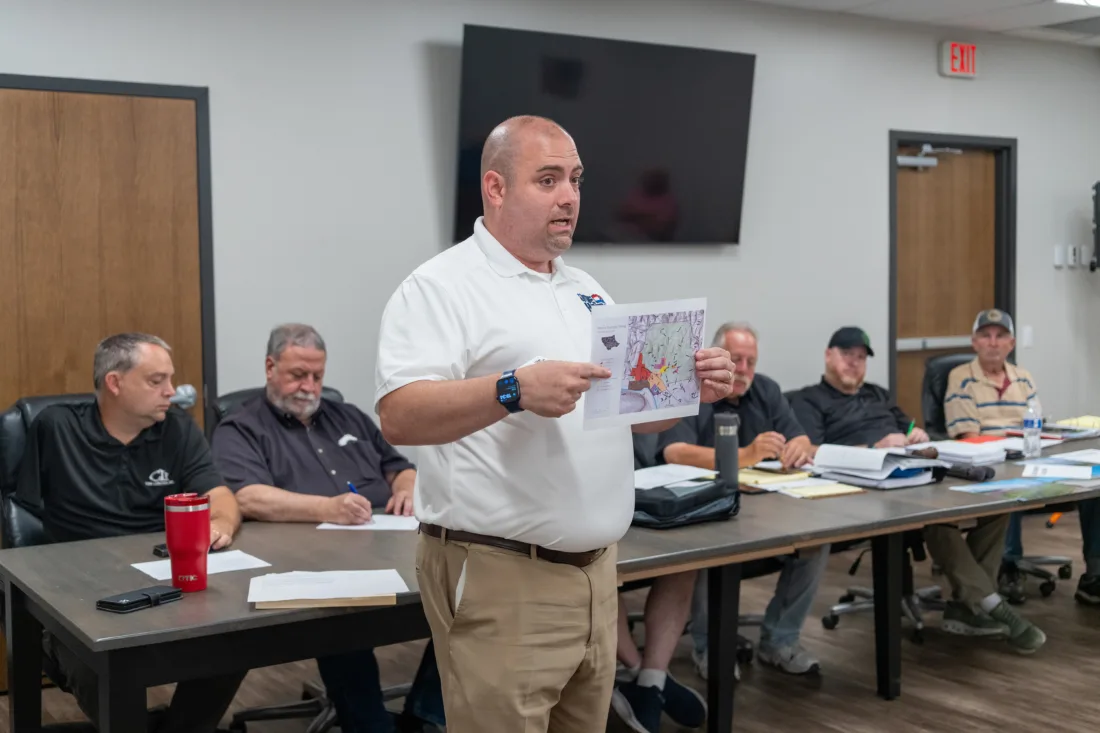
State Rep. Joe Hamm, R-Hepburn Twp., talks to the crowd at the Muncy Twp. Planning Commission meeting Wednesday night in Pennsdale. Hamm came with information to help residents understand the importance of being involved in township meetings that will decide where a proposed data centers could be placed by current zoning. DAVE KENNEDY/Sun-Gazette
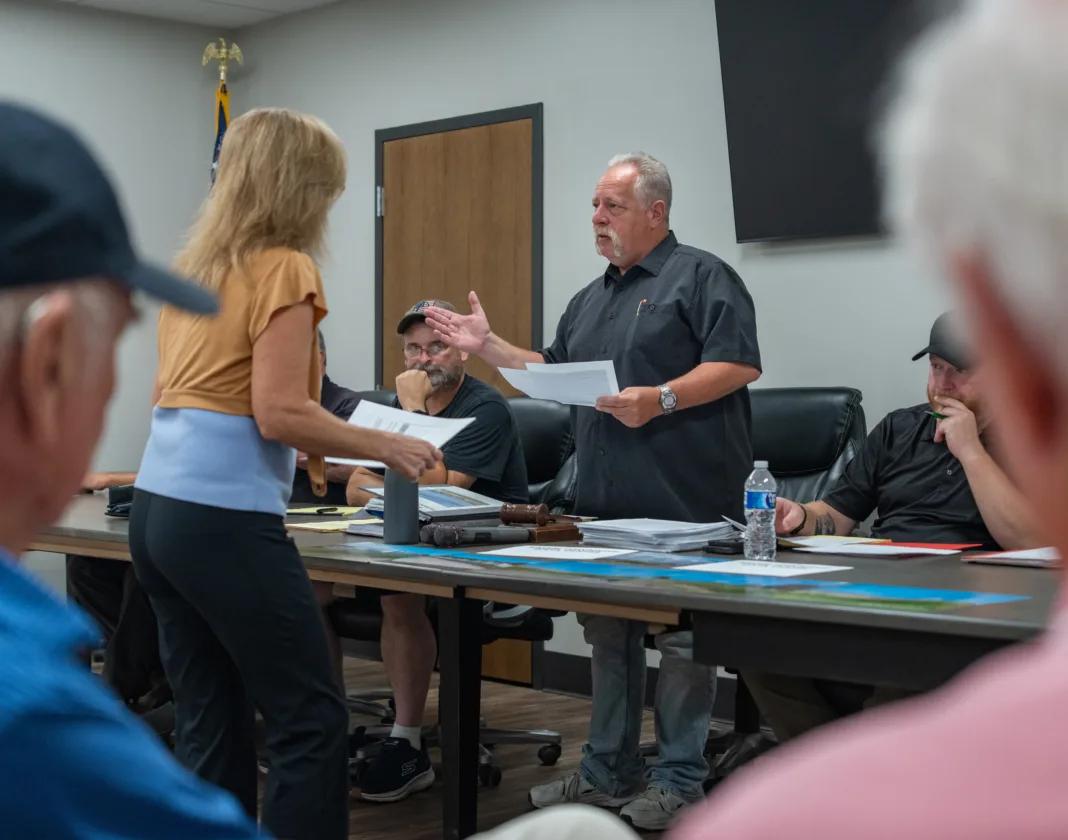
Muncy Township Planning Commission Chair Larry Spatz opens the meeting Wednesday evening by explaining to the crowd how the meeting will be conducted with regard to public comments. Spatz explained to the crowd that all comments would be directed to him and that there would be no out-of-order discussion. DAVE KENNEDY/Sun-Gazette
State Rep. Joe Hamm, R-Hepburn Twp., talks to the crowd at the Muncy Twp. Planning Commission meeting Wednesday night in Pennsdale. Hamm came with information to help residents understand the importance of being involved in township meetings that will decide where a proposed data centers could be placed by current zoning. DAVE KENNEDY/Sun-Gazette
Muncy Township Planning Commission Chair Larry Spatz opens the meeting Wednesday evening by explaining to the crowd how the meeting will be conducted with regard to public comments. Spatz explained to the crowd that all comments would be directed to him and that there would be no out-of-order discussion. DAVE KENNEDY/Sun-Gazette
Trending
PENNSDALE -- The residents of Muncy Township may have come to hear their state representative, Joe Hamm, tell them that the state could do something to keep a data center from locating in their area, but what they heard was, you can't keep them out -- but the people and local officials have the power to control what the finished product ultimately looks like.
"My job is not to tell you how to run your community. The state has no authority over your township. We can't tell you what to do or not to do in your township. It's just not our role...so I want to be clear from the beginning that I'm not here to tell you what to do," Hamm told the group at the Muncy Township Planning Commission meeting this week.
"I'm here to share with you what's going on at the state level, and I'm here to share with you just a little bit about what I know about township work," he added.
Township residents have been voicing their concerns for months about data centers when it was revealed that the township had actually received a proposal in April for a data center to be located on an industrially zoned property on Yetter Road. The township had instituted a six-month moratorium on data centers in order to amend the zoning ordinance to include data centers, and the Planning Commission has been working on a curative amendment for the last few weeks in order to address the issue.
Hamm, who had served as a Hepburn Township supervisor before being elected to the state Legislature, said, "I know a little bit about the second class township code, and I certainly know how ordinances work and what your supervisors, what their authority is, what they can and can't do, and so I hope to make that a little clear for you tonight."
"But if I can press one thing home tonight for you, I want you to know the most important people are your Muncy Township supervisors. They ultimately hold the cards. They ultimately decide what happens and doesn't happen in your township. Not your state rep, not your county commissioners, not your state senator, not your U.S. senator, not the governor. Ultimately, the Muncy Township supervisors will have the say and will ultimately decide what happens in Muncy Township," Hamm said.
He explained that the supervisors are bound by two documents - the Municipal Planning Code and the Second Class Township Code in deciding what is in the ordinance.
"They don't have a choice. They're required to follow those documents because that's where their authority comes from...that tells them what they can do and can't do," he said.
He reiterated that the board of supervisors will be the ones to determine what the ordinance does or doesn't say and where data centers will be permitted to locate.
"Let me be clear: you don't have a choice but to allow them somewhere in your township," Hamm said, something which the residents have heard from other officials - and something they're not happy about.
"Every township, borough, city, town in Pennsylvania has to allow for data centers. You cannot say no, you can't come here, unless the state were to pass a law saying they can't come here...ultimately, your municipalities have to allow for it," he said.
Pointing to the township's zoning map, Hamm said, "You know this zoning map is really important because, this zoning map ultimately, they can decide where they want a data center to be located and where they're not going to allow them, right? And again, that's up to your planning commission, who's going to make a recommendation to your supervisors, and ultimately your supervisors will decide where they go and don't go in your township, but you have to allow them somewhere."
Where the centers will be an approved use is one of the tools that officials can use when crafting a data center ordinance.
"They can say it's an approved use by conditional use hearing, meaning they're allowing them in the industrial zone district in your township, but they're saying it has to come in front of the board for a conditional use hearing," he said.
"The law actually says you can put reasonable conditions on your conditional use approval. You can deny a conditional use permit, but you have to have a lot of reason to be denying it. Otherwise, you're going to end up in court, and the courts can overturn it. If they overturn it, now you're stuck with it just got overturned and no conditions on it at all. And now they can do whatever they want," he said, adding as a caution, "that tool's at your fingertips, you should use that tool wisely."
At one point, Hamm admitted that he was not for -- "I'm not cheerleading for them" -- or against -- "I'm also not picketing them." Hamm said that a balance has to be met.
"I'm not pro-data center. I'm not anti-data center, but I am pro-common sense. And for me -- my opinion -- I don't believe data centers belong in residential areas. I don't believe data centers belong in prime farmland where our food's growing. Just my opinion. I believe they belong in industrial parks. They're an industrial use. That's my opinion. That's not fact. That's me telling you how I feel personally... Ultimately, I believe they've got to respect our quality of life. They've got to respect our communities, and they've got to be good neighbors," he said.
Getting into the specifics of what data centers should bring to the table, Hamm said that he feels they should bring their own energy source and not further tax the state's energy grid.
"We are already in a position where they're talking about blackouts and brownouts in Pennsylvania in the next couple years, because we are not keeping up with the demand that's out there, and that demand isn't because of data centers. It's because of current demand on our grid, and so we don't need to make that any worse," he said.
He said that he also feels data center developers should pay for all the infrastructure to connect to the grid.
"Because ultimately, what happens if they do produce their own energy, and they have leftover energy, they can put it back into the grid to help us with our energy crisis in Pennsylvania. So they have that ability, but I believe that they should pay for all the infrastructure to be able to connect into our transmission lines to make sure that they are feeding back if they have extra," he said.
One of the main concerns residents have expressed at previous meetings was where data centers would get the water needed to cool their equipment. Residents near the proposed center fear that their water supply will be affected while others are opposed for many reasons to water being drawn from the Susquehanna River. Hamm explained that the Susquehanna River Basin Commission governs water withdrawal from the river.
Hamm also detailed the status of bills in the state legislature, but the picture he painted of any of them actually passing any time soon, was rather dismal.
"There are 203 members in the House. There are 50 members in the Senate, and there's a governor. Ultimately, you need 102 in the House. You need 26 in the Senate, and you need a governor that's going to sign it into law. Otherwise, it doesn't matter. You've got to get 102, 26, and one, period. That's on anything we want to do. I'll just tell you that is not an easy task," he said.
"I think at times I get very frustrated with the process because as a township supervisor, literally, if a problem came up within 30 days, we typically had it taken care of, or we had a plan and a decision, and we were moving on it. In Harrisburg, 30 days -- I don't think so. On average, it takes eight years to get a bill signed into law by a governor," he added.
He talked about the various bills that are currently being considered ranging from a six-month moratorium on data centers to a bill that would repeal the sale tax forgiveness on data center equipment. He noted that ultimately they all depend on being passed in both branches and signed by the governor.
"I don't suspect he's going to sign something that's going to say they can't come here at all. I could see a 180-day pause. I think that is likely if we can get it moved. The sales tax exemption is likely if we get it moved because it has broad bipartisan support. Both of those issues have broad bipartisan support, so you could see the sales tax exemption go, and you certainly could see a 180-day pause," Hamm said.
"Outside of that, I just don't think it's likely that anything else is going to move in Harrisburg. But I will tell you, I've been surprised before. Some things that I think are heavy, complicated issues fly through like you know that, and then issues that I think are really, really easy take forever to get done. So Harrisburg surprises me often," he added.
Prior to Hamm's presentation, Karin Waugh, a resident of the township questioned how the proposed DANKO LLC/FishLips LLC data center could be located in a Department of Environmental Protection recognized environmental justice zone.
"That tells us there are even more environmental concerns with this area than usual," Waugh stated.
She wanted to know why the state has an environmental rights amendment to the Constitution if it's not going to be honored.
"What good is this amendment that says we have a right to clean air, clean water, preserving our natural, scenic, historic and esthetic values of our environment," she said.
Waugh concluded by saying, "Pennsylvania supplies about 20 percent of the nation's natural gas. Lycoming County produces about one and a half percent of the entire nation's natural gas. We're doing enough, enough. Let the data centers go somewhere else. Leave us alone."