
Trending
It's the same old story, just with a new player taking the field. Yes, we need data centers. Yes, we all use the technology that is driving the rise in data center construction. But, build them somewhere else -- not in my backyard.
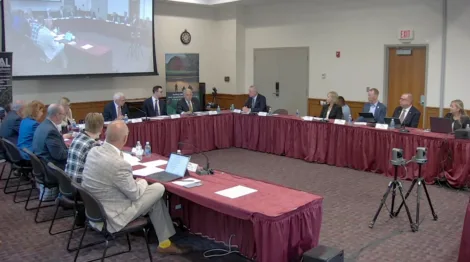
At a recent Center for Rural PA hearing at Bloomsburg University, panelists offered both the good -- data centers offer the potential for an economic boon -- and the bad -- they destroy prime farmland, drive up energy costs and cause constant noise pollution.
Chairman of the Center's Board of Directors Sen. Gene Yaw, R-Loyalsock Township, acknowledged the irony of the fact that people hate data centers but love the technology they support.
"When we talk about data centers, my guess is that everybody in this room today has done something on some electronic piece of equipment that has required a transaction involving a data center," Yaw said.
"That's a fact of life and I think that an awful lot of us probably tend to ignore that and say, well this is some separate thing that is not part of my life. It is a part of everybody's life in this room," he told the group of panelists and Center board members.
He compared the issues facing data center construction to what happened in the rural area of the state during the Marcellus Shale drilling boom about 15 years ago.
"When the first part of the Marcellus Shale exploration happened, we didn't have the people in Pennsylvania that knew how to do drilling. Pennsylvania now does. Pennsylvanians now teach people how to do horizontal drilling. So that is something that we've learned from it and it produced jobs," Yaw said.
He noted that he is often asked how gas drilling affected the local communities.
"These people move to Pennsylvania. A lot of them are working there...their families are now living in rural Pennsylvania in the communities they work in. They've been assimilated into the communities," he said, adding that is
probably what will happen with data centers.
"Everybody seems to be scared or afraid and that's the purpose of what we're doing today is try to say OK, here's the good and the bad and the things that need to be addressed, but here's a good example of what happened in Pennsylvania, especially in rural Pennsylvania, and what the benefits have been," he added.
Yaw also noted that because the state passed Act 13, the communities in his district where drilling has occurred received about $3 billion in impact fees to alleviate damage to infrastructure caused by the gas drilling.
"There's no question about the economic benefits," he said.
There are many who would argue that the economic benefits do not outweigh the damage done to the environment from gas drilling and there were some panelists who predicted the same if data centers are allowed to locate in rural areas, particularly on land which is currently used for farming. In fact, some of the panelists, particularly those from the State Farm Bureau disagreed with farmland being used for either data centers or the transmission lines which are needed for their power usage.
"I'm not here to argue against artificial intelligence," said Andy Bater, a farmer and a member of the Pennsylvania Farm Bureau Board of Directors.
"I'm here to argue that the land beneath artificial intelligence deserves as much attention as the technology above it," he added.
Bater said that he does believe that AI and agriculture do need to work together, "but we also need to be very careful about how we do that."
He also talked about eminent domain when the government seizes private land for public use.
"Eminent domain and agriculture do not mix," Bater said. "That is a fundamental issue."
"About a month and a half ago my phone lit up because farmers were told that they were going to lose their prime farmland for power lines to feed a data center in Allenwood," Bater said.
He explained that the data center at that site was being built in a warehouse that had never actually been used as a warehouse and was being built by a company to facilitate work in the Cloud. That company has asked PPL for the right to have transmission to the data center. Two of the five proposed lines go through farmland, which Bater called some of the best in the state.
Bater indicated that there was another level to the story which comes from the interaction between residents of that area and the government during World War II, which he claimed adds to the farmers' distrust of the situation.
"This area during World War II lost a significant amount of land for a munitions factory. So almost all of the farmers that are potentially going to be impacted by the power lines for the data center have a historical reference in their mind, that their families lost land for this munitions factory. It was promised to come back to them. It never did. The munitions factory didn't actually make it all the way to the end of World War II. It was excess. It was surplus," Bater said.
"So I wanted to put that on the table because we have a situation with data centers that there are a lot of them being proposed. There's a lot of speculation, but the potential is that maybe not all of them are going to be built and that something that we need to be very, very clear that when we're going to disrupt agricultural land for something that may not have a lot of longevity...we may end up permanently disrupting agricultural land and that I'm afraid to say, that's really a sin," he said.
While admitting that there is a need for data centers as they relate to national security, Bater said, "I don't want it to come on the backs of the individual farmers. It needs to be distributed a little bit better. We need to have a better model."
Pointing out that some companies are fully embracing AI, while scientists are urging them to slow down, Bater said that is the dichotomy concerning this issue.
"Let's not make decisions that are hasty, because when we disrupt agricultural land in any way, whether it's for a transmission line or whether it's for a highway, it doesn't come back," he said.
Bater noted that the Farm Bureau's board of directors had recently adopted policy supporting a moratorium on data centers and urged the elected officials on the center's board to support a state moratorium if the measure comes before the state legislature.
In response to Bater, Yaw, who shared that he also is a member of the state's Farm Bureau, said," I understand what the farmers' issues are, but I will also say this, that data centers are very important to farmers."
"Farmers rely on them and I've been on tractors that are on GPS and they control how things are planted and how many seeds are put down and how much fertilizer and everything. All that depends on information that's stored somewhere in some data center, so the farmers are integrally involved in this," Yaw said.
Yaw did agree that he doesn't believe that prime farmland should be used for data centers, "any more than I like prime farmland being used for solar arrays or windmills or anything like that," he said.
On the subject of eminent domain and the project at Allenwood, Yaw said that government regulations require PPL as the distributor, to tell people about eminent domain in locating power lines.
"My understanding is that was said and people you mentioned what they're still fighting World War II and Elvira...I'm not going back 80 years ago and say whether it was right, wrong or indifferent or whatever happened...this is the second or third generation-I've heard all about it," Yaw said.
"The only reason eminent domain was mentioned was because PPL is required to mention it. I can't remember any project where eminent domain was ever exercised in my district. I don't think there ever has been. It was told to people because it's out there and I will just end this conversation at this point," Yaw said.
"I've met with PPL. I don't think they have any intention of exercising or running a power line across the middle of a farmer's field. It was there. It's a proposal out of five and that's it," he added.
Bater pointed out that it's important to understand how a farmer is compensated if they don't want any impact to their land.
Referring back to the situation at Allenwood, he said, "The farmers on this map, most of them said to me 'I have no interest for any amount of money in allowing transmission lines to run across my land."
He noted that in other areas of the state there have been farmers who have had a price, which is something that could be researched.
"But, just know that farmers have an incredibly emotional connection to their land. They are the stewards of their land. In many cases they are stewards of the land for hundreds of years, and so there is no dollar value that is going to change their mind," Bater said.