
Trending
"In any business, you need to understand the rules of the road and what is expected so you can develop a business plan."
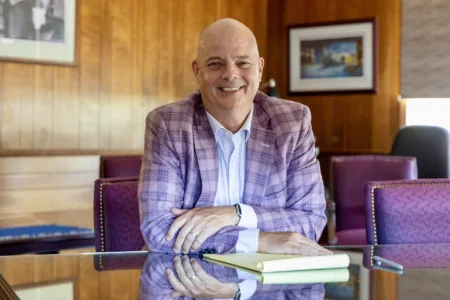
That is what is driving much of the effort by the Marcellus Shale Coalition, said James D. Welty, the organization's president, in a meeting with the Sun-Gazette.
Welty has observed four areas of focus for the Pittsburgh-based coalition.
Pennsylvania's modern regulatory structure was established through Act 13 of 2012, which strengthened requirements for unconventional natural gas development, expanded environmental protections, and created the Impact Fee -- Pennsylvania's unique natural gas severance tax.
Operational certainty
First and foremost for those in the natural gas industry is this, he said.
One of the main issues and challenges facing the industry is "expanded setbacks," he added.
Currently, there is a "very strong push by those that do not want to see natural gas development in Pennsylvania to expand the setbacks that were established under Act 13, the regulation overseeing natural gas exploration," he said.
"That effort is really designed to ban natural gas development through a back door means," Welty asserted.
The setbacks that "they're advocating for would essentially ban 99% of the acreage from development throughout the Commonwealth of Pennsylvania because they establish these setbacks so great that there would be nowhere to operate," he added.
The setbacks that currently exist are some of the most stringent of any natural gas industry or any natural gas producing state in the country, he asserted.
This challenge creates operational "uncertainty," he noted.
Contrary to claims made in recent reporting, Act 13 prohibits unconventional natural gas wells from being drilled within 500 feet of existing buildings, while also establishing additional protections for water supplies, streams, wetlands, and other sensitive areas. These setback requirements are among the most protective in major natural gas-producing states.
Current standards include:
• 500 feet from existing buildings
• 500 feet from water wells
• 300 feet from streams, springs, wetlands, and other water resources
• 1,000 feet from public water supplies
Act 13 also structured the Impact Fee as the exclusive financial responsibility of producers--royalty owners pay none of it. In other states, their severance tax works differently. The tax obligation is shared between producers and royalty owners. Pennsylvania is also the only state in the nation that increases its Impact Fee rate on an annual basis; this year's fee rate is 3.8% higher than last year's impact fee rate.
Pennsylvania's impact fee ensures that local communities receive dedicated funding from energy development without shifting any of that financial burden onto the landowners and residents who host it.
The bill, House Bill 170, would arbitrarily and without any scientific data impose a half-mile setback and represents "nothing but a backdoor ban" on development, according to testimony during the House Environmental Resources & Energy Committee hearing.
Severance tax
This tax is another issue that creates "uncertainty," Welty said.
"We have a very clear structure on how we operate and what taxes we pay in Pennsylvania," he said. "We pay every tax every business is required to pay and then on top of that we pay the impact fee," he said. That is why the MSC believes the existing tax structure maintains operational certainty, he said.
Regulatory predictability is pretty straightforward but what the MSC wants.
"We want to know that when we submit a permit that there is a specific timeframe that we can expect those permits to turn around," he said.
"We also want to know that the regulatory structure that's being implemented is being implemented consistently every year, every month, and every week and consistently through every region of the Commonwealth."
In terms of such regulatory predictability, the organization is looking for permit timeline guarantee or permit time lines that meet the requirements of the regulations and regulatory certainty in terms of what's to be expected on how these regulations are implemented, he noted.
"Those are always contentious points that we have with the state Department of Environmental Protection (DEP), particularly, if the agency keeps "changing the goal line."
Presently, operators are doing their work in a "pretty efficient manner," he said. "We want to maintain regulatory predictability," he said.
Infrastructure build out
When it comes to the natural gas industry, the standard has been the prices on the Nynex and Henry Hub sites but Welty strongly believes "it is an unfair comparison of the price of natural gas in Pennsylvania."
That is because since the height of the start of the drilling in 2008-2009, Pennsylvania producers have received 20 % less, on average, for gas than what is on the Nynex and Henry Hub listings.
"We've got detailed data to demonstrate that," Welty said.
The big reason for that differential is basic economics. Pennsylvania has a lot of supply but "can't get the gas to market," he stressed.
"We have young infrastructure because it's a young play," he said of the Marcellus Shale.
That is why "infrastructure build out" is among the huge components for the MSC and a huge priority for the organization and its operators – "because we want to get that gas to the market."
Clean, efficient way to power the economy
To accomplish this task, the industry needs to get the gas to as many down use opportunities as possible but that cannot happen if the state does not have the infrastructure in place to do so, Welty warned.
That is why there is a lot of focus on the federal level on an infrastructure bill. "We want to see more of that here in Pennsylvania," he said.
Unfortunately, nine of the last 10 pipeline projects that Welty said would have impacted the state's economy in a positive manner were cancelled or withdrawn.
The 10th pipeline project actually required an act of Congress. It was the Mountain Valley Pipeline, which transports natural gas from Southwestern Pennsylvania down through the Eastern seaboard.
The problem remains and the coalition is heightening focus on being able to build out the infrastructure to get the gas out to market.
Another example where the industry has been stymied is the Constitution Pipeline, which would take gas from Northeastern counties north into New England. However, the Constitution Pipeline was withdrawn because of the "regulatory morass it ran into in New York," Welty said.
New York, essentially, has a blockade on natural gas and a blockade on pipelines, he said.
The MSC believes the pipeline should be a priority because there is a reason New Englanders are paying up to 80 % more for their energy and it is because they do not have access to this Pennsylvania produced clean, affordable and reliable energy source that is just a couple hundred miles away from them because of this blockade on the pipeline going through New York.
Capitalizing on downstream opportunities
These are markets that use natural gas, and power generation is among the biggest examples of the use.
The industry saw from 2011 through 2019 an estimated $13 billion of private investment into Pennsylvania to build new natural gas power plants and to convert coal plants to natural gas plants, Welty explained.
"That's what allowed us to become the number one exporter of electricity in the nation," he said.
In 2019, he said, there was a policy implemented by former Gov. Tom Wolf who signed Pennsylvania up and into the Regional Greenhouse Gas Initiative or (RGGI).
"When that happened those private investments stopped," Welty said, adding there was no new natural gas generation privately invested in or being built.
"It's an example of where bad policy has bad consequences," Welty said.
One of MSC's focuses is how to incentivize and create markets here in Lycoming County and in Pennsylvania to "use the gas that is right under our feet so that we can use that for economic development purposes."
That, he said, can happen by building out those downstream markets and downstream opportunities such as natural gas power generation.
Another downstream opportunity is "advanced manufacturing," as there's a very focused effort at the federal level for onshore manufacturing and reshore manufacturing to America."
Meanwhile, Pennsylvania is perfectly suited to do that, Welty added.
"We have power to do that, we have access to this clean, affordable form of energy to do so," he said.