
Trending
With the world descending on Williamsport for the 79th annual Little League World Series, the state Department of Environmental Protection (DEP) and the Lycoming County Conservation District highlighted their efforts to combat mosquitos and the illnesses they carry Tuesday morning.
Started in the mid-1980s, the DEP's Vector Management Program provides funding to counties for suppression efforts as they see fit.
"Every county has a little bit different habitat, a little different mosquito species that are involved," explained Dave Hurley, an aquatic biologist with DEP.
The program was reinforced after West Nile Virus arrived in the U.S. in 1999, with a tick program being added within the past few years.
Counties must opt in to the program, after which full funding for the West Nile Virus program comes from the DEP.
Sampling to gauge the severity of the upcoming season's mosquito population begins in the spring as soon as they begin coming out of hibernation and eggs begin hatching, said Hurley.
That prevalence largely depends on the weather.
"It's temperature, if there's a lot of rain, a lot of standing water, then we'll get our traps out early and start seeing what numbers come in," Hurley said.
Two types of traps are used to collect specimens: gravid traps, which collect only pregnant mosquitos; and host-seeking traps, used to trap mosquitos looking for their next meal.
Gravid, mostly used to monitor West Nile Virus, traps sit atop a container of gravid water to attract the females, who prefer to lay their eggs in organic matter, while host-seeking traps utilize dry ice to attract their targets, Haley Wilde, a West Nile Virus Technician for the Lycoming County Conservation District explained.
Officials typically put out around 15 gravid traps and three host-seeking traps each week, though those may be supplemented in high impact areas, said Carey Entz-Rine, mosquito disease control coordinator for the LCCD.
Testing for mosquito-borne illnesses has evolved over the years and now covers West Nile Virus, Jamestown Canyon Virus and St. Louis Encephalitis, among others.
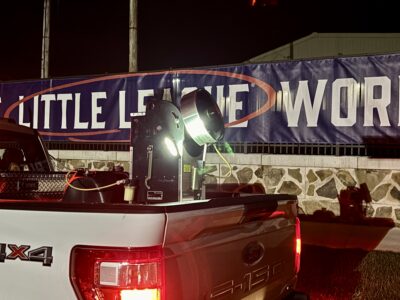
Should those traps turn up an unusually high return, trapping efforts may be combined with mobile and/or backpack sprayers that specifically target adult mosquitos.
"The truck sprayer has a range of 150 feet from each side," Hurley said.
"That knocks them out of the air, and it typically doesn't stay as a residual on the trees. We do have a barrier product that we spray by backpack that'll treat the vegetation. They land on the vegetation and pick that up," Entz-Rine explained.
Spraying is done at night, when mosquitos are most active, which also helps to prevent it from affecting non-targets, such as bees.
"It only hits the mosquitoes that are active, so sometimes we do need to come back and do another treatment," Hurley said.
Officials also stress that the spray used is generally not harmful to humans.
"The one that lands on the plants has a 15-minute window of drying time, and then it's considered safe. So we just try to keep people and pets away until it dries. And the larval product, that's just a natural bacterial product that's labeled to be used in livestock water," Rine-Entz said.
If numbers of a particular virus are high, DEP will release a public notification to help keep area residents aware of the situation.
Though Hurley said the season has been "slower than the last few years" and suppression efforts would be ongoing regardless, as this is peak season for mosquito activity, the World Series does add some extra pressure.
"The Department of Environmental Protection takes a proactive approach to suppressing mosquitoes and black flies before people start showing up to the LLWS," Matt Helwig, environmental group manager with DEP's Vector Management Program said in a statement to the Sun-Gazette.
"This approach keeps people safe and reduces pests during the three weeks of this important event," Helwig said.
Crews were out Monday night with the mobile sprayer in the areas adjacent to the Little League Complex, largely due to the nearby Robert Porter Allen Natural Area, a 227 acre area that also functions as the largest floodplain wetland on the West Branch of the Susquehanna River, according to Wilde.
"Generally, the dragonflies and bats in a natural ecosystem take care of the mosquitoes as part of the food chain, but there are there are a couple fingers that go up and they they dry down, and then the water level comes back, and that's typically where we see a lot of the mosquitoes, in that wet and dry area," Entz-Rine said.
"It's a great example of the partnership between the state and the county, that they're able to basically put their hands together and share the load while having that local knowledge, and bringing the resources the state has together,"said Megan Lehman, regional communications manager for the state DEP..
Though DEP and LCCD are hard at work, both entities stress that being vigilant at home can have a sizable impact.
"People have to kind of police their own environments too to keep it under control," Lehman stressed, with Entz-Rine noting that mosquitos can breed within just a small bottle cap of water, with one egg containing up to 300 mosquitos.
Breeding grounds around homes include mud puddles, stagnant swimming or kiddie pools, old tires, basketball hoops with notches for the ball and even rain gutters.
That moisture is particularly important for the Culex species, the primary carrier of West Nile Virus, because their eggs must be continuously saturated.
Though it typically takes 14 days to hatch, that cycle speeds up significantly if they are in a dry or stressful environment, Hurley said.
"It's one of those quality of life issues. Nobody wants to get sick, and nobody wants to be bitten to smithereens and miserable when they're trying to recreate outdoors, regardless of the potential to catch some disease," Lehman said.
Though cases of West Nile Virus around the area are typically low, that number may be deceiving due to a lack of those affected getting tested, as well as the specific window a test must be administered in.
To help prevent infection, the agencies suggest using any EPA-approved repellants, wearing long sleeves and limiting exposure in the evening.
"It never hurts to make sure that you're using protection personally, anytime you're going outdoors, even if it's in a stadium, at a kid's soccer game or taking a hike, to reduce the chance that you're going any kind of bites, and that include ticks as well," Lehman said.
"Awareness of West Nile and these other mosquito-borne diseases and tick diseases has increased a lot in recent years, but people still need to advocate for themselves. And if they're sick and they're going to the doctor, to mention 'I did get mosquito bites, I did get a tick bite, or I was out somewhere,'" Lehman stressed.
Roughly 20% of those infected will develop flu-like symptoms, according to the state Department of Health.
"Sometimes doctors don't think to test for these things. That might not be the first thing they think of, and it's really important for people to communicate with their doctors, and if they suspect it, to ask specifically to be tested for West Nile, because if we're not getting the data, we're not hearing how bad it is. We might know how many mosquitoes we're testing with it, but we don't necessarily know about the human cases if people aren't reporting them and getting tested," she said.
Fore more information on mosquito and other pest control efforts, including a homeowner's guide, please visit www.pa.gov/agencies/dep/programs-and-services/bureau-of-labs/vector-management.