
Trending
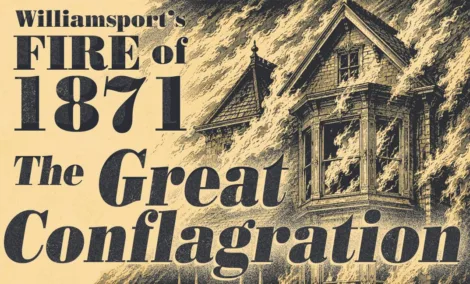
Williamsport's fire of 1871 was a devastating chapter in the city's history and nationally historic because it was most likely the result of the Civil War, even though the war had ended years earlier. Known as the Great Conflagration, a vital part of the city was destroyed in its east end.
The story begins with a nearly deserted city on Sunday, Aug. 20.
"15,000 to 20,000 people were out of town at a church meeting. The wind was howling. As the courthouse bell was striking 8 p.m, a fire broke out in the stable at the rear of C.M. Baker's property on Blackhorse Alley. That's where E. Church St. is now between Canal and East Third streets," said Elaine Decker, who owns developinghistory.com, which researches property history.
Williamsport's original Millionaire's Row and first business district was ablaze. The streets that were engulfed in flames included State St. (formerly Sugar Alley), E. Church St. (formerly Blackhorse Alley), East St. (formerly East Alley) and E. Willow Street (formerly Tom Alley).
"The epicenter was E. Third St. and Mulberry St. and the fire fanned out in all directions," detailed Decker.
"All of the wealthy people in Williamsport prior to the Civil War built their homes in that E. 3rd St. area. It was the center of Williamsport at the time," said Bob Kane, curator at the Rowley House Museum and a board member with Preservation Williamsport.
"It started with the roofs, which turned into liquid flames. You have to imagine the sizzling and sparking of the fire, the roaring of the flames, the ringing of the steam engine bells, horses naying and firemen yelling back in forth, all in the darkness. The only light being from the inferno," said Decker.
As if there weren't enough mayhem already, firefighters were arguing with each other and had subpar equipment.
"We didn't have the fire apparatus to effectively put fires out before they spread. In "Gangs of New York City," they showed how many fire departments there were [in New York City] and they often competed with each other and would turn hoses on each other. We had the same incident during 1871. Fire companies were competing with each other here too. What happened nationally with fire companies happened here," said Kane.
The mayhem was heightened even more because of the proliferation of pickpockets.
"There were pickpockets everywhere, as people were standing around. Many people lost pocket watches and money, while watching and helping with the fire," said Decker.
Because of the strong winds, stores, mansions, homes, apartment buildings and businesses were lost to the quickly moving fire. In addition, Williamsport lost the first structure ever built in the city. Built in 1796, the former Russell Inn later became the Affie Dumm House, when it succumbed to flames.
"It was the first house and the first tavern built in Williamsport and it served as a courthouse for two terms, during which time Russell was thrown in jail for running a tippling house. He opened his tavern for the courthouse and they had nowhere to go and they immediately realized that he was selling liquor illegally and threw him in jail. He got out pretty quick," said Decker.
Decker continued saying that the Mulberry Methodist Church was also claimed by the fire. Built in 1864, it burned down in 1868. Just after the scaffolding had just been removed, the Great Conflagration forced the church's congregants to rebuild once again.
Miraculously, no human lives were lost but the property damage was monumental. According to Decker, the loss would equal over $6 million today. Sadly, many property owners were uninsured or underinsured. Kane added that 45 buildings from the heart of Williamsport were obliterated.
The fire was ruled arson because of a national trend that may have been the motive for setting the blaze.
"Witnesses saw strangers getting off of the train. Remember the town was empty because of the revival. They saw the strangers in the back of Blackhorse Alley and said they saw one with a torch setting something on fire. Don't forget we weren't the only fire. Remember, the Chicago and Boston fires were around the same time. It was in retaliation for the Civil War. They were burning down towns that were of significant economic value in the north. That's the theory. They do believe that Williamsport was part of the retaliation because we had the lumber, the millionaires and businesses. And they hit the heart of our business section and they waited until everyone was out of town," said Decker.
Nobody was ever prosecuted for the Great Conflagration.
The city began to rebuild immediately. It was less than a year before a more modern Williamsport rose from the ashes.
"The town began to grow after the fire because people wanted jobs," offered Decker.
Today, the east end of Williamsport is heading towards another rebirth.
"People are very interested in rebuilding this section of town. I get the questions all the time asking, 'Why do we care what's in the east part? We have the west part.' People care because this was our beginning. Originally, this was the town. They want to bring it back, We have half of a town that is underused or unused and historically, it was really important," noted Decker.
"We are proud of our history because it represents our present."