
Legendary first baseman Steve Garvey recounts career at annual Grand Slam Breakfast
Trending
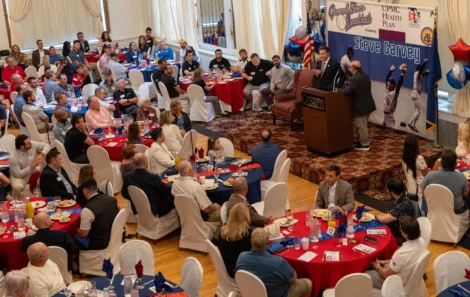
Those attending the Grand Slam Breakfast at the Genetti Hotel and Suites before the opening pitch of the Little League World Series Wednesday were treated to a unique hour-long interview with legendary first baseman Steve Garvey.
Garvey used his keen sense of ability to recall the distant and recent past, offering up many highlights of his 19-year major league career.
There were poignant moments for him such as being a batboy for the world famous Brooklyn, Dodgers, and almost getting sat on by the great color barrier breaking No. 42 Jackie Robinson, and the recent loss of pitcher Tommy John, who returned to pitch after the arm ligament surgery, a procedure that has become the norm for many pitchers in all levels of the game.
No stranger to the Little League World Series, it is Garvey's seventh time to Williamsport, and for those fans who greeted him as grand marshal in the 20th annual Grand Slam Parade the night before, Garvey remains as popular as anyone making appearances in Lycoming County history.
"Steve, first thing, welcome back to Williamsport because I know you've been here before," said Gabe Sincropi, Vice President of Marketing, Williamsport Crosscutters, and the master of ceremonies at the breakfast.
"(Steve) Keener and I spent Monday together and reminisced," he told the crowd. Keener is the longtime former CEO and president of Little League International who recently passed that mantle over to Pat Wilson.
A consummate professional
Garvey, who also played for the San Diego Padres, spent 19 years in the major leagues from 1969-1987. Of those, 14 years with the Dodgers, five with the Padres.
Garvey began his big league career with the Dodgers in 1969 and became one of the game's most accomplished players, winning the National League Most Valuable Player Award in 1974 and earned National League Championship Series MVP honors in 1978.
Garvey was a member of the Dodgers' 1981 World Series championship team. After signing with the Padres in 1982, Garvey helped lead the franchise to its first World Series appearance in 1984, earning his second NLCS MVP award with a dramatic walk-off home run in Game 4.
A 10-time National League All-Star, Garvey also set the National League record with 1,207 consecutive games played. The Padres retired his No. 6 jersey in 1988 in recognition of his outstanding career.
"You know, one of the great fortunes of playing professional baseball is the amount of time you spend playing professional baseball and playing throughout the United States," he said.
Many times, he added, he has been asked to visit minor league ballparks.
"We started thinking the other day that I've probably been to over 100 cities in our great country," Garvey remarked.
Why Little League is special to him
"The reason why this is so special when I was contacted a few weeks ago is that growing up in Tampa, Florida, the foundation was laid right here in 1939," he said.
"That's why coming back here in many ways is like coming home to where this was the place that youth baseball was really founded in America, and I was a part of it," Garvey said – a homage to the organization's foundation.
"So, "it's great to be home again, so to speak, for my baseball," he said.
Before he continued, Sinicropi took the opportunity to thank Garvey, saying when he was in eighth grade in 1978 he wrote to Garvey in care of the Dodgers, sending him a few baseball cards to autograph – despite the fact that he did not include a self-addressed stamped envelope.
"You did return the cards signed, so I want to thank you," Sinicropi said.
Sinicropi acknowledged that one-by-one he thanked those players from his childhood, and he parlayed that tangible form of appreciation to ask about all of the fan mail Garvey has received over the years.
"You used to take care of that in a special way, right?" Sinicropi asked.
Garvey's rationale for answering fans
Garvey used that moment at the breakfast to reflect back to the days of the Brooklyn Dodgers, and being a batboy for the team during spring training. He talked about getting to have the chance to be around these Dodgers, whom he called "great gentlemen" who were not only champions of the sport, but played it during a different time in this nation's history.
It was 1956 and "they were making $12,000," he said.
Being an only child, Garvey said his mother, who was a businesswoman, always used to tell him: '"You can't talk and listen at the same time.'"
It was a great piece of advice, so Garvey said he would sit on the bench between innings and listen to the guys talk about the game of baseball.
"Back then, they didn't talk about where they were going to dinner that night, or the new endorsement – they were watching the Yankees on the field," Garvey said.
He would hear Gil Hodges and Pee Wee Reese talking and they were talking about the Yankee pitcher and how he, when he threw a curveball, would hold the ball like this and bring it back, and when he threw a fastball, he would hold it like this, Garvey said.
"What these legends of the game were doing was actually watching (studying) to pick up something that six months later in the World Series, when the game was on the line, that if either of them were up to the plate and saw the pitcher go like this, they would know it was a curveball," he said.
"I thought, gosh, you know, I am playing Little League this Saturday," he said. "I am going to watch for the pitcher to hold the ball a certain way for a curveball."
Garvey described for the Little Leaguers and their coaches how the "little things like that you start to pick up" and "you start to layer about the game of baseball and that is why Little League plays such a great foundation, especially for the coaches and the organizations that realize it's so much more about the fundamentals – a lot like life."
"The idea is to get them to maybe to think about being a major leaguer some day, or doing something that's very sophisticated," he said.
Garvey also spoke about when he was playing and after his time on the field he had five daughters and two sons – and he joked how the sons came along at the end. "God said, 'You had a lot of estrogen in the house'" he said, to laughter.
He said he began to do some coaching and said to himself – "remember what you were taught – teach the fundamentals first and the other stuff will fall in as you get older."
Batboy for seven years
Sinicropi asked Garvey how long he was a Brooklyn Dodgers' batboy in spring training.
"How long did you do that? Sinicropi asked, before Garvey answered. "I did it for about seven years," he said.
Garvey said he would see these great players, who, in the off season, actually stayed in Brooklyn because "they didn't make that much money, and they worked with different companies in and around New York."
"I never saw them turn down the autograph in all those years," Garvey said.
"It did remind me of the obligation that I learned from these men," he said.
"You know, when you grow up with your idols, it's pretty daunting when you look back and you look at who taught you," he said, adding, "Yes, your parents ... but also it was "those outside of the family that start to teach us things."
As a batboy in Brooklyn, Garvey said Jackie Robinson, No. 42, who famously broke the color barrier, almost sat on him.
"He goes, 'Oh, I'm sorry, son. You okay?'" Garvey said, replying, "Of course, I'm fine, thank you."
Garvey recalled Leo Durocher, the high-profile manager who often functioned as a field leader/head coach for the Brooklyn Dodgers from 1939 through 1946, and briefly in 1948, after playing for them as a shortstop. Later in his career, he also served as coach for the franchise as they moved to Los Angeles.
"He was a pretty rough guy," Garvey said. "You could hear him before you could see him," he said, adding how Durocher also would require the players "sign the balls and sign the cards for the kids."
Tommy Lasorda highlights
Garvey shared the years he played for beloved Dodgers' manager Tommy Lasorda and was asked who were some of the celebrities stopping by the clubhouse when Lasorda was heading the team.
One of those was Mr. Warmth, Don Rickles – who would come into the locker room, go down each locker and say something funny. But Rickles' son was a big fan of Garvey's and Rickles, for once, admittedly, said he could not insult the first baseman.
He said, 'No, I can't say anything about you,'" Garvey said.
But Garvey urged the king of insult to let one fly in his direction, which was considered a badge of honor.
"Well, think of something," he told Rickles, so the comedian obliged with a one-liner: "'He's the only guy that steps out of the shower to take a pee.'"
Garvey also responded to his famous large forearms that resembled the cartoon "Popeye."
When asked by fans if he had developed that way. Garvey returned the jab with light sarcasm – "No, I eat spinach and I squeeze the cans."
He also told the story of how Frank Sinatra, one of Lasorda's close Italian partners, famously forgot the third stanza of the Star Spangled Banner during Opening Day, April 7, 1977.
"We're standing there and we're all starting to smile because Tom's buddy, you know, just screwed up the national anthem," Garvey said.
It was a mistake in which Sinatra turned around the middle section, accidentally repeating lines "we hail at the twilight's last gleaming" out of order instead of cleaning moving through the standard stanzas.
Lasorda warned Garvey, "'Garv, don't say anything,'" he said.
Lasorda also told pitcher Burt Hooton, who was from Texas, who asked in his deep Texas drawl, "Who the hell is that guy out there?" knowing full well it was the legendary singer and actor not to utter a word. Lasorda chided Hooton by saying, 'You say another word, Burt, you are not going to start until June,'" Garvey said.
Garvey was asked about the game where New York Yankees slugger Reggie Jackson in the 1978 World Series stuck his hip out. Jackson's hip interference during the series was a controversial moment, as it appeared he may have intentionally moved his hip to deflect a throw from Bill Russell, allowing a run to score. This incident sparked debate over whether it was a deliberate act or an accident. It happened in the bottom of the 6th inning. Lou Piniella hit a low liner to Dodgers' shortstop Bill Russell, who trapped/dropped the ball, described by Garvey as a "short hop," and stopped on second base to force out Jackson, and then threw toward first base to complete a double play. Jackson, though, had stopped running and drifted into the baseline, sticking his hip out to deflect Russell's throw into right field. The deflection allowed Thurman Munson to score a crucial run for the Yankees. Lasorda argued furiously that it was intentional interference, but the umpires allowed the run to count.
Garvey talked a bit more about the play. "I'm waiting right, and Reggie's in front of me, and all of a sudden I go for the ball. I see it and it's gone. And Reggie's moved over, and now I look around ... Oh my God, where is it? Fortunately, the stands are close to Yankee Stadium, so I run over about 20 feet, pick it up, and call time, and all hell breaks loose then, because he purposely stood out and deflected the ball. You can't do that as a base runner. Later in life, Garvey said Jackson admitted to it. "Yeah, I did it," Jackson said, recreating it during an All Star game in San Diego.
Pressure to perform
Garvey acknowledged when players go to work before 30,000 to 50,000 people who are judging every night it is a big responsibility.
He said he frequently asks people during speaking engagements 'How many of you get booed at work?"
But he is not one for excuses, a lesson for the Little Leaguers to take with them for the series and for life.
"I always think about those Dodgers and I think how hard they ran to first base," he said. "And now I see the guys making $30 million a year who barely make it to first base and I want to go out and slap them," he said to laughter.
"So these were lessons of life that I learned from those Dodgers that I've taken with me," he said. "It's helping me, I think, to be a better parent, be a better professional."
Third base to first
Sinicropi asked Garvey about starting a career as a third baseman to becoming famous as a first baseman. "How did that move come about?" he asked.
It came about on the practice field at Michigan State, getting ready for Notre Dame back in 1968. A linebacker missed the ball carrier and caught Garvey with his face mask in his right shoulder leading to a partial separation. And Garvey was playing both baseball and football. The arm that could toss balls from the hot corner all of a sudden wasn't.
"I could field, I could get to the ball," he said. "By the time he got to the major leagues he could play defense well but his arm was still pretty weak.
Garvey reminded those listening that many of the best in the big leagues hail from small sized cities. "They're from the Williamsport's, and Peoria's and Santa Fe's," he said.
Garvey offered his appreciation to former colleagues such as third baseman Ron Cey, also known as the "Penguin," for his slow, waddling gait and squat frame; and second baseman Davey Lopes.
Garvey had poignant words for his late former teammate, pitcher Tommy John, the two of whom played together on the Dodgers from 1972 through 1978. John, known for the pioneering career-saving elbow surgery used for numerous players through the years, passed away Aug. 16 at the age of 83 in Florida.
"Tommy was not only a great pitcher on the field, but he was a great human being off the field," Garvey said. "He was self-deprecating on bad days. He had a great wit."
"I'll always remember him, how methodical he was, left hander, and threw strikes," Garvey said.
Today, the ligament surgery has become pretty much the norm for those needing the repair which often enables the player to return.
"Think of the millions of dollars that pitchers have earned because Tommy John made the sacrifice," Garvey said.
There also is a movement in the league for the rest of the season to get a patch with the initials T. J. for players who had the surgery.
Garvey said he believes the patch would be a "great, great recognition for not only a great pitcher but a great human."