
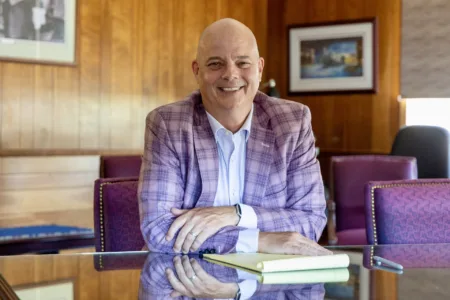
Marcellus Shale Coalition president assesses state of gas industry
Trending
There was a reason why those from the Marcellus Shale Coalition recently held a member reception in Williamsport.
Lycoming County is the 5th largest producing county in Pennsylvania in terms of natural gas in the shale play, said James D. Welty, Marcellus Shale Coalition (MSC) president.
Welty was here to network, discuss policy with legislators and those at the Williamsport/Lycoming Chamber of Commerce.
Today, with 11 active natural gas drilling operators, the county accounts for about 8 % of the state's production, with over 1,020 producing wells, he told the Sun-Gazette editorial board.
From the impact fee alone, the county this year has received $4.1 million; its municipalities, $6.8 million and since 2012 a combined $148 million.
While the MSC is based in Pittsburgh its ties and economic benefits for the county and its operators are unquestionable.
"I'm up here on a regular basis because we have such a strong presence here," said Welty, recognizing the importance of the relationship that operators have in this community.
This is a year-round commitment because the operators are those who live, work and play in these communities. "They hunt and fish here," he said.
The MSC views this as a commitment to this community that remains of the utmost importance to the organization. "The reality is this is an important area for our industry and it's important for the MSC representing them to make sure that connection with the community continues but also providing that opportunity for our members to get together," Welty said.
In the interview, Welty not only produced statistics, data and facts showing how natural gas remains an economic powerhouse but he put a human face on the hard hats, the engineers, the attorneys, and communication specialists – those who are among the many representatives of this organization.
"I think engagement with the communities is where it starts," he said.
Foundation and changes since 18 years ago
The MSC was founded in 2008 and the reason for that was because the operators who existed in the state or were arriving recognized the current regulatory structure, which was set forth then was not prepared and was ill-prepared for what was to come, Welty said.
The organization was formed to "raise the bar" on the regulatory standards under which the industry operates, he said.
"That may be hard to believe but that is why the MSC was formed," Welty said.
"Our industry does about $41 billion in economic activity annually in the Commonwealth, or about 5 % of the entire state's gross domestic product.
"I like to say that 5 % drives the other 95 % because it's the energy that is being used by the industries in the economy throughout Pennsylvania," Welty said.
"We support about 120,000 jobs statewide and that is direct and indirect jobs," he said.
"You see a lot of that here in Williamsport," he said.
Additionally, "we pay landowners over $6 billion annually in royalties," he said.
The owners of those mineral rights are paid a percentage of what is produced out of the ground. Moreover, the industry pays all applicable federal, state and local taxes.
"When somebody says, 'this industry is not paying its fair share,' I would challenge them to say what other industry with the economic impact that we have paid over $6 billion annually."
On top of that it pays the impact fee, which has been over $3 billion since its inception in 2012 and about $150 million of that comes directly to Lycoming County.
The beauty of that impact fee and why the organization supported it when Act 13 was created, is that it ensures that those dollars don't go to the "black hole of government in Harrisburg," Welty observed.
Instead, these dollars are driven out into the communities throughout the state, but particularly heavily into the communities where MSC operators are – hence that term – impact.
From this fee have been improvements to bridges, creation of parks, recreational facilities for families and individuals to relax and play and watch nature, infrastructure that powers the cities, boroughs and townships and these are dollars that otherwise would bankrupt communities that are operating on tight general fund budgets.
"We're very proud of that as an industry."
Historical legislation made it possible
Between 2008 and 2012, there was a lot of work to kind of develop a legislative construct under which unconventional shale development could succeed and do so in an economic and environmentally friendly way in communities in which operations would take place, Welty said.
In 2012, Act 13 passed, which became the framework under which the industry operates from a legislative perspective and out of that came the regulations, and (Chapter 78A), the regulatory construct under the act that operators use.
That regulation includes setbacks that the industry must abide by.
As an example, Act 13 established setbacks for where "we can drill a well," Welty said. Whether it is a waterway, or an occupied structure, or if it is how "we construct the well pad," all of those are set forth under the act that were not there previously," he said.
Who is the MSC?
Welty defined the coalition as a statewide trade association representing unconventional shale development in the Commonwealth as a whole.
Its board represents those that are drawing and producing the gas, those that are processing and transporting the gas as well as large end users like power generation.
Over 95 % of the gas process, produced and transported in the state is done so by MSC members, he noted.
The coalition has 160 members and the bigger section of its members is the service and supply chain and the building trades that work with those operators to do the safe production of natural gas in the state.
Lycoming County is a key component to the development that occurs throughout the state. As an organization, MSC represents the operators, but also works with them on best in class technologies, sharing information on how to do things better, do things more efficiently, and provides opportunities for training.
"We spend a lot of time analyzing data," Welty said, adding this data comes from operators, regulatory agencies, primarily the state Department of Environmental Protection (DEP).
From that data and analysis, the organization reviews what is working, what is not, what DEP is doing and where there might need to be a conversation with the regulatory agency, and that is where the MSC steps in as well.
"We do a lot of trainings for our members on how to improve what we are doing or train them up on the new regulations that are coming in that they now have to operate under," he said.
The MSC looks at DEP many times as a partner in those types of trainings, because if the agency has a new regulation ... "we go to the DEP and make sure our operators know how to comply with these new requirements."
The organization also looks back at the end of the day of connecting various operators with upstream companies, midstream companies, downstream companies, to the service and supply chain and having that networking capability where they can share information and best in class technologies.
As an organization it is driven by committees – much like the General Assembly which has various committees where bills go through – the MSC has 13 technical committees.
For instance, as examples, it has a Drilling and Completions committee, a Midstream/Pipeline committee, and a Legal committee consisting of experts in those fields – which allows the organization to share best in class technologies, understand operations better and become more efficient, look at the regulatory and legislative structure under which the industry operates, making sure of full compliance or helping shape what it believes is a much more efficient and effective means of oversight of the industry.
Sometimes, Welty said, such things mean tensions develop with the regulators but the committees play a vital number of roles.
"As I like to say, they are the 'heart and soul' of what we do because it's made up of the experts that are in the field," he said.
"They are doing the work, giving the guidance we need as an industry and also as an organization to ensure that we are operating in the best manner possible," he said.