
Trending
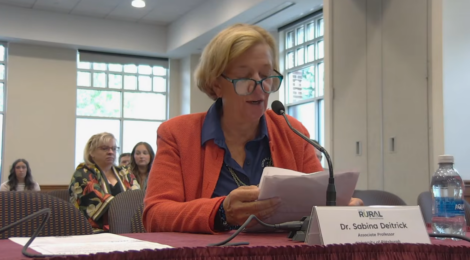
Starting in about 2010, the construction of data centers began to escalate, driven mainly by artificial intelligence and expansions of the Cloud. The current data center market is estimated at $300 to $400 billion this year with growth at about 11% per year, according to Dr. Sabrina Dietrick, an associate professor at the University of Pittsburgh.
Speaking at a recent hearing of the Center for Rural Pennsylvania, Dietrick said, "Much has been and is being written and discussed and debated about data centers. The impacts are across our communities, our municipalities, our counties, our states, and even nations. Governments are considering and discussing prospective bans on data centers, or more accurately, in most places, timeouts on passage, to better understand the costs, the benefits, and especially the impacts on local communities where they are located."
"There's much activism on data center issues today, also, and such interests in organizing are critical, as we know here in Central Pennsylvania, where there's long been activism on environmental issues that pose potential threats to quality of life for community residents," Dietrick said.
"While data centers are not a resource extraction industry like oil and gas, they have environmental impacts similar to some of the impacts from unconventional well drilling, and these have consumed communities for over two decades...these impacts are on air quality, water quality, road conditions, land uses, heat, temperature effects, noise levels, physical size, and design," she added.
Dietrick referred to the Marcellus Shale boom and how it impacted the state both positively in terms of economic opportunities and negatively with the environmental issues it created.
"Data centers must be viewed from local lenses. The impacts and especially the costs are localized. While job creation and property tax benefits are local and promoted as such, many financial benefits flow out of the region and state, but the environmental health costs are local," she said.
"Organizing and gaining community support and trust are critical to not repeating mistakes that occurred during the Marcellus Shale drilling boom and battles that ensued. Rural Pennsylvania has suffered through multiple boom busts and resource extraction, and suffered the costs of the resource curse. It is not necessarily just for extractive industries. Municipal planning and concerns are important to understand and discuss. Municipalities and residents concerned about shifting planning regulations at this time, with discussions about easing zoning permits and fast tracking, are real," she said.
Ultimately the regulation of data centers within a community lies with that community. Local planning groups can set conditions, such as setbacks, building size and height, buffers or any number of things that would need to be met before construction. Dietrick cautioned that the state "must understand local planning concerns if it attempts again to degrade local land use controls."
"Local governments can't go it alone. We have a strong infrastructure in our state, and getting organized and getting information out through state agencies to planning, state planning, environmental, professional organizations, county governments, and councils of governments to local level officials, businesses, and numerous organized residents and communities. Bring them in and hear their voices. Organizing takes time, but it's less time than reactive positioning," she said.
"Make clear the impacts and extensiveness of these impacts, and build in protections now. Local planning can address infrastructure impacts and burdens, zoning issues, community impacts, but knowledge needs to be shared widely... we now have lots of stories and studies on impacts that were not reviewed in advance and have common understandings, such as with energy, water, heat, external temperature, power, soil, tax breaks, resident burdens, and so forth," Dietrick said.
She cited a situation in Georgia where a data center resulted in reduced water pressure and water loss for residents, nearly depleting aquifers for some residents.
"Data centers are power and water-hungry operations. They aren't new, but the size and scale are, and the impacts can be more devastating in financial and environmental ways if they aren't thought about in advance," she said.
Dietrick stressed the importance of getting ahead and to start planning.
"There's certain joint efforts that can be made. There's certain things through the Department of Community and Economic Development that could particularly target this knowledge and this sector," she said.
"We don't want our municipalities, our boroughs, our townships to be going it alone," she said.
She suggested that there could be some type of information back that could be developed. A place to share sources, resources and knowledge, independent of any legislative changes-a pooling of the resources that already are there.
"So that each individual municipality doesn't have to bounce from agency to agency-they know where to go. There could be a kind of an information toolbox in effect developed for small governments," she said.
One of the panelists, Brian Rhone, a codes officer at Salem Township in Luzerne County, has been dealing with data centers since 2021.
The township was first approached by Talon with a spin-off company called Cumulus.
"They came to us with the plans to do their first data center and we had no regulations except for our current zoning, which at that point regulated it by a building larger than 85,000 square feet...these data centers are in the 400 to 800 thousand square feet," Rhone said.
That placed the proposed data center into the category of conditional use. The township put conditions on the plan and the first building was constructed.
Since that time the building has been sold to Amazon and the township developed another ordinance for districts other than industrial because the project now went into the agricultural district.
"It was very time-consuming for a small rural township. We had limited staff and limited resources at the time," Rhone said.
"Move forward four years and we've learned a lot on the fly. We've gone through ordinances, building ordinances which would limit the size of the building; which would limit the total square foot of a building; which would limit the length and width of buildings all the way to the height of buildings," he said.
"It's never ending. It's constantly revolving-we're working on the ordinances all the time," he added.
He said that they're dealing with the setbacks and the screening for the public, plus the response from the public. The township used to have three members of the public come to meetings, now they've had up to 200.
"They're talking to setbacks-they want larger setbacks. They want more screening. They want the buildings gone. In some cases they don't even want them there. Nobody wants them in their backyard," he said.
"But at some point the line is somewhere-it's always everybody's backyard. Somewhere you've got to be able to have a line," Rhone added.
One of the issues Salem Township has dealt with in regards to data centers is the water infrastructure, whether they were hooking onto a public water system or utilizing wells.
"It took a lot of experts. We have to rely on a lot of outside sources. We had to have a lot of studies done, which took a lot of time and took a lot of cost to the township," he said.
When Talon was using the building, they built two buildings and started a Bitcoin operation, something township officials knew nothing about.
"We were swamped with complaints of the noise. It was loud -- it was very loud," Rhone said.
He noted that there were about 150 cooling fans on each of the buildings and the buildings sat near a residential area.
Since then Amazon has shut down the Bitcoin operation, but at that time the township had to hire a company from Philadelphia to do a noise study. Again, the township had to bear the cost.
"They came in and did 24-hour noise studies and helped us develop a noise ordinance that we did not have," Rhone explained.
"A lot of money, a lot of time and a lot of things that we didn't think about, we didn't know going in," he added.
Then there is the issue of increased traffic because of the data centers in his township.
"We knew there was going to be construction traffic, dump trucks and personnel. It has taken over our streets," he said.
He said that even on State Route 11, the township has their local police department three hours in the morning and three hours every night sitting there in the middle lane with their lights going, controlling traffic for the shifts leaving the data center plant, not because it's running, but because they're building it.
"We're in the midst of doing a temporary traffic light there, but you know we also just got submissions for two more data center campuses, which are going to hit other streets and other roads," he said.
"It's just things like that, we just don't have a lot of control and it's taking its toll on little rural America," he said.
Other issues they've had to deal with because of the data centers are the increase in Right to Know requests. They used to get one a year, now it's sometimes up to eight a day.
"We don't have the staff to deal with it. We're actually hiring somebody now to be an assistant manager to help out with the staff," he said.
He's also had to hire another codes officer just to deal with the normal business.
"It's taken its toll. Has it dumped some money into the township? Absolutely. We have the community benefits agreements that we have in place-they've been great. We've definitely been able to use that for some good things in the township, but we're also using it to just keep up with everything that's going on," he said.
They've had to expand office spaces to accommodate the increase in staff.
"It's certainly changed Salem Township. There's no doubt about it. You know, some for the good, you know some for the bad," he added.