
Trending
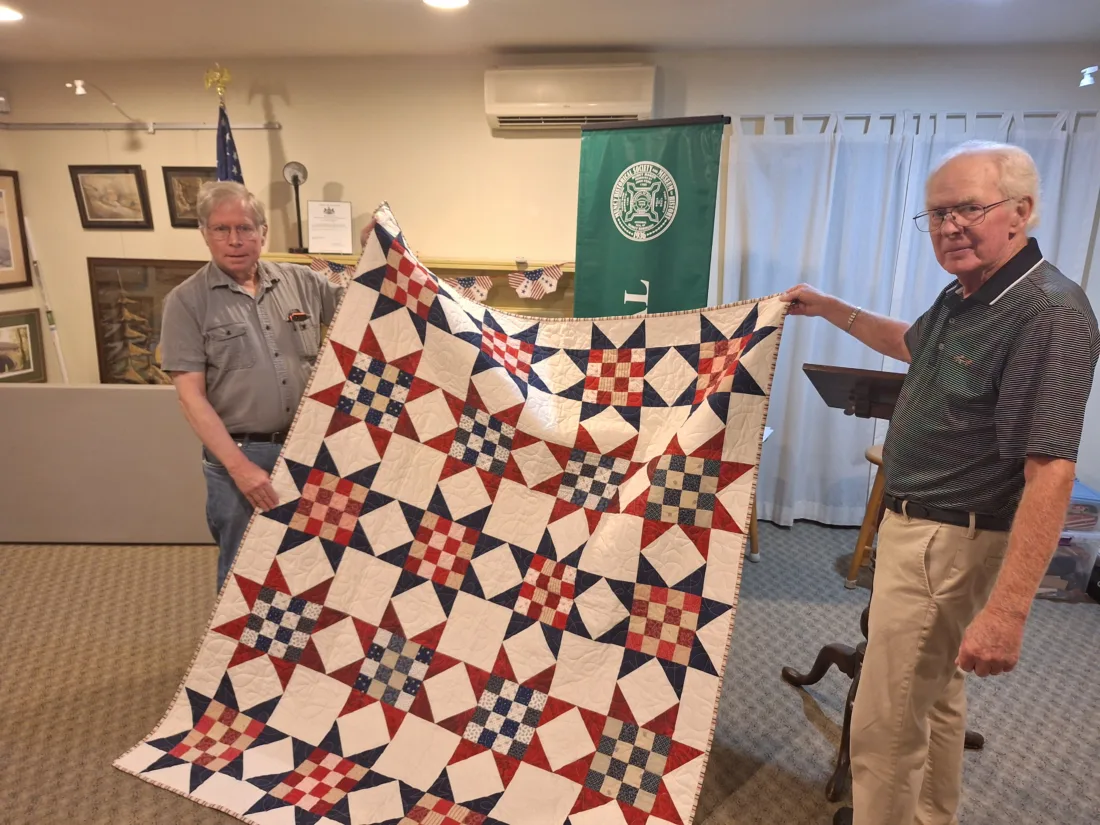
Two military veterans who happen to be father and son were presented with handmade quilts for their service to the country.
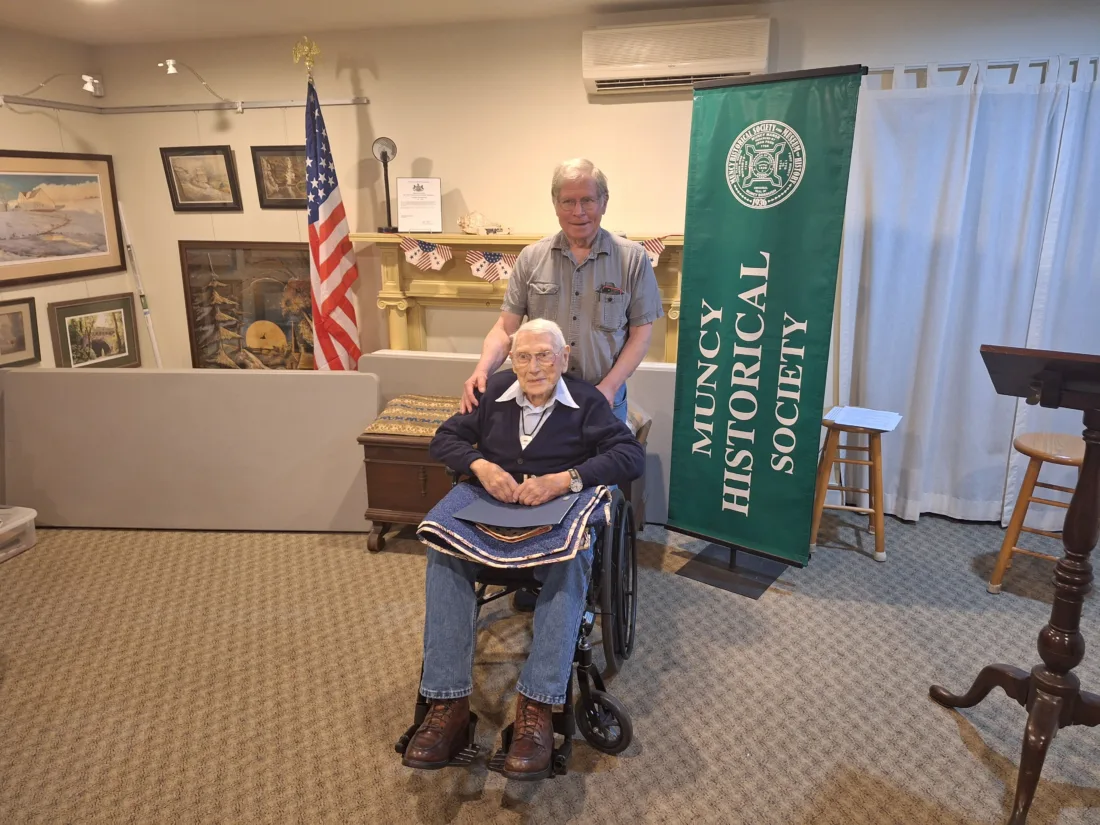
Clyde Eugene Ault, a World War II veteran, and Jeffrey T. Ault, his son, were presented with the locally-crafted quilts Monday at the Muncy Historical Society, 40 N. Main St., Muncy.
The quilts were crafted by talented local quilters belonging to Vintage Gatherers, which is under the auspices of the national organization known as the Quilts of Valor Foundation, said William Poulton, society president and executive director.
Ault served from 1942-1969 and his son 1981-1986.
"Last fall, the Vintage Gatherers, a group of very talented ladies, approached the Muncy Historical Society to support their membership in the Quilts of Valor Foundation," Poulton said.
The Quilts of Valor Foundation began in 2003 and has since then evolved with quilts made for veterans who have been touched by war, those who have served in different times, different wars, and in different conflicts. "They need only be a veteran and honorably discharged to be considered for a quilt to be made for them," he said.
"We present quilts to veterans representing all branches of the United States military," said Frances Appleman, representing the quilters who spent several months creating them and the accompanying pillow covers handed to the deserving veterans.
"These are veterans from the armed forces during declared war, conflicts, police actions, peacekeeping missions, counterterrorism operations as well as veterans who served stateside and abroad," she said.
For the quilters and the society it is a pleasure to honor their service, especially a veteran from the "Greatest Generation," a phrase aptly coined by news anchor Tom Brokaw.
These men and women have a sense of patriotism, duty and community. Their military histories were shared before the son and father got to see their quilts and some keepsake photographs were taken.
Leading up to the war
It was learned that the number of pilots needed grew from 982 in 1939 to approximately 8,000 in 1940 and to over 27,000 in 1941.
Still, with these record numbers, more pilots were still needed.
At the time, the United States Army could not sufficiently handle the training of the large number of flying cadets required.
The U.S. Army Air Forces relied on additional pilots from the Civilian Pilot Training program (CPT) and a large network of civilian flight schools under contract to the US Air Corps, as well as conducting training in its own schools.
Civilian Pilot Training would eventually operate at more than 1,100 colleges and universities. As a result of the high level of training provided, CPT-trained pilots did well while receiving additional training at US Air Corps flight schools.
Between 1939 and 1945, CPT would go on to train more than 435,000 pilots, logging over 12 million flight hours. Following the attack on Pearl Harbor, CPT became known as the War Training Service or WTS.
Graduates of the program entered the US Army Air Corps Enlisted Reserve. Most graduates continued their flight training and were commissioned as combat pilots. Still others became service pilots, liaison pilots, ferry pilots and glider pilots, instructors, or commercial pilots in the Air Transport Command.
Before becoming United States military pilots, fledgling Army aviators underwent the arduous task of attending and completing Air Corps cadet training. Aviation training consisted of several blocks of training from basic flight instruction to advanced flight school. The task of making it successful through flight school was no easy task and many would-be recruits found themselves washed out of the training programs and on their way to carrying a rifle as part of an infantry unit, or off to learn another trade as part of an aircrew.
The successful completion of pilot training was a difficult and dangerous task. From January 1941 to August 1945, 191,654 cadets were awarded pilot wings.
However, there were also 132,993 who "washed out" or were killed during training, a loss rate of approximately 40 % due to accidents, academic or physical problems, and other causes. Those who graduated from flying school were usually assigned to transition training in the type of plane they were to fly in combat. The transition training, usually lasting about two months, became their last opportunity to prepare for combat before they deployed overseas.
Pearl Harbor led to duty
In December 1941 after the Japanese bombed Pearl Harbor, Ault decided he wanted to enlist in the Army Air Corps. His enlistment date was Sept. 15, 1942. His initial assignment was as an aviation student at Dickinson Junior College which is now Lycoming College, into the Civilian Pilot Training program. Studies included navigation, meteorology, Morse code, and 35 hours of flight in the Piper J-3 Cub at the Montoursville airport.
On Jan. 9, 1943, Ault was called to active duty in the Army Air Corps. He was sent to various bases for four months before becoming an aviation cadet at Santa Ana, California. From there he was sent to Blythe, California to the Morton Air Academy to train to fly the two-seat open cockpit Ryan PT-22. This time, it was in the US Air Force Continental Command out of Mitchel Field on Long Island, New York. After processing back into the service, Ault was deployed to Tokyo, Japan at the Far East Headquarters to support the Korean War effort.
In 1954, Ault and his family returned to Mitchel Field, New York. Here he worked in statistical services and flew B-25s and C-47s to maintain his proficiency training.
He also was one of the pilots assigned to fly the lieutenant general who was the commander of the Continental Command. He also earned a regular commission, which was an upgrade from his previous reserve commission. His next assignment was in Honolulu, Hawaii where he was the Base Operations Officer for Aviation at Hickham Field.
On Jan. 1, 1961, Ault was promoted to major. His next assignment was to Logistics Command at Tinker Air Force Base in Oklahoma City. Here he worked in data automation and on March 1, 1965, was promoted to lieutenant colonel.
Ault served his country from 1942-1969.
Following his father's path
Jeffrey Ault graduated from Montoursville Area High School in June 1976. Shortly thereafter, he became an Air Force Academy cadet. Basic Training lasted about seven weeks or so before academics started in August 1976. The Air Force Academy academics lasted four years and at graduation Ault received a Bachelor of Science degree in Management Science. At this same time, he was commissioned as a Second Lieutenant in the Air Force with a regular commission.
One of the military courses Ault had was pilot training in the Cessna T-41. He was proficient as a student pilot and was awarded a pilot training slot after graduation at Reese Air Force Base in Lubbock, Texas.
After pilot training Ault became an orbital analyst in Cheyenne Mountain Complex – a non-public military installation of the U.S. Department of Defense located inside Cheyenne Mountain in El Paso County, Colorado. The installation was established in February 1967 as a bunker and operations center, and it was designed to be partially resistant to at-tack by nuclear-tipped missiles.
As an orbital analyst, Ault's job was tracking all objects that orbited.the earth, including near earth orbits as well as deep space orbits. Analysts play a key role in space missions, ensuring the safety of spacecraft and astronauts, and preventing collisions with space debris – analyzing and predicting the path of satellites and other space objects. They use complex mathematical and physical models to calculate orbits; monitoring and adjusting satellite orbits to avoid collisions with other objects, communicating with mission control and providing real-time updates during space mis-sions; designing and developing algorithms for orbit determination and prediction; and thoroughly knowledgeable with advancements made in space technology and orbital mechanics. In his position, he tracked satellites, rocket bodies, new launches, debris, and the Space Shuttle.
After his five year military commitment, Ault finished his Air Force time as a captain in the Air Force Reserves. Ault served in the US Air Force 1981-1986.
The honoring of veterans with these quilts made by talented and patriotic local quilters is a privilege for the Muncy Historical Society, Poulton said. The group estimates it has made about 120 of these special fabric tributes to honor those who have dedicated their lives to protecting the freedom those of us in the U.S. and free world can enjoy, value and cherish.
Should there be any one out there who might be deserving of such a tribute, please contact the society, an all-volunteer, non-profit organization founded in 1936 to preserve and promote the heritage of Muncy and the surrounding West Branch Valley.