
Trending
"Leave every place better than where you found it."
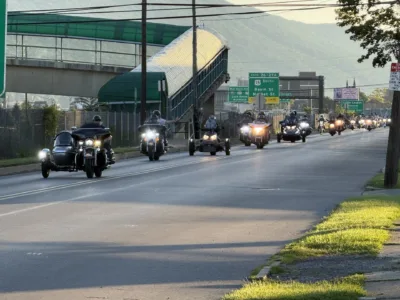
That is what retired U.S. Army Master Sgt. Louis F. Johnson Jr. called on the hundreds of participants in the 9/11 Memorial Ride to do before they rode off to greet spectators on a 42-mile ride through Lycoming County in remembrance of the 25th anniversary of the attacks on the nation's 250th birthday.
It was a stunningly clear Sept. 11 Friday, as it was a quarter century ago on that fateful Tuesday.
A combat veteran from Montoursville and security executive with more than 30 years of leadership experience in military operations, recruiting, retention, personnel management, and organizational leadership, Johnson asked – "What did we learn from it?"
For many Americans, the date is not just one on the calendar, but one where they can remember exactly where they were, he said.
Painful memories
"We remember the disbelief...we remember the uncertainty and we remember watching together as our country experienced both unimaginable tragedy and remarkable courage," he said.
Johnson's admonition carried a common theme. It was a profound principle that is often repeated, but appropriate for this tragic day and the quarter century of post-9/11 history.
"It is leave every place better than when you found it," he said.
"Those words remind us that history is not shaped only by presidents, generals or famous leaders," he noted. "It is shaped every day by ordinary people making extraordinary choices."
These include the firefighter who comforts a frightened child, the teacher who believes in a student who is not believing in themselves, the neighbor who notices someone struggling and quietly offers help, the volunteer who gives their Saturday to serve someone they may never meet again and the first responder, who works through the night because someone else needs them, he noted.
"These are not small things," Johnson said. "These are things that build communities," he remarked.
One of the most inspiring aspects about 9/11 was not simply the heroes that were witnessed that morning, it was what followed, he observed.
Americans lined up for hours to donate blood. Communities opened up their homes to stranded travelers.
People who had never met embraced each other. Political differences disappeared, if only for a time, and people stopped asking, 'What do I deserve?' and began asking, 'How can I help?'"
"For a brief moment, we remember something that perhaps we easily forget – we belong to one another," he said.
That spirit is worth preserving despite the world urging more people to become cynical, or tell us that people can't be trusted," he observed.
"It tells us that kindness is weakness, and that service goes unnoticed and that our individual actions don't really matter," Johnson said.
"But cynicism has never built a school, it has never rescued a family, it has never comforted the grieving, never built community after tragedy," he said. Hope does those things. Faith does those things. Love does those things, he added.
Every generation must decide whether it will surrender to cynicism or choose hope instead, he said.
The generation that responded to Sept. 11 chose hope, he said.
"They chose service. They chose sacrifice," he said. "Many of them never sought recognition, they simply saw a need and stepped forward."
He closed by reiterating a powerful biblical commandment – to love your neighbor as you would yourself.
"Loving your neighbor does not begin in moments of national tragedy, but in ordinary ways," he said, adding it begins by speaking respectfully to someone despite disagreement, or checking on an elderly neighbor, or mentoring a young person.
"It begins when we thank a police officer, a firefighter. EMT, nurse teacher, or a veteran whose service often goes unnoticed.
"It begins when we choose compassion over criticism," Johnson said. "When we choose to forgive over resentment, or when we choose understanding over anger."
"Those choices rarely make headlines, but they make stronger families, they make stronger communities and, ultimately, they make a stronger nation," he said.